May 27, 2026
George William de Saulles Chief Engraver to the Royal Mint, 1892–1903, & Engraver of Jersey Coinage
4 February 1862, Aston Manor, Birmingham · 21 July 1903, Chiswick · Signed: De S. / DES
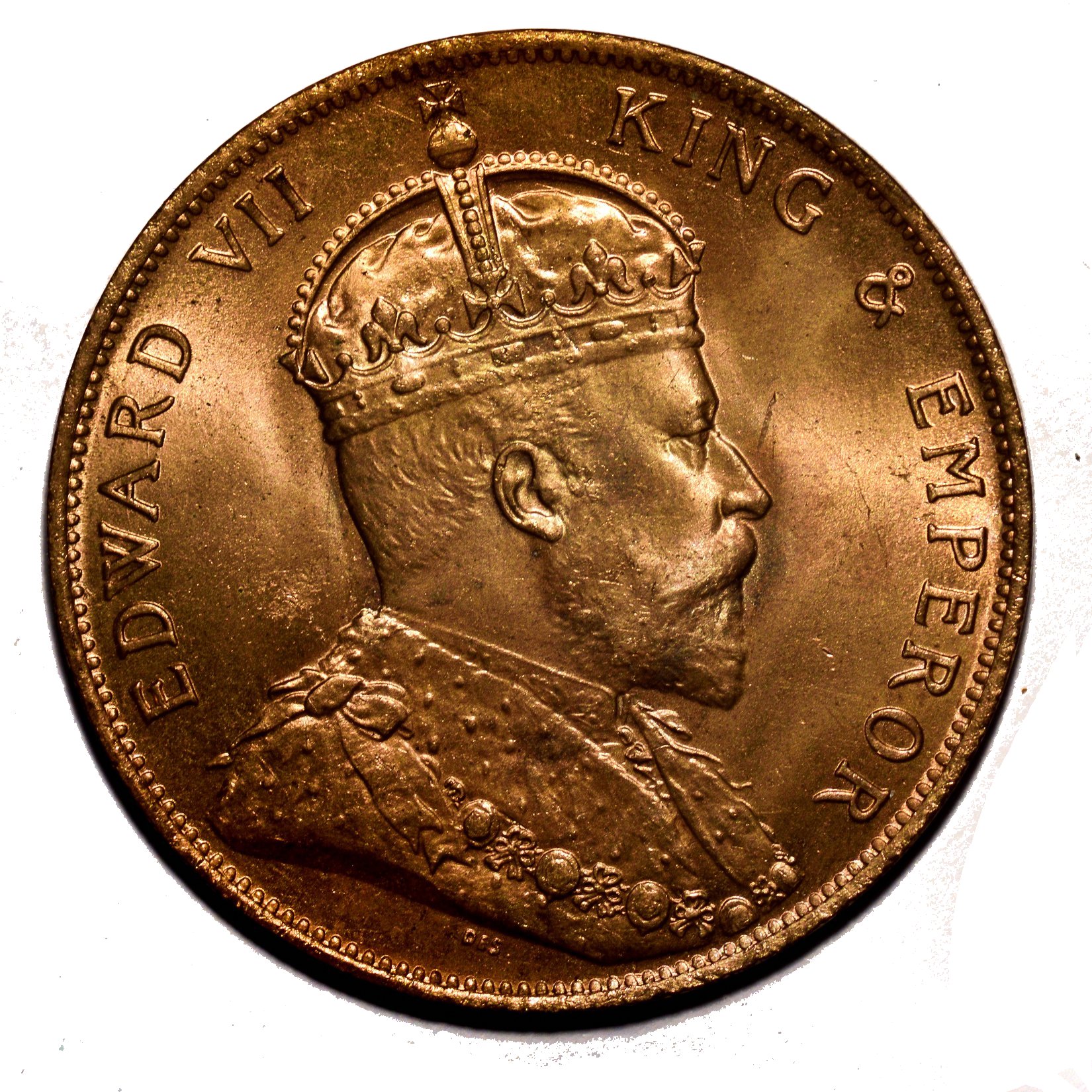
Edward VII, 1909
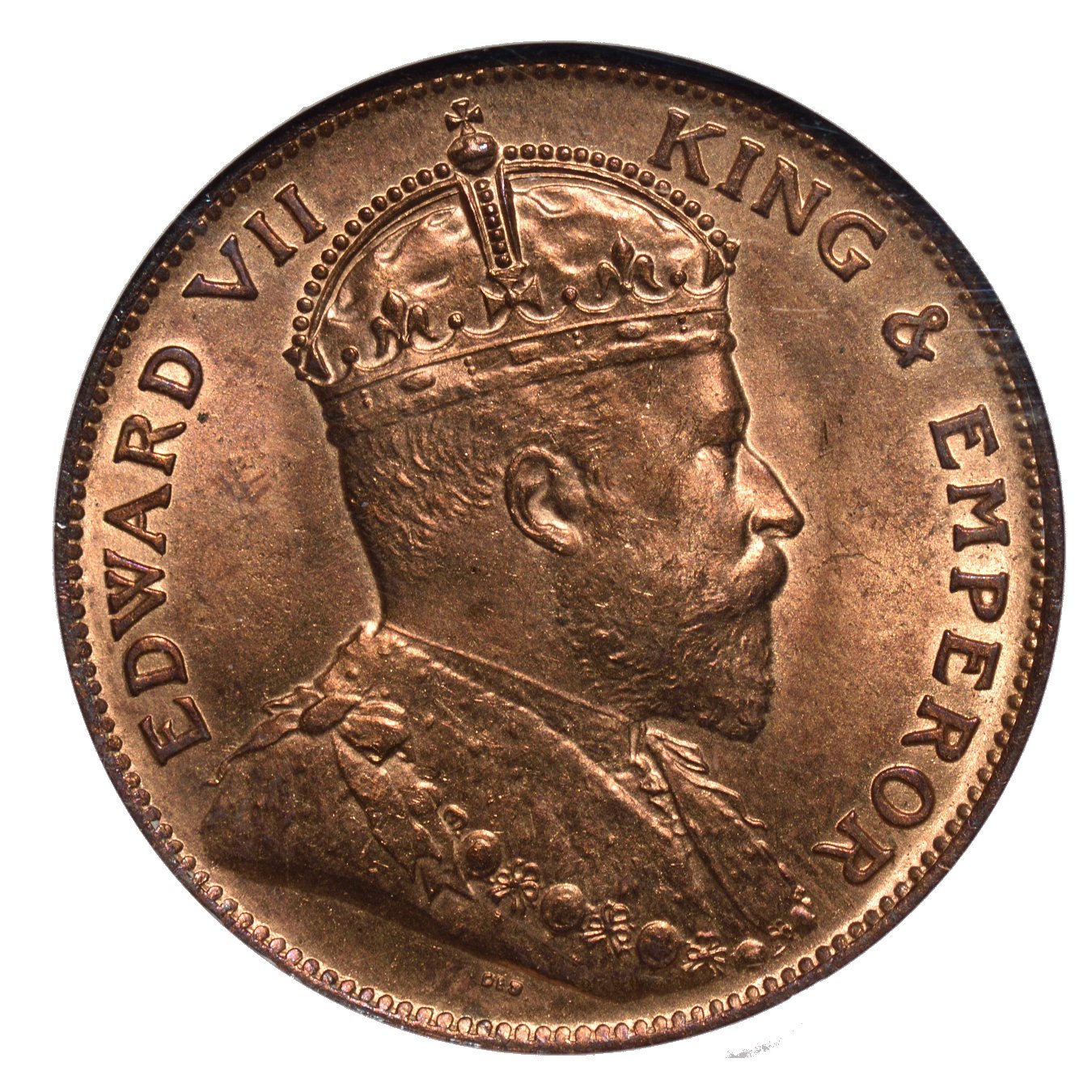
Edward VII, 1909
Life & Training
Jersey Coins
Design Detail
Empire Coinage
Medals & Seals
Legacy
| Phase | Date / Place | Event & Notes |
|---|---|---|
| Life & Training | ||
| Life | 4 Feb 1862 Aston Manor, Birmingham |
Born George William de Saulles at Villa Street, Aston Manor, Birmingham. His grandfather Samuel was a Swiss immigrant who had served as a Page of the Presence in the royal households of George IV and William IV. His father, William Henry de Saulles, was a Birmingham glass merchant. Birmingham was already a centre of British engraving and die-sinking; William Wyon, the great predecessor, was born there in 1795. |
| Life | c. 1874–1880 Birmingham |
Attends the Birmingham School of Art under master Edward R. Taylor — an important centre for the Arts and Crafts movement. Wins several prizes and a scholarship. Apprenticed to a Mr Wilcox, die-sinker in Birmingham, whose workshop included the execution of commercial labels for Manchester goods — varied, unglamorous, technically exacting work. |
| Life | 1884 London |
Moves to London aged 22 and works for John H. Pinches, die-engraver, at Oxenden Street, Haymarket — one of the foremost private medal and die-engraving firms in the country. Marries Myra Hill in June 1884. They have no children. |
| Life | 1888 Birmingham |
Returns to Birmingham and joins Joseph Moore, medallist — an elder craftsman who had himself moved from cutting button dies to designing medals, and whose career trajectory foreshadowed de Saulles's own transition from commercial die-work to official coinage. |
| Life | 1892 Royal Mint, London |
On the death of Leonard Charles Wyon — the Royal Mint's Chief Engraver and last of the great Wyon dynasty — de Saulles is called to the Mint. He takes on the bulk of Wyon's duties immediately, effectively acting as Chief Engraver before formal appointment. The post was held not as a full-time salaried position but via an annual retainer, as it had been for Wyon before him. |
| Life | January 1893 London Gazette |
Gazetted Engraver to the Mint in the London Gazette (Annual Report of the Deputy Master of the Mint for 1893, p. 30). From this point until his death he produces dies continuously for British and colonial coins and official medals. The appointment was confirmed in the 1894 Annual Report, though his work had begun immediately in 1892. |
| Life | 21 Jul 1903 Chiswick |
Dies at Chiswick after a few days' sudden illness, aged 41. He was in the midst of preparing the new Great Seal of Edward VII at the time of his death. Buried at Chiswick churchyard. His obituary and a complete list of his medallic works was compiled by his former employer John H. Pinches and published in the Numismatic Chronicle, 1903, pp. 311–313. |
| Jersey Coinage — De Saulles's Role | ||
| Jersey | Context: The Jersey Obverse |
Jersey's fractional-shilling bronze coins (the 1/12 shilling penny and 1/24 shilling halfpenny) had used the same heater-shaped shield reverse — three lions passant on red — since the reform coinage of 1877, engraved by Leonard Charles Wyon. The obverse, however, needed updating with each new reign. It was de Saulles who supplied the obverse for the first and only Jersey coin issue of the Edwardian era. The reverse design — the Jersey shield of arms — was not de Saulles's work. It originated with L. C. Wyon in 1876–77 and was carried forward unchanged into the 1909 issue. |
| Jersey | 1/24 Shilling Edward VII, 1909< |
Halfpenny denomination. Obverse: crowned and draped bust of Edward VII facing right, legend EDWARD VII KING & EMPEROR. De Saulles's initials DES appear beneath the bust truncation. Mintage: 120,000 pieces (Royal Mint records: 121,920 coined using a single pair of dies; blanks cut: 124,800). Diameter: 25.55 mm. Seven dots below the orb at the centre of the crown. |
| Jersey | 1/12 Shilling Edward VII, 1909 |
Penny denomination. Obverse: crowned and draped bust of Edward VII facing right, legend EDWARD VII KING & EMPEROR; initials DES below truncation. Reverse: Wyon's heater-shaped shield bearing three golden lions passant, dividing the date 19 09, with STATES OF JERSEY above and ONE TWELFTH OF A SHILLING below. Mintage: 180,000 pieces. Royal Mint records: 182,208 coined using two obverse dies and one reverse die; blanks cut: 182,784. Diameter: 30.90 mm. Eight dots below the orb in the crown. The letters FTH in "TWELFTH" are noted by collectors to be out of alignment. |
| Jersey | Why only 1909? | Although Edward VII reigned from 1901 to 1910, Jersey coins bearing his effigy were struck only in 1909 — the penultimate year of his reign. Contemporary newspaper reports indicate a discussion about issuing £3,000 worth of new coinage, but ultimately only £1,000 was authorised and minted. Source: Jersey Independent and Daily Telegraph, 6 February 1909, "The Issuing of Copper Money." Royal Mint file MINT 1/51 covers orders, Privy Council minutes, and Treasury authorities relating to this issue, July 1907 – 1910. |
| Jersey | The English Legend Controversy | Unusually, the obverse legend reads in English — EDWARD VII KING & EMPEROR — rather than the customary Latin, and omits the ancient heraldic symbols used on earlier Jersey issues. This was considered undesirable by island authorities. Wilfrid du Pré (Annual Bulletin of the Société Jersiaise, 1948): "advantage was accordingly taken of the next ensuing Jersey issue, that of George V in 1911, to reinstate the symbols, and to revert to the Latin abbreviations." George V issues from 1911 use GEORGIVS V D G BRITT OMN REX F D IND IMP. |
| Jersey | Royal Permission for the Crest | Although the heater-shaped shield of the Jersey Arms had appeared on coins since 1877, it was not until 1907 — during Edward VII's reign — that King Edward VII formally granted royal permission for the Jersey Crest to be used as the island's official motif. This is a distinction between the shield appearing as an unofficial badge (as it had for centuries) and its formal royal recognition as Jersey's official device. |
| Jersey | Old Coin Remelting | Some of the earlier Victoria-era bronze coinage was returned to the Royal Mint for melting down, and the resulting metal was used in the production of the 1909 Edward VII Jersey coins. This recycling is believed to account for the streaky or uneven appearance sometimes seen on examples of the 1909 issue. "Some of the old coinage was returned to the Royal Mint for melting to be used for this issue and probably accounts for the streaky appearance on some of the coins." (jerseycoins.com) |
| The Design — De Saulles's Obverse Approach | ||
| Design | The Edward VII Portrait | De Saulles was commissioned to portray the new King very soon after Victoria's death in January 1901. He was granted two sittings with Edward VII — the first on 21 February 1901, less than a month after Victoria's death. The result is a crowned and draped bust facing right, a deliberate reversal of the leftward-facing Victorian tradition. This portrait, signed De S. below the truncation, appeared on all British coinage from 1902 and — posthumously — on colonial issues through 1910, including the 1909 Jersey pieces. |
| Design | Influenced by the French School | Contemporary observers noted that de Saulles was influenced by the French medallic school of Louis-Oscar Roty and Jules-Clément Chaplain — artists celebrated for their fluid, portrait-naturalistic medals. However, as the Dictionary of National Biography notes, "in his official work there was no great scope for innovation and the play of fancy." Official coinage demanded heraldic discipline, not artistic experiment. |
| Design | Working Method | Unlike many die-engravers who worked from models produced by a sculptor, de Saulles designed, modelled and engraved most of his dies himself — a true all-round craftsman. Contemporary accounts emphasise the speed and skill with which he worked. His friend and former employer J. H. Pinches wrote that he was "a man of kindly disposition, entirely devoted to his craft." |
| Design | The Signature | De Saulles signed his work variously as De S., DES, or DS. On the 1909 Jersey coins the initials DES appear in small lettering beneath the bust truncation — visible with care on well-preserved examples, and particularly clear under digital microscopy. jerseycoins.com notes: "the letters 'DES' for George William De Saulles can be found beneath the truncation." |
| Design | The Old Head Victoria (1893) | Although the portrait was sculpted by Sir Thomas Brock, it was de Saulles who engraved the dies for the "Old Head" or "Widowed Head" coinage of 1893 — Victoria crowned and veiled. In 1895 the Brock portrait was extended to the bronze coinage (penny and fractions), and de Saulles designed the new standing Britannia reverse for those coins. The 1893 Old Head coinage was the first British series to include IND IMP (Indiae Imperatrix) in the monarch's titles, as the coins also circulated in the colonies. |
| Empire & Colonial Coinage — Selected Works | ||
| Empire | Great Britain | Executed dies for the complete Victoria Old Head coinage (1893–1901) from Thomas Brock's designs. Designed the standing Britannia reverse for the English bronze coinage (penny and fractions) in 1895. Designed and engraved the complete Edward VII coinage from 1902: all denominations from the farthing to the crown, including the shilling, florin (with standing Britannia reverse), and half crown reverses. |
| Empire | Australia | Designed the obverse for Australian threepence, sixpence, shilling, and florin of 1910 (Edward VII portrait). These were among the first coins of the new Commonwealth of Australia, struck at the Royal Mint, London. |
| Empire | Canada | Designed all Canadian obverse coins 1902–1910 bearing the Edward VII portrait. |
| Empire | British India | Designed obverse coins for British India, 1902–1910. Also responsible for the British Trade Dollar for India (1895), a significant commercial coin used across South and East Asian trade routes. |
| Empire | British East Africa | Designed the reverse for the British East Africa copper pice, 1897–1899; subsequently also the reverses for the 25-cent and 50-cent denominations in various years 1906–1919 — his work outlasting him by over a decade. |
| Empire | Straits Settlements, Ceylon, Cyprus, Jamaica, British Honduras, Newfoundland, Hong Kong, British Guiana |
The Edward VII obverse portrait was deployed across all of these colonial coinages during 1902–1910. For British Honduras (1894) and British East Africa (1897) he also produced original reverse designs. The Straits Settlements Dollar of 1903 was one of the last pieces he worked on before his death in July of that year. |
| Medals, Seals & Other Works | ||
| Medals | Scientific & Institutional Medals | Between 1894 and 1903 he produced at least thirty medals and three plaques. Notable examples include: the Royal Society Medal (Sir George Buchanan), 1894; Stokes Medal, 1899; Samuel Carnegie medal, 1901; Coronation Medal of Edward VII, 1902; Royal Society of British Architects Medal, 1902; National Lifeboat Institution Medal, 1903. |
| Medals | Military Campaign Medals | South Africa Medal 1899–1902; Ashanti Medal 1900; Transport Service Medal 1902. For the India Medal (instituted 1896) he provided a modified form of the Old Head Victoria portrait, and he designed unique Victoria portraits for the East and Central Africa Medal (1899), the Queen's Sudan Medal (1899), and the Queen's South Africa Medal (1900). |
| Medals | The Great Seal of Victoria (1899) | In 1899 de Saulles produced the last Great Seal for Queen Victoria — the large wax seal used to authenticate the most important state documents. It was a commission of the highest official rank. He was working on the equivalent seal for Edward VII at the moment of his death in July 1903. |
| Medals | Unfinished: Great Seal of Edward VII | De Saulles was actively engaged in preparing the new Great Seal of Edward VII when he fell ill and died. This circumstance — dying in the service of the Crown, mid-commission — underscores the relentless pace of his decade-long career at the Mint. |
| Legacy | ||
| Legacy | The Last of the Wyons' Line | De Saulles succeeded Leonard Charles Wyon, and with that succession the long era of the Wyon family's dominance of British die-engraving came to an end. De Saulles represented a new generation: Birmingham-trained, commercially seasoned, and technically self-sufficient in a way that owed nothing to dynastic inheritance. |
| Legacy | A Posthumous Portrait | De Saulles died in July 1903 — yet coins bearing his portrait of Edward VII continued to be struck until 1910 and on colonial issues beyond. His Jersey coins of 1909 were produced from a portrait model he had completed before his death; the dies were produced posthumously from his work. |
| Legacy | Jersey in Context | The two 1909 Jersey coins represent de Saulles's only direct contribution to Jersey coinage — but through the obverse portrait they carry, they are the most technically accomplished coins the island had received to that point. For Jersey numismatists, the DES mark beneath the truncation is the key diagnostic — tiny, precise, and worth finding. Sources: Pinches (1903), Numismatic Chronicle pp. 311–313 · Dictionary of National Biography, 1912 supplement · Forrer, Biographical Dictionary of Medallists, 1904 · jerseycoins.com · Wilfrid du Pré, Jersey's Copper Coinage, Société Jersiaise, 1948 · Royal Mint Annual Report 1909, Vol. 40 · Royal Mint file MINT 1/51. |