May 27, 2026
Edgar Bertram Mackennal Sculptor, Medallist & Designer of the George V Jersey Coinage, 1911–1935
12 June 1863, Fitzroy, Melbourne, Australia · 10 October 1931, Watcombe, Devon · KCVO, RA · Signed: BM
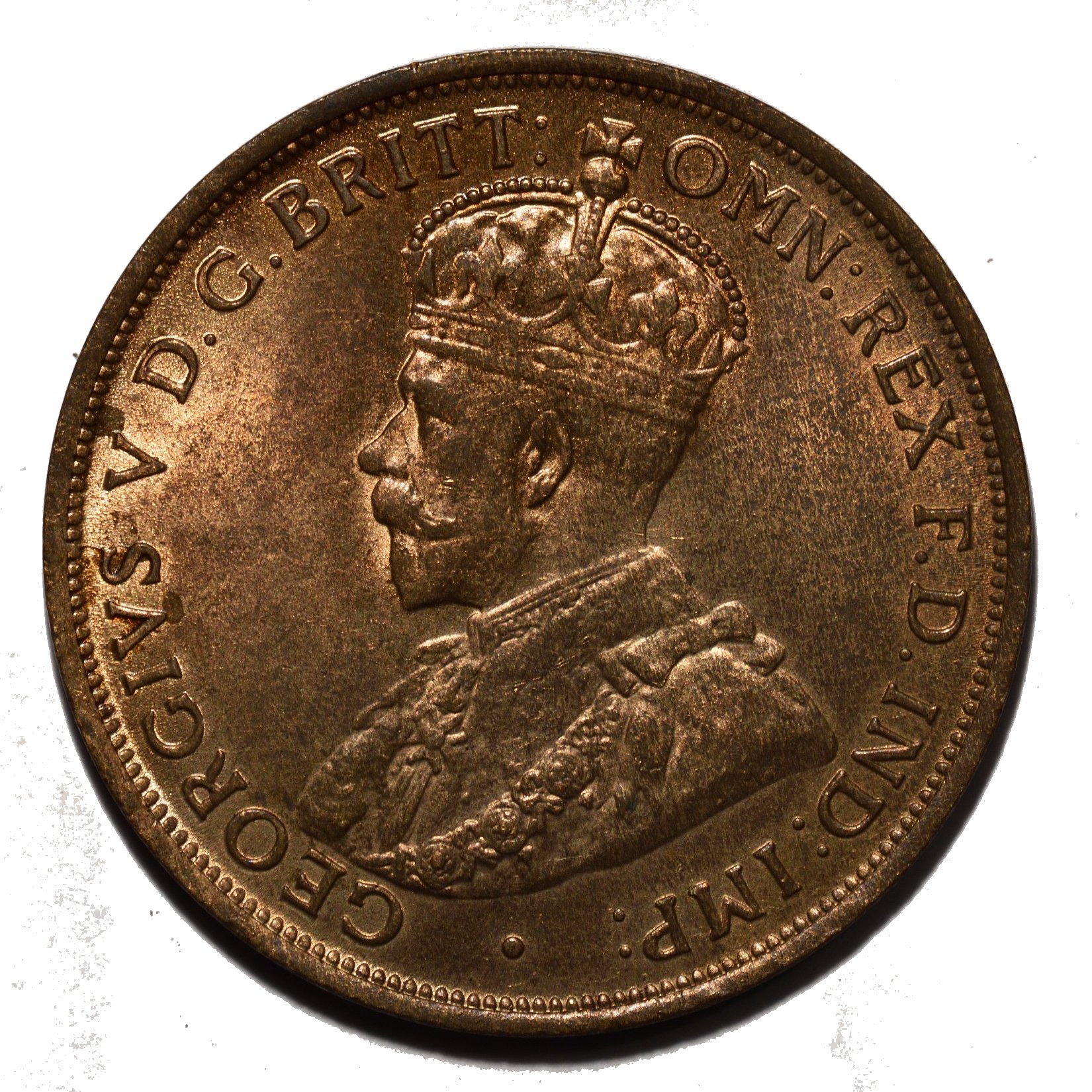
George V, 1911
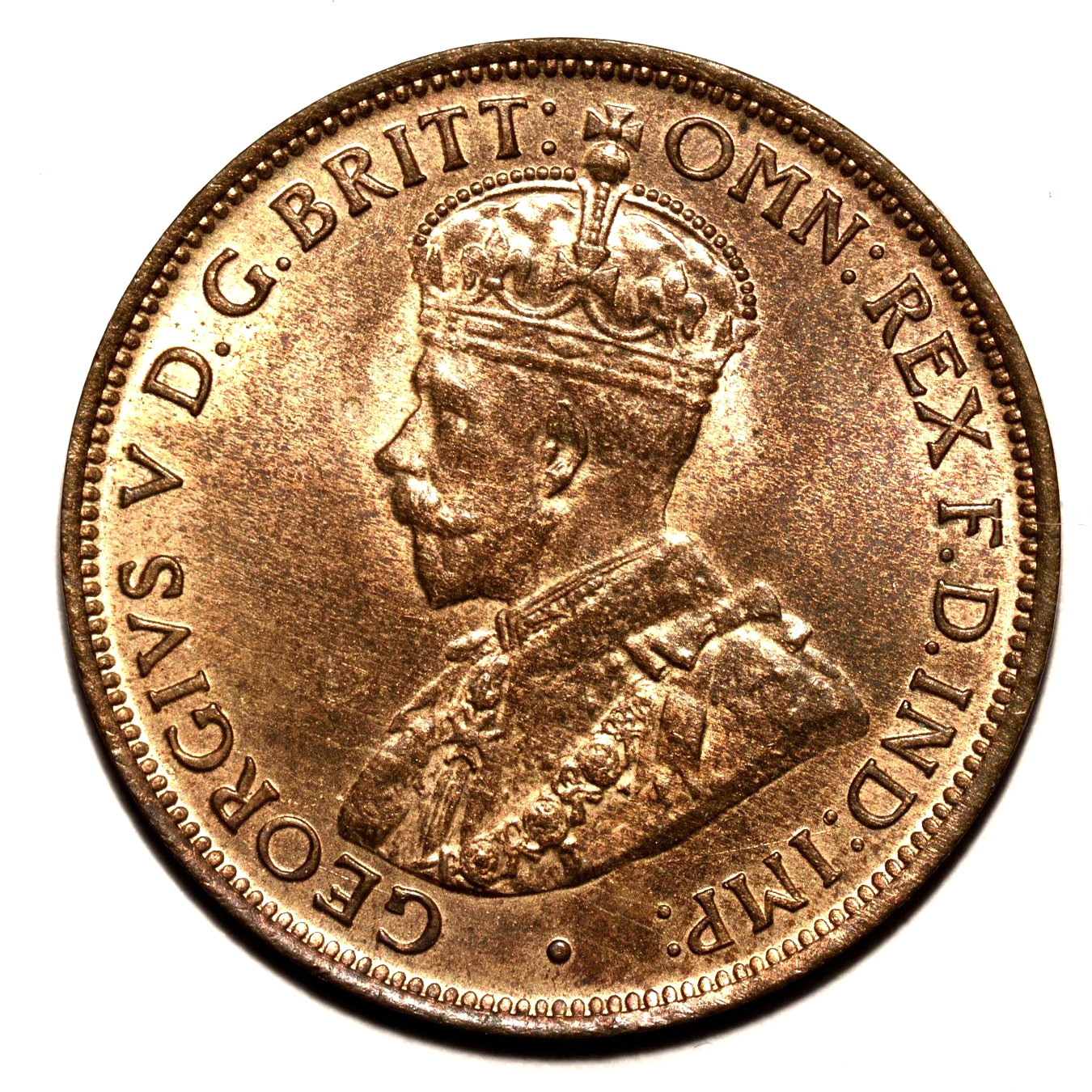
George V, 1911
Life & Training
Jersey Coins
Design Detail
Empire Coinage
Sculpture & Medals
Legacy
| Phase | Date / Place | Event & Notes |
|---|---|---|
| Life & Training | ||
| Life | 12 Jun 1863 Fitzroy, Melbourne |
Born Edgar Bertram Mackennal in Fitzroy, a suburb of Melbourne, Victoria, Australia — the second son of John Simpson Mackennal, a prominent Melbourne sculptor and architectural modeller of Scottish descent, and his wife Annabella, née Hyde, also of Scottish origin. He is educated at the Melbourne Model School and King's College. Usually known simply as Bertram Mackennal, he is the first Australian-born artist to be knighted and the first to be elected an Associate of the Royal Academy. |
| Life | c. 1877–1882 Melbourne |
Studies sculpture under his father, then at the National Gallery School of Design, Melbourne. His early training lays a foundation in classical modelling and figurative work that will distinguish him from the trade engravers who had previously dominated Royal Mint portrait commissions. |
| Life | 1882–1883 London |
Travels to London aged 19, intending to study under English sculptor Marshall Wood. Finds that Wood has died. Enrols instead at the Royal Academy Schools, but soon grows disillusioned and shares a studio with Charles Douglas Richardson and Tom Roberts. Roberts would later become one of Australia's most celebrated painters; their early shared studio in London reflects the close-knit circle of expatriate Australian artists in this period. |
| Life | 1883–1888 Paris / Australia |
Leaves London for Paris, then returns to Australia. Wins the competition to decorate Government House, Victoria — his first major commission. Exhibits in Melbourne, but his nude sculpture is censured by the local press, and Sarah Bernhardt (on tour) encourages him to seek wider recognition in Europe. A group of patrons funds his return to Paris. |
| Life | 1889–1892 Paris |
Works in Paris. In 1892 two sculptures are accepted at the Paris Salon. He marries Agnes Spooner. Despite periods of extreme poverty, his reputation begins to grow and his work attracts the attention of serious collectors and critics. |
| Life | 1893 Paris & London |
Exhibits his life-size plaster Circe at the Paris Salon, where it receives an Honourable Mention and is illustrated in the catalogue. The following year it is shown at the Royal Academy in London, where the Hanging Committee covers the base — finding the relief of Odysseus's companions too explicit — creating a scandal that makes Mackennal famous overnight. A French critic in the Revue des Deux Mondes wrote that Circe showed "a tense, restrained, but triumphant beauty... free from every trace of vulgarity." The controversy at the Royal Academy only added to its notoriety. |
| Life | 1907–1909 London |
His marble group The Earth and the Elements is purchased for the National Gallery of British Art under the Chantrey Bequest in 1907; in 1908 his Diana Wounded is also purchased for the nation. This dual acquisition by the Tate brings him into great prominence. In 1909 he is elected an Associate of the Royal Academy — the first Australian to receive this honour. He also designs the medals for the 1908 London Olympic Games. |
| Life | 1910 London |
On the accession of George V, Mackennal wins the commission to design the Coronation Medal for the new King and — most importantly — the obverse portrait for all new British and colonial coinage from 1911. He is one of the few artists that George V genuinely liked, and develops a warm professional relationship with the Crown. From the portrait modelled for the coin, he also develops the design for the King's head on British postage stamps — making his likeness of George V arguably the most widely reproduced portrait of any human being in the early twentieth century. |
| Life | 1921 London |
Knighted as Knight Commander of the Victorian Order (KCVO) by George V on the occasion of the unveiling of Mackennal's bronze equestrian statue of King Edward VII in London — the first Australian artist to receive a knighthood. Elected a full Royal Academician (RA) the following year, 1922. |
| Life | 10 Oct 1931 Watcombe, Devon |
Dies at Watcombe Hall, near Torquay, Devon, aged 68. He is survived by his wife and daughter. His George V portrait remains in use on British and colonial coinage at the time of his death, and continues to appear on Jersey coins until 1935. |
| Jersey Coinage — Mackennal's Obverse | ||
| Jersey | Context: The Jersey Obverse |
During the reign of George V, Jersey issued one obverse design and three successive reverse designs. The obverse throughout — a crowned bust of George V facing left — was modelled and engraved by Mackennal, as was typical for colonial coinages of the era. His portrait appears unchanged across all Jersey issues from 1911 to 1935. The reverse designs — the Jersey shield of arms — were the work of other engravers. The first two reverses derive from L. C. Wyon's original 1877 design; the third, from 1923 onwards, was redesigned by George Kruger-Gray. |
| Jersey | 1/24 Shilling George V, 1911, 1913, 1923 |
Halfpenny denomination. Obverse: crowned bust of George V left, legend GEORGIVS V D.G.BRITT: OMN: REX F.D.IND:IMP:. Mackennal's initials BM appear on the truncation of the King's neck. Reverse: the Wyon-derived heater-shaped shield. Mintage per year: 72,000. Diameter: 25.55 mm. Royal Mint records state that for the 1911 coins, 73,200 pieces were coined using a single pair of dies. |
| Jersey | 1/12 Shilling George V, 1911, 1913, 1923 |
Penny denomination. Same Mackennal obverse; reverse the Wyon heater-shaped shield dividing the date, STATES OF JERSEY above, ONE TWELFTH OF A SHILLING below. Mintage per year: 204,000. Diameter: 30.85–30.90 mm. Royal Mint records state that for the 1911 coins, 205,632 pieces were minted using two obverse dies and four reverse dies. Of special interest is the 1913 coin, which uses GEORGIVS V D.G.BRITT: OMN: REX F.D.IND:IMP: — note the spelling "BRITT" for "BRITANNIARUM," which is correct Latin. |
| Jersey | 1/24 Shilling George V, 1923, 1926 |
Second reverse design introduced after the 1923 recoinage. The States of Jersey requested a new design; after debate at the Royal Mint Advisory Committee, Kruger-Gray's modified coat-of-arms reverse was adopted. Mackennal's obverse continued unchanged. Mintage: 72,000 (1923); 120,000 (1926). Diameter: 25.55 mm. The 1923 recoinage used approximately 500,000 recalled French coins — which had infiltrated during WWI — melted down and struck into new Jersey bronze at the Royal Mint. |
| Jersey | 1/12 Shilling George V, 1923, 1926 |
New Kruger-Gray reverse paired with the unaltered Mackennal obverse. The 1923 coins did not enter circulation until 1924 due to their late striking. McCammon notes that coins from the French-bronze recoinage are typically darker than other Jersey issues. Mintage: 301,200 (1923); 82,800 (1926). Diameter: 30.80 mm. |
| Jersey | 1/24 Shilling George V, 1931, 1933, 1935 |
Third and final George V reverse — a further Kruger-Gray redesign commissioned in 1930 when the States requested a new treatment of the shield. This refined design proved so successful that it endured (with minor adaptations) until the complete decimal redesign of the coinage in the 1980s. Mackennal's obverse is retained throughout. Mintage per year: 72,000. Diameter: 25.50 mm. The 1933 halfpenny has two noted obverse die varieties. |
| Jersey | 1/12 Shilling George V, 1931, 1933, 1935 |
Final Mackennal obverse issues for Jersey, paired with the third Kruger-Gray reverse. The 1933 penny is of particular numismatic interest, having two distinct obverse die varieties documented by collectors. Mintage per year: 204,000. Diameter: 30.80 mm. Mackennal died in October 1931; the 1933 and 1935 Jersey coins bearing his portrait were thus issued posthumously. |
| Jersey | The Latin Legend | The return to the full Latin legend on George V Jersey coins — after the controversial English-language legend of the 1909 Edward VII issue — was exactly what Jersey's authorities had wanted. The legend GEORGIVS V D.G.BRITT: OMN: REX F.D.IND:IMP: is an abbreviation for Georgius V, Dei Gratia Britanniarum Omnium Rex, Fidei Defensor, Indiae Imperator — "George V, by the Grace of God King of all the Britains, Defender of the Faith, Emperor of India." The spelling "BRITT" rather than "BRIT" for "Britanniarum" is grammatically correct Latin, as noted by Fred. W. Madden in the Numismatic Chronicle, vol. 20, 1857. The use of "OMN[IUM]" for "omnium" shortens a legend that would otherwise be too long for the coin field. |
| Jersey | WWI Coin Shortage & the 1923 Recoinage |
During the First World War, a coin shortage led to French bronze coins infiltrating Jersey and being accepted as change, despite the States of Jersey enactment of 1834. On 7 February 1923 the States passed a law banning the import of foreign copper coinage exceeding one shilling. This was confirmed by Order in Council on 12 March 1923. Between 27 August and 8 September 1923, the Treasury exchanged French 1 and 2 sous coins for Jersey halfpenny and penny coins at their office, advertising the exchange in the press. Approximately 500,000 French coins were recalled and sent to the Royal Mint for recoinage — giving rise to the new Kruger-Gray reverse designs, while Mackennal's obverse was retained unchanged. Source: A. L. T. McCammon, Currencies of the Anglo-Norman Isles (London: Spink & Son Ltd., 1984), p. 159; Royal Mint file MINT 20/827, Jersey: issue and withdrawal of coinage, 1923–1926. |
| The Design — Mackennal's George V Portrait | ||
| Design | The George V Portrait | Mackennal's portrait of George V shows the King as a bare-headed, left-facing bust with a simple truncation — a deliberate return, after de Saulles's crowned Edward VII, to the uncrowned tradition that had prevailed since the seventeenth century. The portrait is clean, restrained, and dignified: a sculptor's reading of the King rather than a die-engraver's convention. George V was one of the few artists' subjects that Mackennal genuinely liked working with. The relationship between artist and king was warm, and the portrait reflects a degree of personal familiarity unusual in official coinage commissions. |
| Design | Two Portrait Varieties | Two versions of the Mackennal portrait were produced during George V's reign. The first, used on coins struck between 1911 and approximately 1928, features a larger portrait. Production difficulties at the Royal Mint led to a revised, slightly smaller version of the effigy, used from around 1929 to 1932. Both variants carry Mackennal's initials BM on the truncation of the King's neck. Jersey coins struck between 1911 and 1926 use the first (larger) portrait. The 1931–1935 issues use the revised portrait. Collectors examine the relative size of the bust and the spacing of the legend to distinguish them. |
| Design | The Signature | Mackennal signed his coin portrait with the initials BM, placed at the truncation of the King's neck. These initials are visible on well-preserved examples and are a primary means of attribution. The same BM mark appears on all George V coinage across the many countries that used this portrait. jerseycoins.com notes: "He designed the well-known obverse of King George V, and initialled it 'BM'. This can be seen on the coins of the following countries: Australia, British India, British West Africa, Canada, Ceylon, Cyprus, East Africa, Fiji, Great Britain, Hong Kong, Mauritius, Newfoundland, Jersey, Jamaica, Straits Settlement, Southern Rhodesia, and South Africa." |
| Design | Postage Stamps | From the same portrait session used for the coinage, Mackennal also developed the design for King George V's head on British postage stamps — the "Downey Head" issued from 1911. The coin and stamp portraits are closely related; the stamp design shows a slightly softer, more frontal treatment but derives from the same modelled likeness. This dual deployment made Mackennal's image of George V among the most widely reproduced human portraits in history. |
| Empire & Commonwealth Coinage — Selected Issues | ||
| Empire | Great Britain | Mackennal's George V obverse portrait appeared on all British coinage from 1911: farthing, halfpenny, penny, threepence, sixpence, shilling, florin, half crown, crown, and gold sovereign. The portrait was used continuously until the introduction of a new effigy following George V's death in 1936. |
| Empire | Australia | Mackennal's obverse portrait appeared on all Australian coinage from 1911 through 1936, spanning the halfpenny, penny, threepence, sixpence, shilling, florin, and sovereign. As an Australian-born artist, Mackennal's portrait gracing Australia's own coinage carries particular national significance. |
| Empire | Canada | Designed the George V obverse for all Canadian coinage 1911–1936, from the cent through to gold sovereigns and commemorative issues. The 1935 silver dollar — the first Canadian dollar coin — uses the Mackennal portrait for the Silver Jubilee issue. |
| Empire | British India, British West Africa, Ceylon, Cyprus, East Africa, Fiji, Hong Kong, Jamaica, Mauritius, Newfoundland, Straits Settlement, Southern Rhodesia, South Africa |
Mackennal's George V portrait was used across all of these colonial coinages, making it the most geographically widespread coin obverse portrait in the world during the 1910s–1930s. Each territory retained the standard Mackennal likeness while deploying its own reverse designs. The breadth of this deployment — over fifteen separate territories — is unmatched by any single coin portrait designer before or since, with the possible exception of the subsequent portraits of Elizabeth II. |
| Sculpture, Memorials & Medals | ||
| Sculpture | 1908 London Olympic Games | Designed the medals for the IV Olympic Games held in London in 1908 — a prominent international commission that brought him to the attention of the highest official circles and directly preceded his George V coinage commission. |
| Sculpture | Memorial Tomb of Edward VII St George's Chapel, Windsor |
A joint commission with Sir Edwin Lutyens as architect. Mackennal produced the sculpted elements of the memorial tomb of King Edward VII at St George's Chapel, Windsor — arguably the most prestigious memorial commission of the Edwardian era. |
| Sculpture | King Edward VII Statues | Sculpted equestrian and standing statues of Edward VII for London (equestrian, unveiled 1921, the occasion of his knighthood), Melbourne (equestrian, Queen Victoria Gardens, unveiled 1920), Calcutta (bronze equestrian, Victoria Memorial Hall, 1916), and Adelaide. |
| Sculpture | King George V Statues | Sculpted marble portrait statues of George V for Delhi (formerly at the Flower Bazaar Police Station, Madras; now at the Rashtrapati Bhavan, New Delhi, 1916) and other locations. Among the few sculptors personally favoured by the King. |
| Sculpture | National Gainsborough Memorial Sudbury, Suffolk |
The National Memorial to Thomas Gainsborough at Sudbury, Suffolk — a significant public commission demonstrating Mackennal's standing as the leading portrait sculptor in Britain by the mid-1910s. |
| Sculpture | Circe, 1893 National Gallery of Victoria |
His most celebrated sculptural work. The life-size Circe — the sorceress of Homer's Odyssey — received an Honourable Mention at the Paris Salon of 1893 and caused a sensation at the Royal Academy in 1894. Cast in bronze in Paris in 1901; acquired by the National Gallery of Victoria through the Felton Bequest in 1910. Regarded as a masterpiece of the British New Sculpture movement. |
| Sculpture | Other Notable Works | The Earth and the Elements (marble, purchased by Tate Gallery 1907); Diana Wounded (marble, purchased by Tate Gallery 1908); Eton College War Memorial figure (Here I Am); Parliamentary War Memorial, London; cenotaph figures, Martin Place, Sydney; bronze statue of George V, Old Parliament House, Canberra. |
| Legacy | ||
| Legacy | First Among Australians | Mackennal holds a unique position in the history of both British and Australian art. He was the first Australian to be elected an Associate (1909) and then a full Royal Academician (1922) of the Royal Academy of Arts. He was the first Australian artist to be knighted (1921). His achievement demonstrates that colonial origins were no barrier to the highest official commissions in Edwardian and Georgian Britain. |
| Legacy | A Sculptor on the Coinage | Unlike his predecessors at the Royal Mint — Wyon, de Saulles — who were primarily die-engravers by training, Mackennal was a sculptor of international standing whose primary medium was bronze and marble. His appointment to design the George V coinage portrait represents a conscious decision to bring a different order of artistic ambition to the task. The resulting portrait has an authority and plasticity that distinguished it from the more mechanical coin-portrait tradition. |
| Legacy | Jersey in Context | Mackennal's portrait of George V appears on every Jersey bronze coin struck between 1911 and 1935 — eight distinct issues across three successive reverse designs and two obverse portrait varieties. It is his BM mark on the truncation that identifies his contribution. Alongside the work of Kruger-Gray on the reverses, Mackennal's obverse forms one half of the enduring visual identity of Jersey's pre-decimal bronze coinage. Sources: Wikipedia, Edgar Bertram Mackennal · Museums Victoria collections · jerseycoins.com, George V Jersey Coins · McCammon, A. L. T. Currencies of the Anglo-Norman Isles, Spink, 1984 · Royal Mint Annual Report 1911, Vol. 42 · Wilfrid du Pré, Jersey's Copper Coinage, Société Jersiaise, 1948. |