South Africa (ZAR) 2½ Shillings, 1892 Paul Kruger — Berlin Mint — The Republic's First National Coinage in Eighteen Years
KM# 7 · Silver (.925) · 32.3 mm · 14.14 g · Reeded edge · First year of a 1892–1897 type · Royal Prussian Mint, Berlin (1892 only)
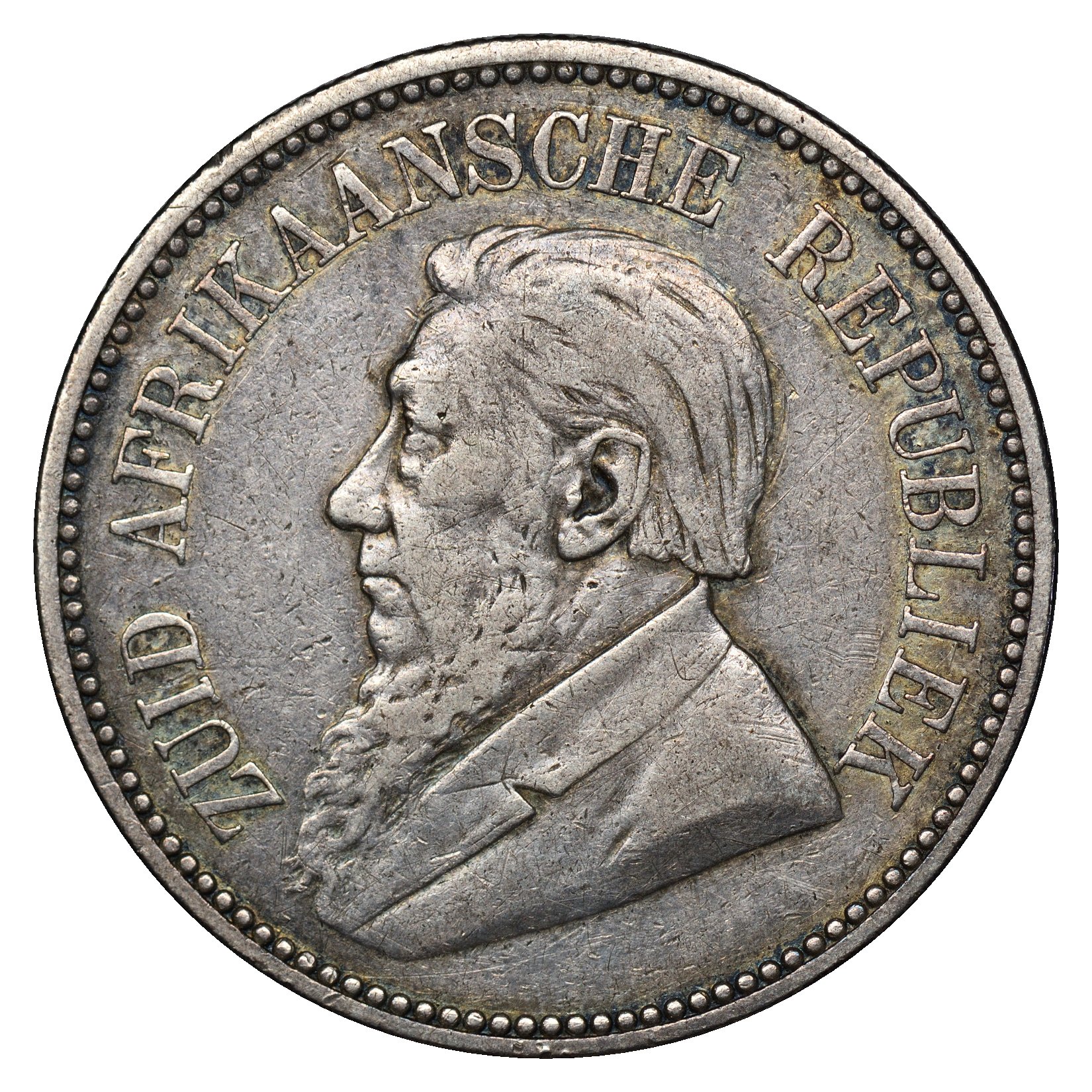
President Paul Kruger — head left
ZUID AFRIKAANSCHE REPUBLIEK
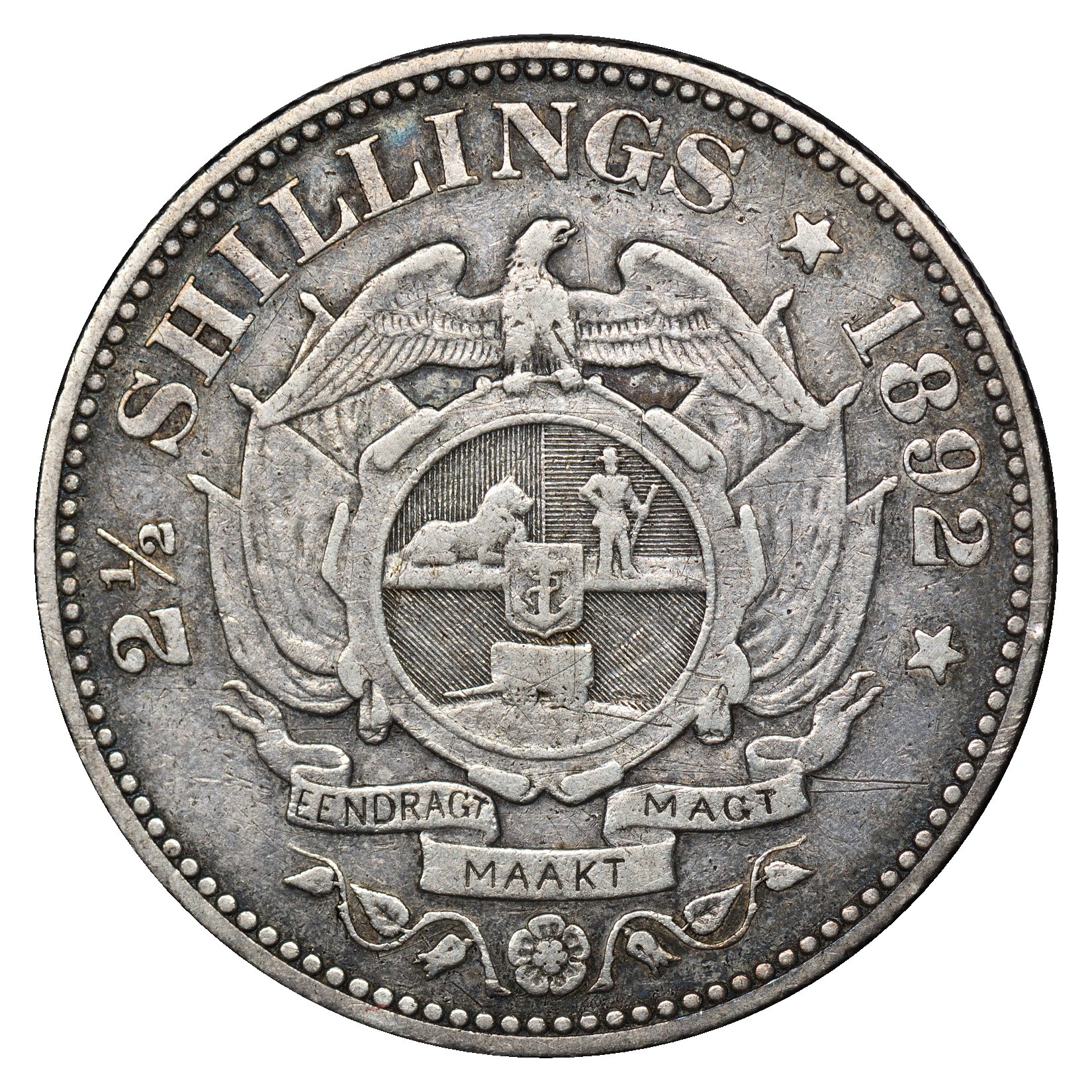
Arms of the Republic above value and date
2½ SHILLINGS · EENDRAGT MAAKT MAGT
The Wagon-Shaft Story — And Why This Coin Escaped It
Sources differ slightly on exactly which denominations show the double-shaft error: Wikipedia and a dealer history (rarecoins.co.za) both name the pond, half-pond and 5-shillings specifically, and a numismatic society article describes the error as affecting "the 5-shillings, half-pond, and pond" while noting the florin and shilling "avoided these errors." None of the sources I checked list the 2½ shillings among the affected denominations — I'm treating that as reasonably well-established, but I have not found a source that discusses the half crown's wagon die by name in as much depth as it does the gold and crown pieces.
| Section | Topic | Notes | |||||||||
|---|---|---|---|---|---|---|---|---|---|---|---|
| History & Context | |||||||||||
| History | A Republic Without Its Own Coinage |
Between the tiny 1874 Burgerspond issue (only 837 struck) and 1892, the South African Republic had no coinage of its own — its people transacted in British, and other, circulating coin. The Witwatersrand gold discoveries of 1886 transformed the Republic's finances within a few years, and by the early 1890s Kruger's government was ready to fund a full national coinage: bronze pennies, silver from threepence up to the crown (5 shillings), and gold half-ponds and ponds, all introduced together in 1892. The direct causal link between the Witwatersrand gold boom and the decision to strike this coinage is drawn by me from the timing and from South Africa's own central bank history page, which states only that "after the discovery of gold, South Africa built a mint in Pretoria and began issuing coins depicting Paul Kruger" — the fuller economic reasoning isn't spelled out in the sources I checked. | |||||||||
| History | An Election-Year Coinage |
Because the Republic's own Pretoria mint was still under construction in 1892, the first coins were struck under contract at the Royal Prussian Mint in Berlin, with Kruger reportedly anxious to get the new national coinage into circulation ahead of the 1893 presidential election. That election turned out to be close: Kruger defeated Piet Joubert by just 872 votes (7,881 to 7,009), with a third candidate, John Gilbert Kotzé, also on the ballot, and with the electoral roll itself later disputed. A dealer history (rarecoins.co.za) frames the wagon-die error described below as something that "almost cost Kruger the election" — I can confirm the election really was that close, but I have not found an independent, more rigorous source that draws a direct causal line between the coinage embarrassment and the vote margin, so I'd treat that specific claim as a colorful but unverified detail. | |||||||||
| History | The Wagon-Shaft Embarrassment |
The Berlin-cut dies for the gold pond and half-pond, and for the silver crown (5 shillings), showed the traditional Voortrekker ox-wagon with two shafts and mismatched front-and-rear wheel sizes, rather than the correct single shaft — the engraver, working from unfamiliar reference material, appears to have confused the Boer wagon with a European design. The mistake was politically awkward enough that new, corrected dies followed once it was noticed. This particular denomination, the 2½ shillings, was not among the affected pieces — its wagon was correctly rendered from the start, along with the shilling and 2-shillings (florin). Kruger’s political opponents immediately noticed the incorrect depiction of the “Voortrekker wagon” on the national coat of arms and declared this “an insult,” insisting that the engraver Otto Schultz’s initials “OS” represented the Dutch word for an Ox. Kruger took full ownership for this error and quickly had the appropriate design changes made. | |||||||||
| Design | |||||||||||
| Design | Obverse | A bearded, left-facing bust of President Stephanus Johannes Paulus ("Paul") Kruger fills the field, with the legend ZUID AFRIKAANSCHE REPUBLIEK ("South African Republic") around the rim. This was one of the first coin portraits of Kruger, who had by 1892 already served as President since 1883 (following an earlier term as head of the restored Republic's Triumvirate government). | |||||||||
| Design | Reverse | The Republic's coat of arms sits below the denomination and date, with the motto EENDRAGT MAAKT MAGT ("Unity makes strength") worked into the legend. The arms themselves are a small heraldic history lesson: a lion for strength on one side of the shield, a man in Voortrekker dress holding a rifle on the other, an ox-wagon across the base of the shield recalling the Great Trek, and — despite the Republic being entirely landlocked — a small anchor as an inescutcheon at the shield's center, with an eagle perched above as the crest. | |||||||||
| Design | The Engraver: Otto Schultz |
Otto Schultz, a German medalist working for the Berlin Mint, cut the dies for the entire 1892 series. His unfamiliarity with the specifics of a Voortrekker wagon is the root of the shaft-and-wheel error described above on the gold and crown pieces — an understandable mistake for an engraver working far from the subject he was asked to depict, but one that became a small political headache for the Republic all the same. | |||||||||
| Forms & Varieties in Detail | |||||||||||
| Variety | One Correct Design, No Known Variety |
Unlike its gold and crown siblings, the 2½ shillings does not have a documented single-shaft/double-shaft variety pair — every source I found describing the "Disselboom" (double-shaft) error names the pond, half-pond and 5-shillings as the affected denominations, and one specifically notes that the florin and shilling "avoided these errors." That leaves the half crown in the same escaped category as the florin and shilling, on the strength of it not appearing on anyone's list of affected pieces rather than a source stating outright "the half crown has no variety." | |||||||||
| Variety | 1892 Circulation (16,300 struck) |
The only 1892 mintage figure reported for this denomination, struck exclusively at Berlin. Two independent sources (Numista and the Becklake-derived tokencoins.com mintage table) agree on this figure. | |||||||||
| Variety | 1892 Proof (~50 struck) |
A small proof mintage, reported as approximately 50 pieces (one source says "50–60"). Genuinely rare and a different collecting tier from the circulation strikes. | |||||||||
| Variety | 1893–1897 (Pretoria strikes) |
The same KM#7 type continued at the Republic's own Pretoria mint from 1893 once it became operational, in much larger annual mintages (134,800 to 284,760 pieces per year) — making 1892 the clear key date of the type by mintage alone, before even accounting for later melting. | |||||||||
| Mint & Production | |||||||||||
| Mint | Royal Prussian Mint, Berlin |
All of the Republic's 1892 half crowns were struck at the Royal Prussian Mint (Kaisermünze) in Berlin, since the Republic's own mint in Pretoria was not yet ready to strike coin. Friedrich Munscheid, sent from the Berlin mint, arrived in Pretoria at the end of 1891 with three Ludwig Loewe minting presses to help set up the new facility. Exactly when the Pretoria mint began striking coin is a genuinely disputed point among the sources I found — one numismatic-society researcher lists conflicting claims from several named historians (Becklake, Arndt, Begeer) ranging from "small quantities in 1892" to "beginning of 1893," with the building itself only formally handed to the government in November 1893. I'm not resolving that dispute here — I'm simply noting that the 1892-dated half crown, at least, is Berlin-only by every mintage table I checked. | |||||||||
| Mint | Technical Specifications |
32.3 mm diameter, 14.14 g, 2.32 mm thick, reeded edge, struck in medal alignment (↑↑), .925 fine silver (92.5% silver / 7.5% copper) — a British sterling-standard alloy, appropriate given the coin's explicit basis on the pound sterling system. | |||||||||
| Valuation | |||||||||||
| Value | Market Overview | At 16,300 pieces (plus ~50 proofs), the 1892 half crown is the clear key date of the KM#7 type — its mintage is roughly a tenth of any subsequent Pretoria year. Dealer commentary consistently notes that much of the original mintage went into circulation heavily or was later melted, so problem-free mint-state survivors are scarce even relative to that already-small mintage. | |||||||||
| Value | Observed Prices (individual listings) |
|
|||||||||
| Collecting Notes | |||||||||||
| Collect | Confirm the Date and Mint |
Because 1892 is worth many multiples of the common 1893–97 Pretoria dates, confirm the date is genuinely 1892 (not an altered or misread later date) before paying a key-date premium. There is no mintmark difference to check — the Berlin-vs-Pretoria distinction for this type is a matter of date and, for specialists, subtle die/style differences, not a visible mint letter. | |||||||||
| Collect | What to Look For | Key points: (1) Kruger's beard and hair on the obverse — high-relief areas that flatten first. (2) Fine detail in the arms on the reverse — the wagon, the lion, and the small figure with the rifle all reward a loupe. (3) The reeded edge, for filing or alteration, especially given the coin's value relative to its size. (4) Weight and diameter, as a basic authenticity check on a coin valuable enough to attract reproductions. | |||||||||
| Collect | Problems to Avoid | Common problems: (1) Cleaning — as with most 19th-century world silver, over-polished examples are common (one of the comparison listings above explicitly disclosed a cleaned coin); check for hairlines and unnatural surfaces. (2) Melting losses distorting supply — because a real share of the mintage was melted, surviving examples skew toward well-circulated grades, so an unusually choice example deserves extra scrutiny, not less. (3) Confusing this coin with its variety-bearing siblings — don't assume a single-shaft/double-shaft distinction applies here the way it does to the pond, half-pond and crown. | |||||||||
| Collect | Collection Contexts | This coin fits naturally into: a Kruger/ZAR type set spanning 1892 to the Republic's absorption into the Union of South Africa in 1910; a 1892 Berlin-mint set alongside the penny, threepence, sixpence, shilling, 2-shillings, 5-shillings and gold half-pond/pond all struck that same year in Germany; or a South African Republic by denomination collection tracking the 2½ shillings from its scarce 1892 debut through the much more available Pretoria years. | |||||||||
| Collect | Related Coins | Immediate companions: the 1892 5 Shillings (Crown) and gold Pond/Half-Pond — all Berlin-struck in 1892 and all carrying the double-shaft "Disselboom" variety this coin avoided. The 1893–1897 half crowns are the same KM#7 type, struck at Pretoria in far larger numbers. | |||||||||
Sources: Numista catalogue entry (2½ Shillings, South African Republic, KM#7) — specifications, mintage, engraver · tokencoins.com (mintage tables, after J.T. Becklake, "Real to Rand") — mintage by year · Western Cape Numismatic Society — "The ZAR Coinage of 1892" — history, wagon-shaft variety, Pretoria mint timeline · rarecoins.co.za — 2½ Shilling (Half Crown) product history · Wikipedia — "Coins of the South African pound"; "Coat of arms of the Transvaal"; "1893 Transvaal presidential election" · South African Reserve Bank — "History of banknotes and coin" · eBay dealer listings — comparative pricing for 1892 and 1894/1895 examples