May 29, 2026
Serbia 1 Dinar, 1915 Peter I Karađorđević — Paris Mint — Struck During the Great Retreat
KM# 25 series · Silver .835 · 23 mm · 5.0 g · Smooth edge · ASW 0.1342 troy oz · Four die varieties · Paris Mint privy mark
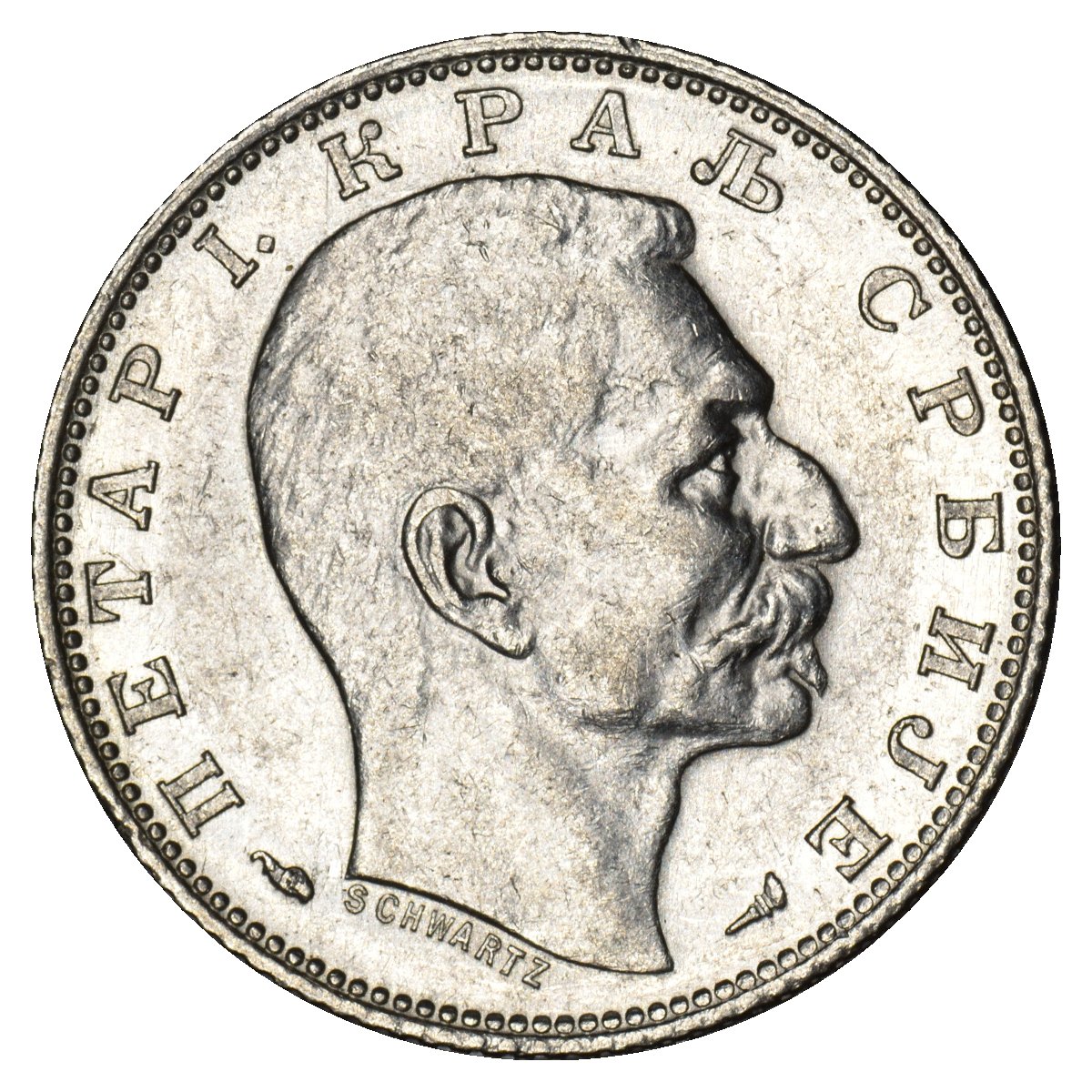
Peter I — right-facing bust
SCHWARTZ below (on KM#25.1/25.3)
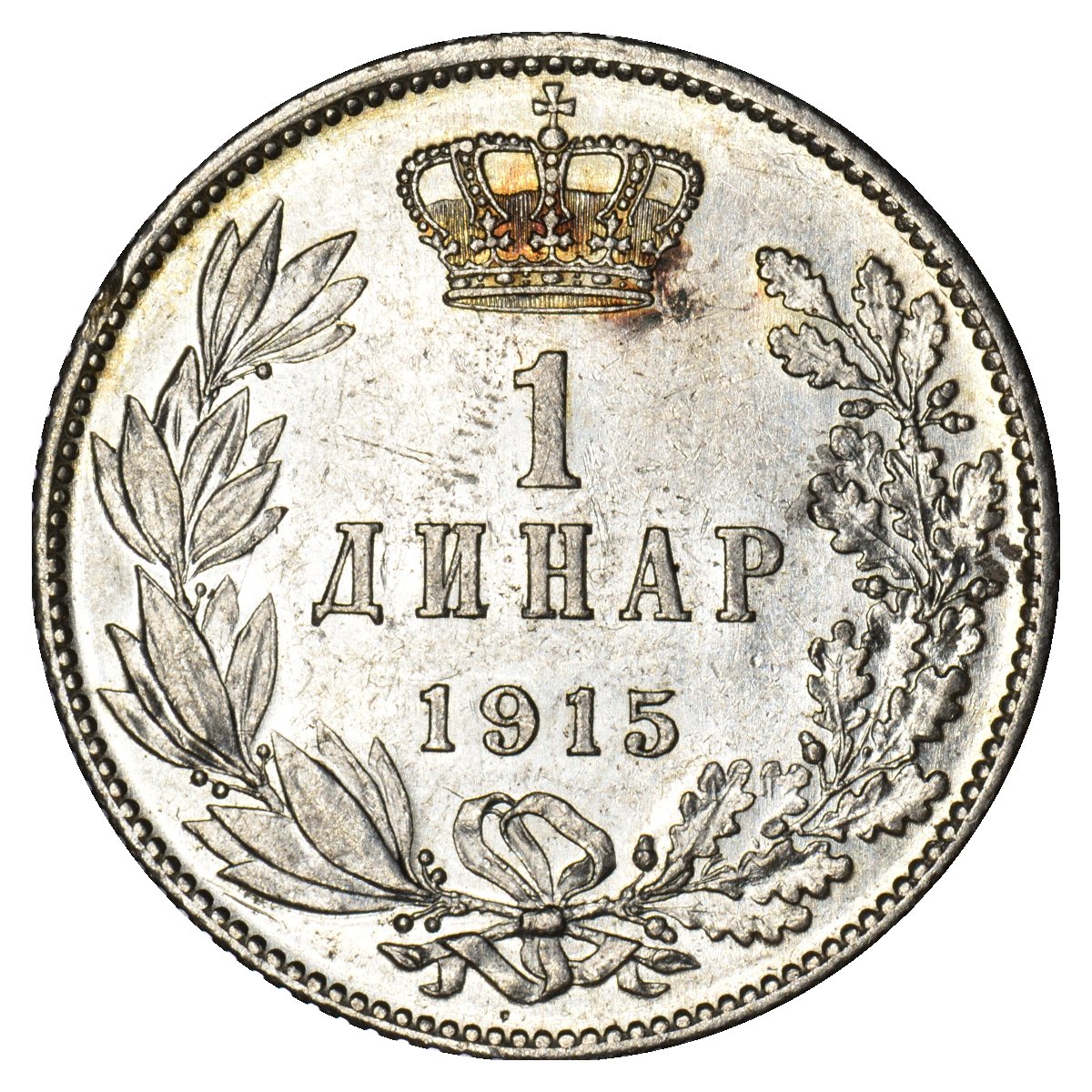
Value within wreath
1 · DINAR · 1915
Denomination
1 Dinar
Country
Kingdom of Serbia
Year
1915
Monarch
Peter I Karađorđević
Catalogue
KM# 25.1–25.4
Metal
Silver .835 fine
Diameter
23 mm
Weight
5.0 g
Edge
Smooth (plain)
ASW
0.1342 troy oz
Mint
Paris — Monnaie de Paris (a)
Varieties
4 (see below)
The Four 1915 Die Varieties — KM# 25 Series
KM# 25.1
With designer's name (SCHWARTZ below bust) · Medal alignment (↑↑) · Applies to 1904–1915 type · Most common variety
KM# 25.2
Without designer's name · Medal alignment (↑↑) · 1915 only · Uncommon
KM# 25.3
With designer's name (SCHWARTZ) · Coin alignment (↑↓) · 1915 only · Scarce — noted by Baldwin's as "a scarce variety"
KM# 25.4
Without designer's name · Coin alignment (↑↓) · 1915 only · Scarce · Also listed as KM# 25.4 (some sources vary)
Note: Krause catalogue entries for this series contain errors; Numista notes that "various sources state" corrections to the alignment and name combinations. All four varieties carry the Paris Mint privy mark (a) on the reverse. The die alignment is checked by holding the coin with the obverse portrait upright and rotating to the reverse: medal alignment (↑↑) has the reverse text also rightway-up; coin alignment (↑↓) has it inverted.
History & Context
Design
Varieties
Mint & Production
Valuation
Collecting Notes
| Section | Topic | Notes | ||||||||||||||||||||||||||||||||||||
|---|---|---|---|---|---|---|---|---|---|---|---|---|---|---|---|---|---|---|---|---|---|---|---|---|---|---|---|---|---|---|---|---|---|---|---|---|---|---|
| History & Context | ||||||||||||||||||||||||||||||||||||||
| History | Serbia in the First World War |
The First World War began, in a direct sense, with Serbia. Austria-Hungary's declaration of war against the Kingdom of Serbia on 28 July 1914 — in response to the assassination of Archduke Franz Ferdinand in Sarajevo on 28 June — was the trigger that activated the European alliance system and plunged the continent into four years of catastrophic conflict. Serbia, a small nation of some 4.5 million people, found itself fighting the Austro-Hungarian Empire from the very first day, then later Germany and Bulgaria as well. The irony of the 1915 Serbian dinar and the 1916 Austrian 1 Corona sharing the same silver standard (835/1000), the same weight (5g), the same diameter (23mm), and the same engraver (Stephan Schwartz) is striking: enemies, but numismatic twins. | ||||||||||||||||||||||||||||||||||||
| History | The Great Retreat, November 1915 |
In October 1915, the combined forces of Germany, Austria-Hungary, and Bulgaria launched a coordinated invasion of Serbia on three fronts simultaneously. Vastly outnumbered and outgunned, the Serbian Army — with King Peter I, aged 71, among its ranks and refusing to abandon his men — made the decision not to surrender but to retreat. Rather than capitulate, the government, the army, and over 400,000 civilian refugees undertook a harrowing mid-winter march through the Albanian highlands — the "Prokletije" (Accursed Mountains) — to the Adriatic coast. Peter I famously picked up a rifle in 1915 and fired at enemy soldiers during a visit to the trenches. At 71, in failing health, he was the supreme commander of an army in existential crisis. He was carried on a litter through much of the Albanian retreat. | ||||||||||||||||||||||||||||||||||||
| History | The Toll of the Retreat |
The retreat across the Albanian mountains in the winter of 1915–1916 was one of the most devastating military and civilian catastrophes of the war. Of approximately 400,000 people who set out, an estimated 77,455 soldiers, 47,000 Austro-Hungarian prisoners of war, and 160,000 civilians died of cold, starvation, disease, and enemy raids. Just 130,000 soldiers and 60,000 civilian refugees reached the Adriatic coast alive. Austrian pilots used the new technology of aerial warfare to drop bombs on the retreating columns — described as the first aerial bombardment of civilians in history. The survivors were evacuated by Allied ships — primarily French — to the Greek island of Corfu, which became the seat of the Serbian government-in-exile. Vido island, off Corfu, where thousands of survivors died from illness and exhaustion upon arrival, became known to Serbs as the "Island of Death" and is a place of national commemoration. | ||||||||||||||||||||||||||||||||||||
| History | A Coin Struck in Wartime Exile |
The 1915 1 Dinar was struck at the Paris Mint — not in Belgrade, not in Serbia, not even at a point when Serbia still controlled its own territory in any meaningful sense. The order for the coins was placed in Paris because the Paris Mint (Monnaie de Paris) had been Serbia's preferred foreign mint since the 1870s, and because France was Serbia's principal ally. Coins struck to supply a nation whose capital and territory were under enemy occupation and whose army was in the process of the Great Retreat represent one of the most dramatically contextualised issues in 20th-century European numismatics. Parallel: Austria was simultaneously striking its own 1 Corona (KM#2820) in Vienna, under the same Stephan Schwartz portrait, for the same silver standard — the coin of the enemy. The 1915 Serbian dinar and the 1916 Austrian 1 Corona are thus inverse mirrors of the same war. | ||||||||||||||||||||||||||||||||||||
| History | Peter I Karađorđević |
Peter I (1844–1921) was the founder of the Karađorđević royal dynasty that continues in the line of the current Crown Prince of Serbia. Born in Belgrade, exiled as a child with his father in 1858, educated at the École spéciale militaire de Saint-Cyr in Paris, he had fought as a volunteer in the Franco-Prussian War of 1870–71 under the alias "Pierre Mrkonjić," and participated in the Herzegovina Uprising against the Ottomans in 1875–77. He came to the throne of Serbia in 1903 following the assassination of King Alexander Obrenović in a military coup. He was known for his constitutional, libertarian approach to government and was deeply respected by his army. Peter I survived the war and the Great Retreat and became the first King of the newly proclaimed Kingdom of Serbs, Croats and Slovenes (later Yugoslavia) in December 1918. He died in 1921, aged 76. | ||||||||||||||||||||||||||||||||||||
| Design | ||||||||||||||||||||||||||||||||||||||
| Design | Obverse | The right-facing head of King Peter I. The portrait is by Stephan Schwartz (1851–1924) — the same Vienna Mint engraver whose portrait of Franz Joseph appeared on the Austrian 1 Corona and 2 Corona of the same period. Schwartz signed his work on the truncation of the Serbian coins as well, and the presence or absence of this signature — SCHWARTZ — is the primary distinguishing feature between the four die varieties of 1915. The legend reads ПЕТАР I КРАЉ СРБА, ХРВАТА И СЛОВЕНАЦА (Peter I, King of Serbs, Croats and Slovenes) — or, on the coins dated to the pre-1918 type, simply ПЕТАР I КРАЉ СРБИЈЕ (Peter I, King of Serbia). The remarkable fact that the same engraver (Schwartz) designed both the Habsburg Franz Joseph portrait used on Austrian coinage and the Serbian King Peter I portrait is a numismatic accident of history — a function of the Vienna Mint's pre-eminence in Central European medallic art and the fact that the Serbian Mint had used Vienna-trained artists since the 1870s. | ||||||||||||||||||||||||||||||||||||
| Design | Reverse | The value 1 centred in the field, within a laurel and oak wreath, with ДИНА·Р (Dinar) above the value and 1915 below. The wreath is tied with a ribbon at the base. The Paris Mint privy mark (a) — the cornucopia and fasces, or in the 1915 period, the torch mark of the mint director — appears on the reverse field. This privy mark is the definitive confirmation of Paris origin and distinguishes these coins from any forgeries or later issues. The Paris Mint used changing "differents" (privy marks of the mint director) in addition to the standing mint mark. For the 1915 series, the relevant privy mark is the torch of Edmond-Émile Bazor. These marks appear in the reverse field near the wreath. | ||||||||||||||||||||||||||||||||||||
| Design | Physical Character | At 23 mm and 5.0 g the 1 Dinar is identical in size and weight to the Austrian 1 Corona and the French 1 Franc of the Latin Monetary Union — by design, since Serbia had adopted the Latin Union silver standard. The plain (smooth) edge is standard across the series. The portrait has a more vigorous, martial quality than the elderly Franz Joseph it superficially resembles — Schwartz's rendering of Peter I captures a king who had spent years as a soldier before ascending the throne. On uncirculated examples, the fields are lustrous and the portrait shows crisp detail in the King's beard, ear, and collar. | ||||||||||||||||||||||||||||||||||||
| The Four 1915 Die Varieties in Detail | ||||||||||||||||||||||||||||||||||||||
| Variety | How to Identify Your Variety |
All four varieties of the 1915 1 Dinar share the same obverse and reverse design; they differ in two attributes: (1) whether the word SCHWARTZ appears beneath the truncation of the bust, and (2) the die alignment — medal (↑↑) or coin (↑↓). Identifying your variety requires only a loupe and a steady hand: Step 1: Hold the coin with the obverse portrait upright and legible. Step 2: Rotate the coin 180° around its vertical axis to show the reverse. Medal alignment (↑↑): the reverse legend is now rightway-up. Coin alignment (↑↓): the reverse legend is now upside-down. Step 3: Examine the obverse truncation under a loupe. The word SCHWARTZ — if present — appears in very small lettering at the base of the portrait. | ||||||||||||||||||||||||||||||||||||
| Variety | KM# 25.1 With name / Medal ↑↑ |
The standard pre-war type, continued into 1915. SCHWARTZ visible below truncation; medal alignment. This is the most common variety across the full 1904–1915 date range and is the base type for valuation purposes. Most raw 1915 dinars encountered on the market are KM#25.1 unless otherwise identified. Baldwin's description of a 1915(a) example of KM#25.4 (coin alignment, without name) as "a scarce variety" implies that KM#25.1 is the standard — i.e., it is the variety dealers assume unless specified. | ||||||||||||||||||||||||||||||||||||
| Variety | KM# 25.2 Without name / Medal ↑↑ |
Medal alignment with the Schwartz signature omitted. 1915 only. Uncommon. The absence of the designer's name may reflect a change of dies at the Paris Mint during the production run — the Mint's own priorities in wartime meant that Serbian coin production was squeezed into available press time alongside French military and civilian coinage needs. | ||||||||||||||||||||||||||||||||||||
| Variety | KM# 25.3 With name / Coin ↑↓ |
Coin alignment (↑↓) with SCHWARTZ signature present. 1915 only. Scarce. Baldwin's Auctions describes this variant explicitly as "a scarce variety" in their listing, with an example in good VF offered as a collectible piece beyond type-set level. The coin alignment is unusual for this series and its occurrence in 1915 only is consistent with a die change at the Paris Mint. RP Coins (UK) lists a KM#25.1 example as "coin alignment, light even wear" at VF+ — note that some dealers conflate the alignment varieties; verify your example's alignment before pricing. | ||||||||||||||||||||||||||||||||||||
| Variety | KM# 25.4 Without name / Coin ↑↓ |
Coin alignment (↑↓) without SCHWARTZ signature. 1915 only. Scarce. The least common combination and the most sought-after by variety collectors. A PCGS MS-65 example has been offered by Caesar's Ghost Numismatics, confirming that certified high-grade pieces exist. An eBay seller described this variety specifically as "RARE" in capital letters, though this should be treated with the usual caution regarding seller claims. Krause catalogue entries for the 1915 series contain admitted errors regarding which varieties exist and their alignment/name combinations. Always cross-reference Numista (entry #19683) and consult Baldwin's, coinshome.net, and hobbyray.com for verified attribution. | ||||||||||||||||||||||||||||||||||||
| Mint & Production | ||||||||||||||||||||||||||||||||||||||
| Mint | Paris Mint — Monnaie de Paris |
The 1915 1 Dinar was struck at the Monnaie de Paris, Paris, France — confirmed by the Paris Mint's distinctive privy mark (a) on the reverse. The Paris Mint had been Serbia's principal foreign mint since 1875, when the first modern Serbian silver coinage was struck there. The relationship between the Serbian royal government and the Paris Mint was one of the most durable in Balkan numismatic history, surviving wars, occupations, and the Great Retreat itself. The Paris Mint's "(a)" privy mark is a combination of symbols that changed with successive mint directors. For 1915, the relevant mark is that of Edmond-Émile Bazor. The presence of this mark on the reverse is the primary authentication identifier and confirms the coin was struck under French mint authority, not forged or privately produced. | ||||||||||||||||||||||||||||||||||||
| Mint | The Engraver: Stephan Schwartz |
The portrait was designed by Stephan Schwartz (1851–1924) of the Vienna Mint — the same engraver whose portrait of Franz Joseph I appeared on the Austrian 1 and 2 Corona simultaneously. The Serbian royal government had commissioned Schwartz's portrait of Peter I for the original 1904 reform coinage, and it continued in use — with and without his signature, as the variety system shows — until the end of the kingdom's silver coinage. The fact that Schwartz worked for both the Austrian Mint and the Serbian Mint, producing portraits of rulers who were at war with each other, is one of the more extraordinary coincidences in 20th-century numismatic history. | ||||||||||||||||||||||||||||||||||||
| Mint | The Latin Monetary Union |
Serbia had participated in the Latin Monetary Union since 1875, adopting the 5.0 g / 835/1000 silver standard for the 1 Dinar — exactly matching the French 1 Franc, the Austrian 1 Corona, and the Italian 1 Lira. This meant that Serbian dinars could circulate throughout the Union at face value. The Paris Mint's production of Serbian coinage was therefore both a practical arrangement (France was Serbia's ally) and a monetary one (French and Serbian silver was interchangeable at the same standard). | ||||||||||||||||||||||||||||||||||||
| Valuation | ||||||||||||||||||||||||||||||||||||||
| Value | Market Overview | The 1915 1 Dinar is one of the more historically resonant small silver coins of the First World War — struck for a nation in the middle of its most catastrophic military ordeal, by a Paris Mint acting as banker to a government in exile. Collector demand is driven by both WWI thematic collectors and Balkan/Serbian specialist collectors. The standard variety (KM#25.1) is modestly priced in circulated grades; the coin-alignment variants (25.3/25.4) command meaningful premiums; and certified MS examples of all varieties are scarce and sought-after. Market references: Baldwin's GVF example of KM#25.4 (coin alignment, without name) offered as "a scarce variety." NGC MS-62 of a 1915 dinar at $57 (allnumis.com). PCGS MS-65 of the 50 Para 1915 coin-alignment with Schwartz at $139 (eBay, 2025) — used as an analogous benchmark. The 1 Dinar in equivalent grade commands comparable or slightly higher premiums than the 50 Para. | ||||||||||||||||||||||||||||||||||||
| Value | Price Guide — KM#25.1 (standard) (approx. 2025–26) |
|
||||||||||||||||||||||||||||||||||||
| Value | Variety Premiums |
|
||||||||||||||||||||||||||||||||||||
| Collecting Notes | ||||||||||||||||||||||||||||||||||||||
| Collect | Variety Attribution First |
Before assessing grade or value, establish which of the four varieties you have. Examine: (1) the truncation of the bust for SCHWARTZ; (2) the die alignment by the rotation test. Once attributed, consult the variety-specific premium table above. An unattributed 1915 dinar in EF condition is worth $20–45; the same coin correctly identified as KM#25.3 in EF is worth $30–70. The alignment test takes thirty seconds. | ||||||||||||||||||||||||||||||||||||
| Collect | What to Look For | Key grading points: (1) Peter I's beard and whiskers — the most detailed areas of the portrait; individual hairs define EF from VF. (2) The laurel wreath on the reverse — individual berries and leaf-tip definition at EF and above. (3) The Paris Mint privy mark — should be legible under a loupe on all grades above F; its presence is an authentication marker. (4) The SCHWARTZ signature (KM#25.1/25.3 only) — small but sharp on EF examples; slightly soft on VF; barely traceable on F. | ||||||||||||||||||||||||||||||||||||
| Collect | Problems to Avoid | Common problems: (1) Cleaning — silver dipping or mechanical cleaning is widespread in Balkan coins; check for directional hairlines or over-bright surfaces. (2) Variety misattribution — many eBay and general dealers list all 1915 dinars as "KM#25" or "KM#25.1" without checking the alignment or signature; buyer verification is essential. (3) Counterfeit concerns — the 1915 series has been reproduced; check the Paris Mint privy mark carefully. Genuine examples have crisp, well-defined privy marks; forgeries often show blurred or incorrect mark forms. (4) False "rarities" — some sellers mark coin-alignment variants as "RARE" and price accordingly; they are genuinely scarcer than the medal-alignment type but not rare at circulated grades. | ||||||||||||||||||||||||||||||||||||
| Collect | Collection Contexts | The 1915 Serbia 1 Dinar fits naturally into: a Balkan silver collection (Serbia, Montenegro, Bulgaria, Romania — all Latin Union members); a World War I combatant coinage thematic set (Serbian, Austrian, German, French, British — all 1914–1918 silver); a Paris Mint foreign coinage collection; a Peter I Karađorđević type set (1904–1918, all denominations); or an all-four-varieties specialist set of the 1915 issue specifically. The historical backstory — coins struck for a nation retreating through the Albanian mountains — gives this modest silver piece an extraordinary narrative weight for any WWI collector. | ||||||||||||||||||||||||||||||||||||
| Collect | Related Coins | Companions in the KM#25 series: the 1904–1915 dates of KM#25.1 (the full medal-alignment with-Schwartz run); the 50 Para 1915 (KM#24 series — same four-variety structure, same Paris Mint, same year; PCGS MS-65 at $139); the 2 Dinara 1915 (KM#26 — same varieties, larger coin, 10g / 27mm); the 5 Dinara 1915 (KM#27 — large crown-size silver). For the broader context, the 1916 Austrian 1 Corona (KM#2820) is the enemy coin sharing the same specifications and the same engraver. | ||||||||||||||||||||||||||||||||||||
The 1915 Serbia 1 Dinar is not just a small silver coin. It is a coin struck in Paris for a government whose capital was under enemy occupation, for a king retreating through the Accursed Mountains in winter, for an army that had chosen to fight on rather than surrender. In terms of historical gravity per gram of silver, few coins of the 20th century come close.
Sources: Krause, C. L. & Mishler, C. Standard Catalog of World Coins — KM# 25 series · Numista catalogue entry #19683 — variety notes and corrections to Krause · hobbyray.com / coinshome.net — 1915 KM-25.3 NGC MS-63 description · Baldwin's Auctions — 1915(a) KM#25.4 description ("scarce variety") · Silver Age Coins — variety listing (KM#25.1–25.4) · allnumis.com — NGC MS-62 at $57 · Caesar's Ghost Numismatics — PCGS MS-65 reference (1 Dinar) · eBay completed sales 2023–2026 — circulated grade benchmarks · eBay ngcoins2003 — PCGS MS-65 50 Para 1915 coin alignment with Schwartz at $139 (benchmark) · Wikipedia — Great Retreat (Serbia): casualty figures · 1914-1918-online.net — Peter I Karađorđević biographical entry