May 29, 2026
Russia 20 Kopeks, 1914 Nicholas II — Imperial Russia — St. Petersburg Mint — СПБ ВС
KM# Y-22a.1 · Silver .500 · 22 mm · 3.5 g · Reeded edge · ASW 0.0563 troy oz · Mintage: 52,750,000 · Mint mark: СПБ ВС
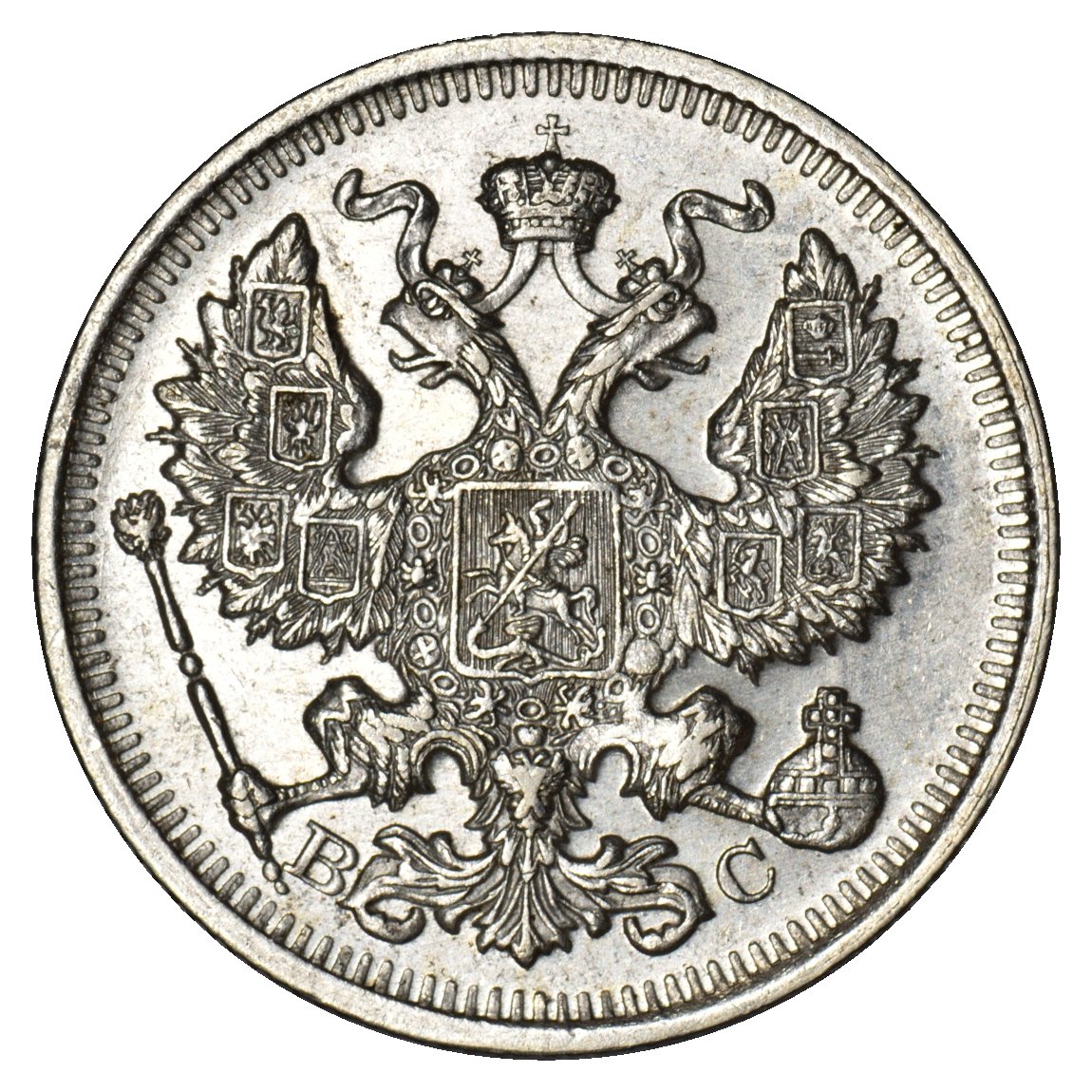
Double-headed imperial eagle
Crowned, ribbons on crown
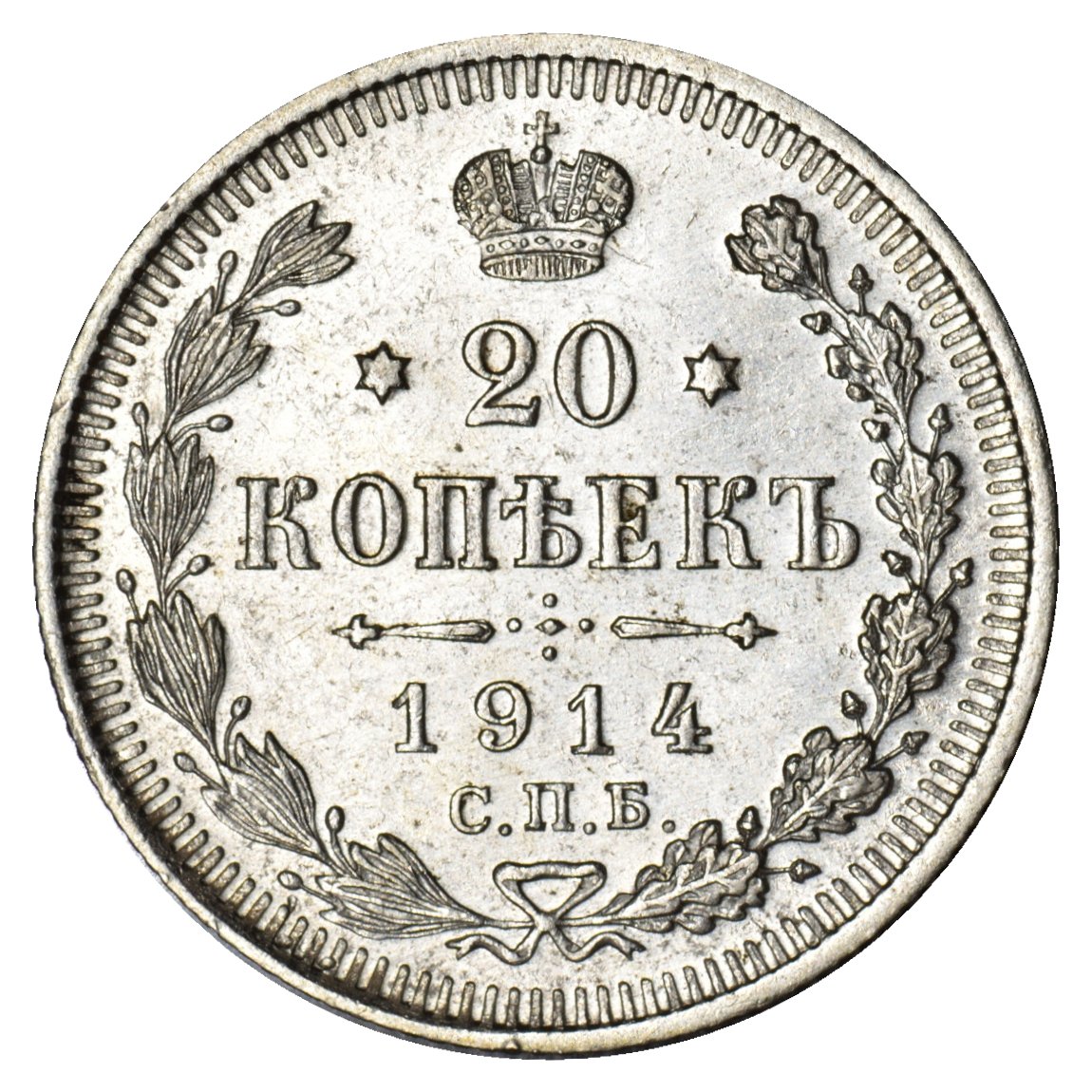
★ 20 ★ КОПѢЕКЪ / 1914
Crown above, wreath around
Mint mark (1914) СПБ Санкт-Петербург — St. Petersburg
Last year this mark was used
Last year this mark was used
Mint master ВС Вениамин Смирнов (Veniamin Smirnov)
Mint master's initials on reverse
Mint master's initials on reverse
City renamed Петроград Petrograd — from 31 August 1914
Coins from 1915 carry no mint mark
Coins from 1915 carry no mint mark
Reverse legend КОПѢЕКЪ Kopeek — in pre-reform Cyrillic orthography using
the yat (ѣ) letter
Denomination 20 Kopeks (Копѣекъ)
Country Russian Empire
Year 1914
Tsar Nicholas II
Catalogue KM# Y-22a.1 (also Y#22a.1)
Metal Silver .500 fine (500 milliemes)
Diameter 22 mm
Weight 3.5 g (nominal)
Edge Reeded
ASW 0.0563 troy oz
Mint St. Petersburg — СПБ
Mintage 52,750,000
| Section | Topic | Notes | |||||||||||||||||||||||||||||||||
|---|---|---|---|---|---|---|---|---|---|---|---|---|---|---|---|---|---|---|---|---|---|---|---|---|---|---|---|---|---|---|---|---|---|---|---|
| History & Context | |||||||||||||||||||||||||||||||||||
| History | Russia in 1914 | The Russian Empire in 1914 was the largest country in the world by land area — spanning eleven time zones from the Baltic to the Pacific, from the Arctic to the borders of Afghanistan and China. Tsar Nicholas II ruled over some 170 million subjects: Russians, Ukrainians, Poles, Finns, Georgians, Armenians, Jews, Tatars, and dozens of other nationalities. The Empire was in a period of rapid industrialisation and significant social tension — revolutionary movements, peasant unrest, labour strikes, and the legacy of the humiliating defeat in the Russo-Japanese War of 1904–05 all creating fault lines beneath the imperial surface. On 28 June 1914 — just weeks after these coins were struck — Archduke Franz Ferdinand was assassinated in Sarajevo. By 1 August, Germany had declared war on Russia. The 1914 20 kopek was struck literally at the moment the world changed. | |||||||||||||||||||||||||||||||||
| History | St. Petersburg Renamed Petrograd |
On 31 August 1914 — just weeks after Russia entered the war — Tsar Nicholas II issued a decree renaming Sankt Peterburg (Saint Petersburg) to Petrograd (Петроград). The reason was anti-German sentiment: "Sankt Peterburg" sounded German (from the Dutch/German "Sankt Peter Berg" — St Peter's Mountain). Replacing it with the purely Slavic "Petrograd" (Peter's City) was a nationalist gesture fitting the war's opening weeks. The practical consequence for numismatists: the St. Petersburg Mint's mark СПБ disappeared from coins after 1914. All coins struck from 1915 onward carry no mint mark, or the new Petrograd mark. Caesar's Ghost Numismatics describes their NGC MS-65 1914 СПБ ВС as: "Last date with St. Petersburg mint mark with the start of World War I" — precisely capturing the coin's historical significance. The city would be renamed again: to Leningrad in 1924, then back to St. Petersburg in 1991. | |||||||||||||||||||||||||||||||||
| History | Nicholas II & the Last Tsar |
Nicholas II (1868–1918) was the last Emperor of Russia, reigning from 1894 until his forced abdication on 15 March 1917. His reign was marked by military disasters (Russo-Japanese War 1904–05, WWI 1914–17), revolutionary upheaval (1905 Revolution, the Duma system, Rasputin), and ultimately the February and October Revolutions of 1917 that ended the Romanov dynasty after 304 years. Nicholas, his wife Alexandra, and their five children were executed by Bolshevik forces at Yekaterinburg on 17 July 1918. The coins of Nicholas II from 1914–1917 are thus the last imperial Russian coinage ever struck. The 1914 20 kopek is from the final year before the war that would destroy both the Empire and the Romanov dynasty. No Russian silver coins were issued for general circulation after 1916 — wartime conditions caused the withdrawal and hoarding of all silver. | |||||||||||||||||||||||||||||||||
| History | Silver Hoarding & Gresham's Law |
As soon as Russia entered WWI in August 1914, silver coins began disappearing from circulation across the Empire. Gresham's Law — bad money drives out good — operated immediately: paper rubles were being issued in increasing quantities to fund the war, while people hoarded the silver coins they received. By 1915, the withdrawal of silver from circulation was so complete that the Russian government issued cardboard postage stamps and small paper notes as substitute small change. Russia's wartime silver coins circulated so briefly and in such troubled conditions that high-grade survivors are disproportionately scarce relative to their large mintages. | |||||||||||||||||||||||||||||||||
| Design | |||||||||||||||||||||||||||||||||||
| Design | Obverse | The crowned double-headed imperial eagle of the Romanov dynasty — one of the oldest and most powerful heraldic symbols in Europe, used by Russia since the reign of Ivan III in the 15th century. The two heads face left and right simultaneously, traditionally interpreted as representing the Empire's dual gaze toward East and West. The crown above (the Imperial Crown of Russia) is elaborate; ribbons hang from the crown on either side. The eagle occupies the entire obverse field; no legend appears on the obverse of the 20 kopek. The double-headed eagle design on Russian 20 kopeks was largely unchanged across multiple reigns — Alexander II, Alexander III, Nicholas II all used essentially the same composition. The consistency reflects the heraldic function of the device: it is the symbol of empire, not of a specific monarch. The same eagle still appears on the Russian Federation's coat of arms today. | |||||||||||||||||||||||||||||||||
| Design | Reverse | The reverse carries an ornate crown above; below it, the denomination in two forms: ★ 20 ★ (the numeral, flanked by decorative stars) and below that КОПѢЕКЪ (Kopeek — in the pre-reform Cyrillic orthography that used the yat letter ѣ, abolished in the 1918 spelling reform). Below the denomination: the year 1914. All enclosed within a laurel wreath. At the base of the reverse, outside the wreath: the mint master's initials ВС (Veniamin Smirnov). On coins with the СПБ mint mark, the mark С.П.Б. appears. The pre-reform spelling КОПѢЕКЪ (with the yat ѣ and the hard sign ъ at the end) is a key identifier for pre-1918 Russian coins. The orthography reform of 1918 replaced ѣ with е and dropped the final ъ from words. Post-reform coins read КОПЕЕК or similar. The spelling on this coin thus places it definitively in the pre-revolutionary era. | |||||||||||||||||||||||||||||||||
| Design | .500 Silver — The Russian Standard |
Russian 20 kopeks used .500 fine silver (500 milliemes, or 50% silver / 50% copper alloy) — significantly lower fineness than the French, Austrian, and Serbian coins in this series (all at .835). The lower fineness was the Russian standard for small silver denominations since the 1860 monetary reform. The result is a coin that is heavier and whiter-looking than its silver content would suggest, and that ages with less spectacular toning than .835 silver — the lower silver content means less rich colour development. The ASW of 0.0563 troy oz (about ¼ of the Austrian 1 Corona) gives a bullion floor of approximately $1.86 at May 2026 silver prices. | |||||||||||||||||||||||||||||||||
| The Series & Mint Marks — KM#22a | |||||||||||||||||||||||||||||||||||
| Series | The Nicholas II 20 Kopek Series |
The KM#22a series of 20 kopeks runs from 1901 to 1917. Within this series, mint marks (indicating the city and mint master) appear on most dates through
1914 and then disappear or change as the city was renamed and wartime conditions disrupted normal mint mark protocols.
|
|||||||||||||||||||||||||||||||||
| Series | Why the 1914 СПБ is Special |
The 1914 СПБ ВС issue holds a unique place in Russian numismatics as the last coin struck at what was still officially called the St. Petersburg Mint. After 31 August 1914, no new coins were officially minted under the СПБ designation — all subsequent issues carried the Petrograd attribution without the city mark. The 1914 СПБ ВС coins were struck in the first months of WWI, at the very moment Russia entered the war and while the city was still named after Peter the Great's Dutch-inflected founding. They represent the end of an era literally encoded in their mint mark. | |||||||||||||||||||||||||||||||||
| Mint & Production | |||||||||||||||||||||||||||||||||||
| Mint | St. Petersburg Mint (Санкт-Петербургский монетный двор) |
The St. Petersburg Mint (established 1724 by Peter the Great) was the principal mint of the Russian Empire throughout its history. Located on Zayachy Island in the Peter and Paul Fortress in St. Petersburg, it struck virtually all standard circulation coinage for the Empire. The mint was renamed the Petrograd Mint in 1914, then the Leningrad Mint in 1924, and operates today as the Saint Petersburg Mint. It is one of the largest and oldest functioning mints in the world. The mint mark СПБ (Санкт-Петербург) had appeared on Russian coins since the reign of Peter II (1727) — nearly 200 years before it was replaced by the Petrograd mark in 1914. The 1914 20 kopeks are among the very last coins to carry this venerable mark. | |||||||||||||||||||||||||||||||||
| Mint | Mint Master ВС: Veniamin Smirnov |
The initials ВС on the reverse stand for Вениамин Смирнов (Veniamin Smirnov), who served as mint master at the St. Petersburg Mint from 1911 to 1917. His initials appear on all coins of this period, including the 1914 issue. In Russian numismatics, the mint master's initials are an important cataloguing attribute — different mint masters are associated with different KM sub-types and are used to date die state changes within a year's production. | |||||||||||||||||||||||||||||||||
| Mint | Mintage in Context |
The 1914 mintage of 52,750,000 pieces is large in absolute terms, but modest compared to 1915 (105,500,000) and represents normal pre-war demand. Of the 52+ million pieces struck, a substantial proportion entered circulation immediately and was hoarded within weeks as war fever gripped the Empire. The population ratio of survivors in high grade — MS-63 and above — is therefore lower than the raw mintage suggests: the wartime hoarding removed coins from circulation quickly but did not necessarily preserve them in high-grade condition. | |||||||||||||||||||||||||||||||||
| Valuation | |||||||||||||||||||||||||||||||||||
| Value | Market Overview | The 1914 20 kopek is a highly collected coin with an active market across all grades. The last-СПБ-mint-mark status adds collector interest beyond what the large mintage would otherwise suggest. Average market price for the regular strike is approximately $60 USD across all grades (coinstrail.com, January 2026 data). In MS grades, values rise sharply — the NGC MS-67 Stack's Bowers example was estimated at $100–150; MS-67 and above examples have realised $500–6,000 depending on grade, with the record of $6,000 achieved at Heritage Auctions in January 2022 for an exceptional top-pop example. The proof strike (PF) versions average $1,600 (coinstrail.com) and are entirely separate collector items. This article addresses only the regular business strike. | |||||||||||||||||||||||||||||||||
| Value | Price Guide (approximate, 2025–26) |
|
|||||||||||||||||||||||||||||||||
| Value | PCGS/NGC Population Data |
The coinstrail.com census data (January 2026) reveals the NGC/PCGS population for the 1914 СПБ ВС: MS-67: 76 coins · MS-66: 111 coins · MS-65: 106 coins · MS-64: 61 coins · MS-63: 30 coins · MS-62: 11 coins · MS-68: 3 coins. The relatively large MS-65/66/67 population reflects both the large original mintage (52.75 million) and the tendency of early-hoarded coins to survive in high grade. The record MS-68+ population of just 3 coins explains the dramatic $6,000 auction record at that level. | |||||||||||||||||||||||||||||||||
| Collecting Notes | |||||||||||||||||||||||||||||||||||
| Collect | Confirming the Mint Mark |
The single most important identification step for a 1914 20 kopek is confirming the mint mark. Examine the reverse field below the wreath: the letters С.П.Б. (or СПБ) followed by ВС should be clearly visible on EF and better examples. The presence of СПБ confirms: (1) the coin was struck at the St. Petersburg Mint; (2) it predates the city's renaming on 31 August 1914. Without the СПБ mark, the coin would be a 1915+ Petrograd issue (KM#22a.2), which is a more abundant date and commands lower premiums. | |||||||||||||||||||||||||||||||||
| Collect | Reading the Pre-Reform Cyrillic |
The reverse legend uses pre-1918 Russian orthography. The word КОПѢЕКЪ contains two abolished letters: ѣ (yat) — now replaced by е — and the final ъ (hard sign) which is no longer written at the end of words. These features, visible under a loupe, confirm the coin's pre-revolutionary origin. A post-1917 forgery or a later Soviet issue would use the modern spelling КОПЕЕК without the yat. The pre-reform spelling is an authentication marker as much as an orthographic curiosity. | |||||||||||||||||||||||||||||||||
| Collect | What to Look For | Grading points: (1) Eagle feathers — the primary and secondary feathers of both wings; individual feathers should be distinct at EF and above. (2) Crown above reverse — the Imperial Crown's elaborate arched band and orb; finest detail on the reverse. (3) Mint mark СПБ ВС — sharp and legible at EF. (4) Original lustre — .500 silver develops a distinctive glow; genuine uncirculated examples have a bright, flowing lustre; cleaned pieces show flat or hairlined fields. (5) Prooflike fields — many early-die-state examples exhibit semi-prooflike fields (reflective background against frosted devices), noted in the Stack's description as "lustrous surfaces and frosty devices." | |||||||||||||||||||||||||||||||||
| Collect | Problems to Avoid | Common issues: (1) Cleaning/dipping — Russian silver is frequently cleaned; check for cartwheel lustre vs flat brightness. (2) Counterfeits — the 20 kopek series has been copied; verify mint mark letter spacing and the pre-reform Cyrillic under magnification; genuine dies produce sharp, consistent letter forms. (3) 1915 misattribution — the 1915 coin (without СПБ mark, much larger mintage, lower premium) is sometimes offered as equivalent to the 1914; confirm the year and the presence of СПБ. (4) Harshly cleaned — NGC and PCGS will grade these as "Details"; avoid unless the price is very low and condition otherwise acceptable. | |||||||||||||||||||||||||||||||||
| Collect | Collection Contexts | The 1914 20 kopek fits naturally into: a complete Nicholas II 20 kopek date/mint mark run (1901–1917, all sub-types); a Russian Imperial silver type set; a last-year-of-mint-mark collection (comparable to the 1916 Austrian 1 Corona and 1901 Ceylon quarter cent in this series); a WWI coinage set showing the final pre-war issue of the Russian Empire; or as part of a broader Eastern European silver 1914 collection alongside the Austrian and Serbian issues examined in this series. | |||||||||||||||||||||||||||||||||
| Collect | Related Coins | Natural companions: KM#22a.2 (1915) — first Petrograd issue, no city mark, mintage 105,500,000; 1914 15 kopeks and 10 kopeks — same СПБ ВС last-year status applies to the entire 1914 Nicholas II silver series; 1913 Romanov Tercentenary commemorative 20 kopeks — struck the previous year to mark 300 years of Romanov rule; 1916 and 1917 20 kopeks — increasingly rare as silver hoarding intensified; the Soviet-era 20 kopeks that replaced them from 1921 onward, using a radically different design and iconography. | |||||||||||||||||||||||||||||||||
In 1914 a Russian 20 kopek coin bore the mark СПБ — Sankt Peterburg — the city that Peter the Great had built on a swamp to drag Russia
toward Europe. Within months, the Tsar had renamed it Petrograd, and the Empire that had struck these coins was at war. Three years later, Nicholas II would abdicate.
Four years later, he would be dead. The СПБ mark on the 1914 20 kopek is a small piece of Cyrillic script that marks the end of an age.
Sources: Krause, C. L. & Mishler, C. Standard Catalog of World Coins — KM#Y-22a.1 · coinstrail.com — average price $60, record $6,000 (Heritage lot 34334, Jan 2022); NGC/PCGS population census (Jan 2026) · Numiscorner.com — mintage 52,750,000; diameter 22mm; fineness .500; KM#22a.1 · Stack's Bowers / lot-art.com — NGC MS-67 СПБ ВС estimate $100–150 · Caesar's Ghost Numismatics — NGC MS-65 1914 СПБ ВС ("last date with St. Petersburg mint mark") · Golden Eagle Coins — KM#Y-22a.1 XF description · Numista catalogue entry — 20 Kopeks, Nicholas II · Numiscorner — 1915 mintage 105,500,000 (KM#22a.2, no mint mark)