Panama 2½ Centesimos, 1916 Republic of Panama — Copper-Nickel — Three-Year Type — Philadelphia Mint
KM# 7.2 · Copper-Nickel · 21.5 mm · 5.0 g · Plain edge · Series: 1916–1918 only · Struck at Philadelphia US Mint
Panama — The Canal Republic
In 1916 the Panama Canal — one of the greatest engineering achievements in history — had been open for just two years (it opened 15 August 1914). Panama's very existence as a republic was intertwined with the Canal: the United States had supported Panama's separation from Colombia in 1903 precisely to secure the Canal route. The Hay–Bunau-Varilla Treaty of 1903 gave the US perpetual sovereignty over the Canal Zone, making Panama simultaneously an independent republic and a country with a foreign power controlling a strip through its centre. This political context shapes every aspect of Panama's early coinage — including the denomination system, the mint choice, and the coin designs.
National Coat of Arms
REPUBLICA DE PANAMA
2½ Centesimos / 1916
Laurel wreath
| Section | Topic | Notes | ||||||||||||||||||||||||||||||||
|---|---|---|---|---|---|---|---|---|---|---|---|---|---|---|---|---|---|---|---|---|---|---|---|---|---|---|---|---|---|---|---|---|---|---|
| History & Context | ||||||||||||||||||||||||||||||||||
| History | The Republic of Panama, 1916 |
Panama declared independence from Colombia on 3 November 1903 — with the explicit support of the United States, which recognised the new republic within three days. The US motive was direct: Colombia had rejected the Hay–Herrán Treaty that would have given the US rights to build a canal. Once Panama was independent, the Hay–Bunau-Varilla Treaty granted the US sovereignty over a 10-mile-wide Canal Zone "in perpetuity." By 1916 the Canal had been open for two years, and Panama's economy was deeply tied to Canal traffic, US military spending, and the commercial activity generated by the Zone. The Canal Zone was essentially a US territory within Panama from 1903 until the Torrijos–Carter Treaties of 1977, which scheduled its return to Panama on 31 December 1999. For the entire early period of Panamanian independence, the Canal Zone divided the country physically and politically. | ||||||||||||||||||||||||||||||||
| History | Panama's Currency System |
Panama's monetary system was established in 1904 based on the Balboa (= 1 US dollar), with 100 centesimos to the balboa. From the very beginning, Panamanian law made US currency legal tender alongside the balboa — meaning US dollars and Panamanian coins circulated interchangeably. In practice, for most transactions, US dollars were the de facto currency and Panamanian coins filled the small-denomination gaps. Panama has never issued its own paper currency; US dollar bills are the paper money of Panama, and Panamanian coins serve as the coinage. This currency arrangement — Panamanian coins for fractions, US dollars for paper — has continued to the present day. Panama is one of the most fully dollarised economies in the world. The 2½ centesimos coin thus occupied a very specific niche: too small for most US denominations to cover, but essential for daily commerce in a country where the basic unit was the dollar. | ||||||||||||||||||||||||||||||||
| History | The Curious 2½ Denomination |
The 2½ centesimos denomination is unusual and deserves comment. It exists because 2½ centesimos = ¼ of a US dime (10 cents = 10 centesimos). Panama's entire early denomination structure was calibrated to subdivide US coinage conveniently: ½ centesimo, 2½ centesimos, 5 centesimos, 10 centesimos, 25 centesimos, and 50 centesimos all correspond to standard fractional sub-units of US denominations. The 2½ centesimo piece thus served as Panama's equivalent of a US ¼-dime — a denomination that had existed briefly in US history (1796–1873) and whose practical utility in a dollarised economy was real but limited. The 2½ centesimos denomination was eventually abolished. The 1916–1918 copper-nickel type was succeeded by a new smaller copper-nickel type (KM#8, 1929–1940, 18mm, 3.27g) and then by the current 5 centesimos denomination. The unusual fractional denomination makes early Panamanian coinage distinctively interesting to collectors. | ||||||||||||||||||||||||||||||||
| History | The Silver Transition of 1916 |
1916 was a pivotal year for Panamanian coinage because of the silver crisis caused by WWI. Panama's larger denominations (5 centesimos and up) had been struck in silver, but |
||||||||||||||||||||||||||||||||
| Design | ||||||||||||||||||||||||||||||||||
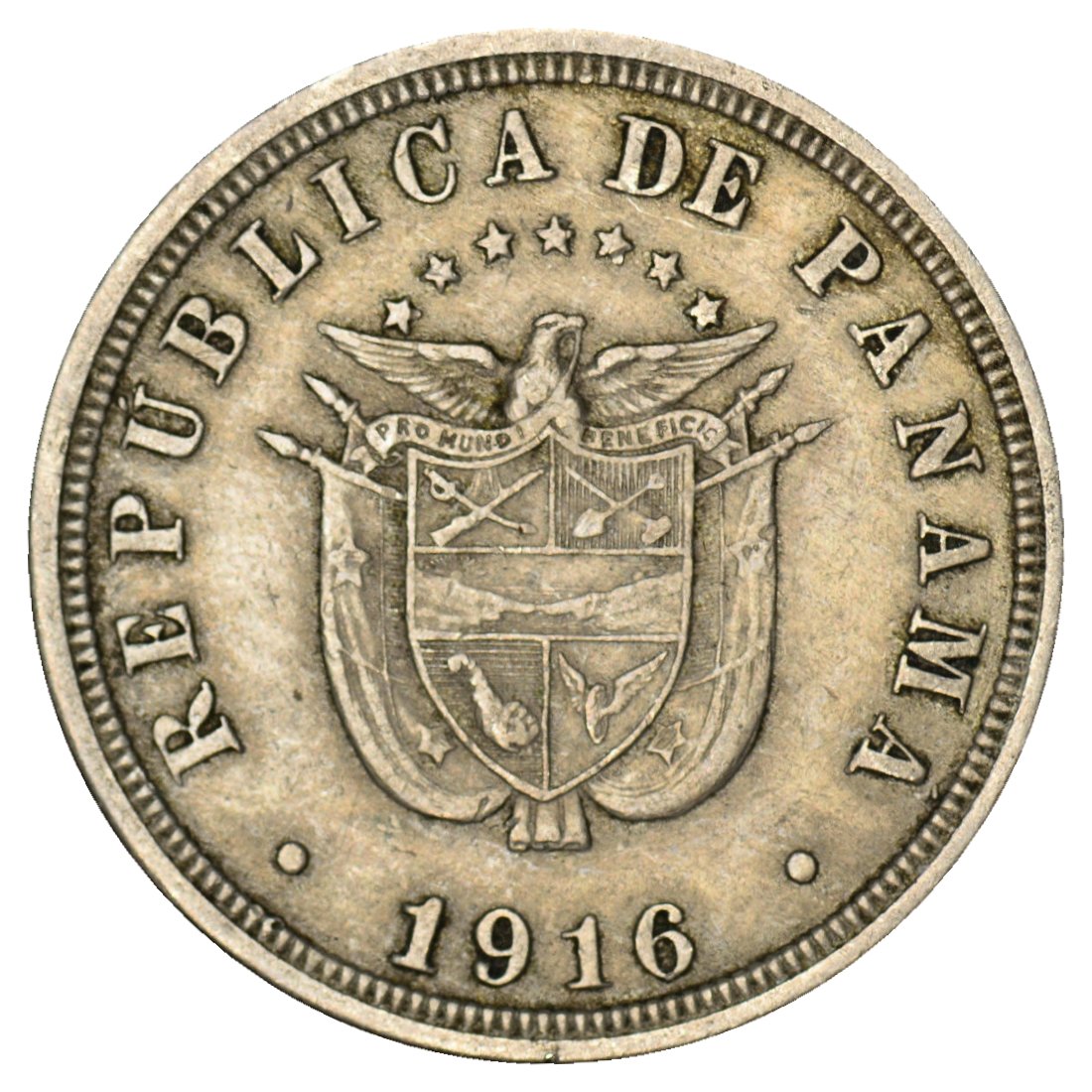
| Design | Obverse | The obverse carries the National Coat of Arms of Panama — a rich heraldic composition introduced with the Republic in 1904. The shield is divided into four quarters: (1) a sword and rifle crossed on a blue field — symbolising the rejection of civil war; (2) a shovel and pick on a gold field — representing labour; (3) a cornucopia on a white field — representing abundance; (4) a winged wheel on a white field — representing progress. Above the shield: an eagle displayed with spread wings, holding a ribbon in its beak inscribed with Panama's motto, PRO MUNDI BENEFICIO (For the Benefit of the World — a direct reference to the Canal). The legend reads REPUBLICA DE PANAMA around the rim. The motto PRO MUNDI BENEFICIO on the coat of arms is one of the most apt national mottos in the world for a country whose defining geographic feature is the canal connecting the world's two great oceans. It appears on this coin's obverse on the ribbon held by the eagle. | ||||||||||||||||||||||||||||||||
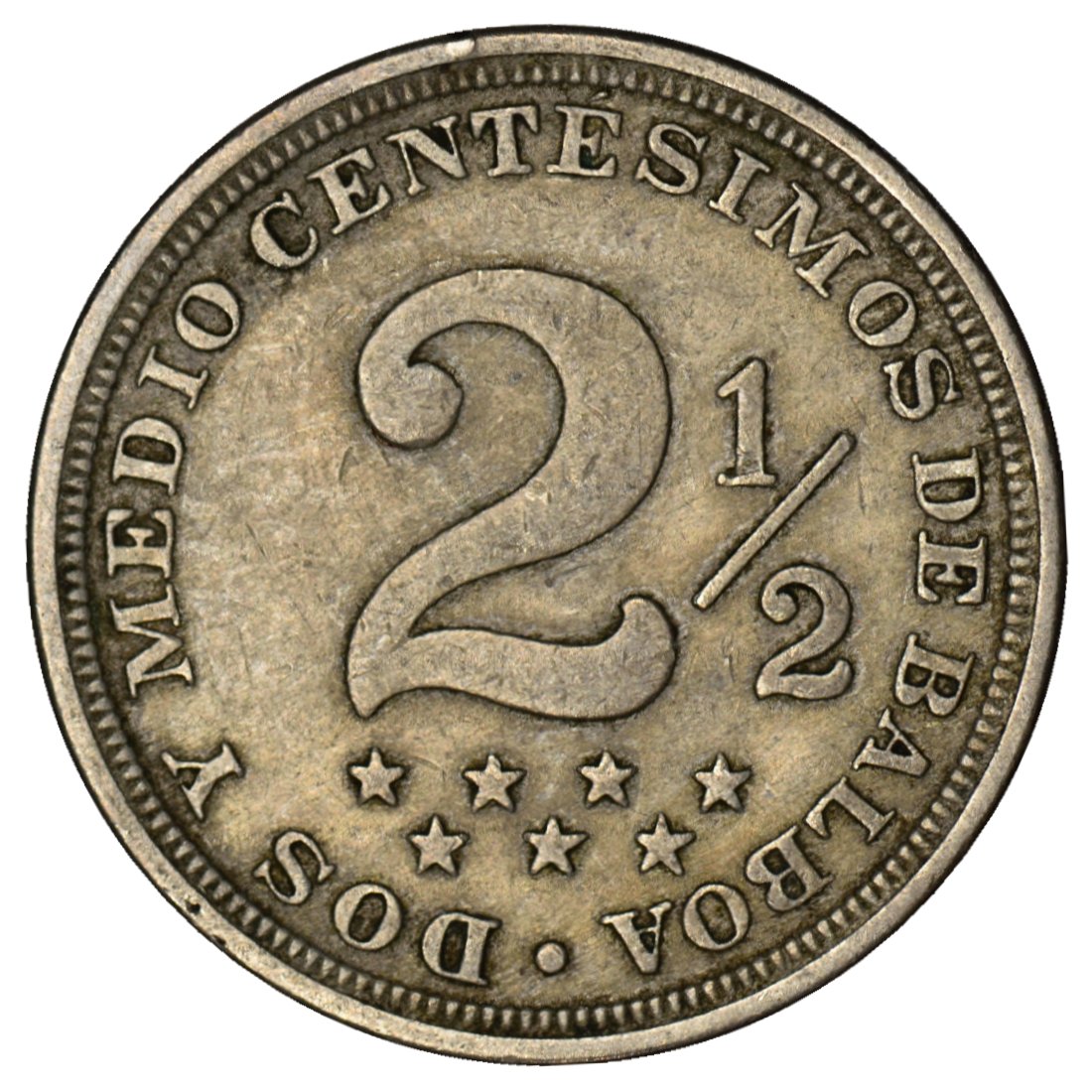
| Design | Reverse | A clean, uncluttered reverse: the denomination 2½ (two and a half) centred in large numerals, above which are the words CENTESIMOS DE BALBOA in a curve, all enclosed within a wreath of laurel. The date 1916 appears below the wreath at the base. The design is simple and functional — there is no elaborate symbolism here, just the information the coin needs to convey: denomination, currency, date. | ||||||||||||||||||||||||||||||||
| Design | KM#7.1 vs KM#7.2 | There are two sub-types of the 2½ centesimos copper-nickel coin: KM#7.1 — the 1907 issue only, with slightly different design elements — and KM#7.2 — the 1916, 1917, and 1918 issues. The Golden Eagle Coins description notes that KM#7.2 is the 1916 type specifically. The design differences between the sub-types are minor (primarily related to letter spacing, device positioning, and finish standards at the Philadelphia Mint) but cataloguers treat them separately. The eBay seller's description for a 1916 example reads "KM-7, 1916 Panama 2½ centesimos; copper-nickel, plain edge; 3 year type" — confirming the plain edge and three-year type designation. Note that some sources list it as KM#7 without the sub-type distinction; KM#7.2 is the correct reference for 1916. | ||||||||||||||||||||||||||||||||
| Design | Physical Character | At 21.5mm and 5.0g, the 1916 2½ centesimos is a medium-sized coin for its denomination — larger and heavier than it might be expected to be, giving it a satisfying hand-feel. The plain edge distinguishes it from milled-edge coins; the copper-nickel composition gives uncirculated examples a pale silver-grey appearance that can be mistaken for silver at first glance. The National Coat of Arms is struck in moderate relief; on well-preserved examples the individual heraldic elements — the sword and rifle, the shovel and pick, the eagle and ribbon — are all distinct. The coin's modest size and plain design make it easy to underestimate; in high grade it is genuinely attractive. | ||||||||||||||||||||||||||||||||
| The KM#7 Series — Complete Listing | ||||||||||||||||||||||||||||||||||
| Series | All Issues of the 2½ Centesimos |
|
||||||||||||||||||||||||||||||||
| Series | Context Within Early Panama Coinage |
The 1916 2½ centesimos sits within a rich context of early Panamanian coinage. The 1904 initial series (KM#1–5) introduced Panama's silver denominations — struck at the Philadelphia Mint in specifications matching or closely related to US denominations. The 1907 copper-nickel issues extended into base metal. The 1916 issues mark the transition period when silver coinage was becoming problematic due to rising wartime metal prices: 1916 Panama companion issues: the silver 5 centesimos (KM#2, 100,000 mintage — the last silver 5 centesimos and the denomination's most dramatic key date); the silver 10 centesimos (last silver issue); and the silver 25 and 50 centesimos (last silver issues). The 1916 marks the end of Panama's silver coinage era. The 2½ centesimos, being copper-nickel from the start, was unaffected by this transition. | ||||||||||||||||||||||||||||||||
| Mint & Production | ||||||||||||||||||||||||||||||||||
| Mint | Philadelphia US Mint | The 1916 2½ centesimos was struck at the United States Mint, Philadelphia — the oldest US Mint, established 1792. All of Panama's early coinage was struck in the United States at Philadelphia, reflecting the deep dependency on the US for currency infrastructure. The Philadelphia Mint produced coins for Panama as a foreign government contract (as it did for many small nations). No mint mark appears on the coins — US Mint Philadelphia production in this era routinely omitted mint marks. Stack's Bowers described a Panama 50 centesimos (1904, NGC MS-64) as "lacking any bag marks which are normally encountered on this issue, due to having been minted in Philadelphia and sent to Panama via rail and ship" — emphasising the physical journey these coins made from mint to circulation. The coins were produced in Philadelphia, transported to New York, and shipped to Panama via the canal route. | ||||||||||||||||||||||||||||||||
| Mint | Copper-Nickel: Base Metal from the Start |
Unlike the other coins in this series of articles — which are all silver — the 2½ centesimos was designed as a base-metal coin from its first issue in 1907. Copper-nickel (CN) was used for small denominations across many countries in the late 19th and early 20th century as a more practical alternative to silver: it was harder-wearing, cheaper, and not subject to the bullion value fluctuations that made small silver coins problematic. The US had used copper-nickel for its 3-cent and 5-cent pieces since the Civil War era; it was a natural choice for Panama's smallest denominations. | ||||||||||||||||||||||||||||||||
| Mint | Mintage | Specific mintage figures for the 1916 KM#7.2 are not uniformly published across catalogue sources. The coin is described as a three-year type with production across 1916, 1917, and 1918. Based on the typical production volumes for Panama's copper-nickel denominations in this period and the coin's relative availability on the market, a mintage in the range of 500,000–1,000,000 for the 1916 issue is plausible, but this should be verified against Philadelphia Mint Annual Reports or the Numista catalogue. The companion 1929 Panama 5 centesimos (KM#9) had a documented mintage of 500,000 — a comparable denomination and era — which provides a useful reference point for the likely range of the 1916 2½ centesimos production. | ||||||||||||||||||||||||||||||||
| Valuation | ||||||||||||||||||||||||||||||||||
| Value | Market Overview | The 1916 Panama 2½ centesimos is an affordable, widely collected coin in circulated grades — a pleasant piece of Caribbean/Central American history available for $5–$25 depending on condition. It is neither rare nor a key date within its type; the 1907 (KM#7.1, one year only) is the more sought-after sub-type. In MS grades, certified examples command meaningful premiums: a Heritage Auctions lot (232050) containing a PCGS MS-62 1916 2½ centesimos was estimated at $250–300 for the full lot of two coins, suggesting a single MS-62 value of approximately $100–150. The NGC MS-63 1916 in the Ira & Larry Goldberg lot was part of a six-coin estimate of $250–300. No single-coin sale prices are publicly available for MS-63 or higher of this specific date. The estimates below are derived from the lot estimates, comparable Panama minor denominations, and the relative availability of the issue in the certified market. | ||||||||||||||||||||||||||||||||
| Value | Price Guide (approximate, 2025–26) |
|
||||||||||||||||||||||||||||||||
| Value | 1907 KM#7.1 vs 1916 KM#7.2 |
The 1907 (KM#7.1 — one year only) is the more desirable sub-type and typically commands a premium of 2–3× the 1916 at equivalent grades. The Numista selling listings include "BU 1907 Panama 2½ Centesimo KM#7.1 ~ Rare HIGH Grade World Foreign Coin!" suggesting the 1907 is meaningfully scarcer in high grade. The 1916, 1917, and 1918 KM#7.2 dates are roughly equivalent in value; none is a standout key date within the three-year sub-type. | ||||||||||||||||||||||||||||||||
| Collecting Notes | ||||||||||||||||||||||||||||||||||
| Collect | What to Look For | Key grading points: (1) The eagle on the coat of arms — the highest point of the obverse; the wing feathers and the ribbon held in the beak should be distinct at EF and above. (2) The heraldic quarters of the shield — the sword and rifle, the shovel and pick, the cornucopia, and the winged wheel should all be individually readable at VF and above. (3) Original luster — copper-nickel develops a characteristic silvery lustre when freshly struck that gradually dulls with age and handling; genuine MS examples have a bright, flowing lustre quite different from cleaned coins. (4) Rim definition — the plain edge and rim should be sharp and un-nicked on MS examples; rim nicks are the most common defect on copper-nickel minor coins. | ||||||||||||||||||||||||||||||||
| Collect | Problems to Avoid | Common issues: (1) Cleaning — copper-nickel is frequently cleaned with metal polish, leaving a bright but false appearance and microscopic scratches; check fields under magnification. (2) Artificial toning — some examples have been chemically treated to simulate natural toning; check that toning is uneven and concentrated in recesses. (3) Sub-type confusion — not all sellers distinguish KM#7.1 (1907) from KM#7.2 (1916–1918); verify the date on your coin, as the 1907 commands a premium the 1916 does not. (4) Corrosion spots — copper-nickel is susceptible to green or black spotting from contact with other metals or atmospheric chemicals; significant corrosion reduces value substantially. | ||||||||||||||||||||||||||||||||
| Collect | Collection Contexts | The 1916 2½ centesimos fits naturally into: a complete early Panama type set (KM#1–9, covering all denominations from 1904 to 1929); a Latin American copper-nickel minors collection; a Panama Canal history thematic collection (alongside postage stamps, medals, and scrip from the Canal Zone); a US Mint foreign-contract coinage collection (alongside other small nations whose coins were struck at Philadelphia); or a WWI-era global coinage set showing how different nations responded to the monetary pressures of the war — Panama's 1916 coinage represents the moment the silver era ended for the republic. | ||||||||||||||||||||||||||||||||
| Collect | Related Coins | The natural companions are: KM#7.1 (1907) — the one-year first sub-type; KM#7.2 1917 and 1918 — completing the three-year type set; KM#8 (1929–1940) — the successor smaller type; the 1916 Panama silver 5 centesimos (KM#2) — NGC AU-55 offered by Caesar's Ghost at a premium, last silver 5 centesimos, 100,000 mintage; and the 1904 Panama 50 centesimos — the flagship early issue (NGC MS-64 at Stack's Bowers). For thematic collectors, the contemporaneous Panama Canal Zone postage stamps and Panama Canal medal issues of the same period are natural companions. | ||||||||||||||||||||||||||||||||
Sources: Krause, C. L. & Mishler, C. Standard Catalog of World Coins — KM#7.2 · Numista catalogue entry #2984 — 2½ Centésimos, Panama · Heritage Auctions lot 62485 — PCGS MS-62 1916 2½ centesimos (pair lot, estimate $250–300) · Ira & Larry Goldberg Coins, Auction 96, lot 3380 — NGC MS-63 1916 in six-coin lot ($250–300) · acsearch.info — lot record compilation · Golden Eagle Coins — KM#7.2 VF description (21.5mm, 5g, copper-nickel) · eBay BJ Coins — 1916 CN circulated at $10 · Numista — 5 Centésimos Panama, note "when the 1916-dated coins were issued, their bullion value exceeded their face value" · Caesar's Ghost Numismatics — NGC AU-55 1916 silver 5 centesimos ($[price], "last silver 5 centesimos") · Stack's Bowers August 2013 ANA, lot 13294 — Panama 50 centesimos 1904 NGC MS-64 (context note on Philadelphia shipping)