September 20, 2026
Monaco 100 Francs, 1950 Rainier III — Paris Mint — First Substantial Coinage of a New Reign
KM# 133 · Copper-Nickel · 30 mm · 12.0 g · Reeded edge · Single date of issue · Cupronickel, silver-essai and gold-essai forms · Paris Mint (Bazor wing privy mark)
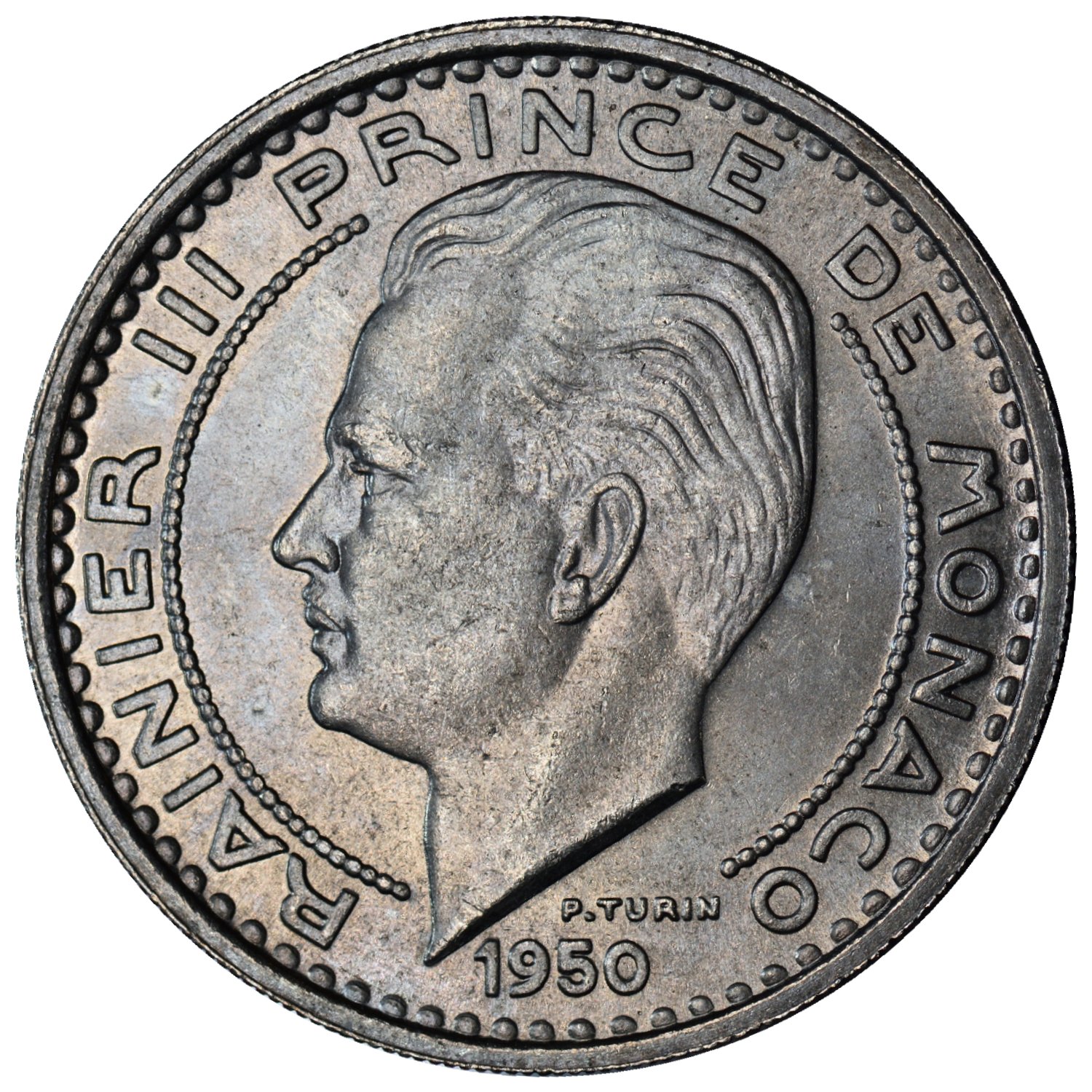
Rainier III — head left
P. TURIN 1950 in field
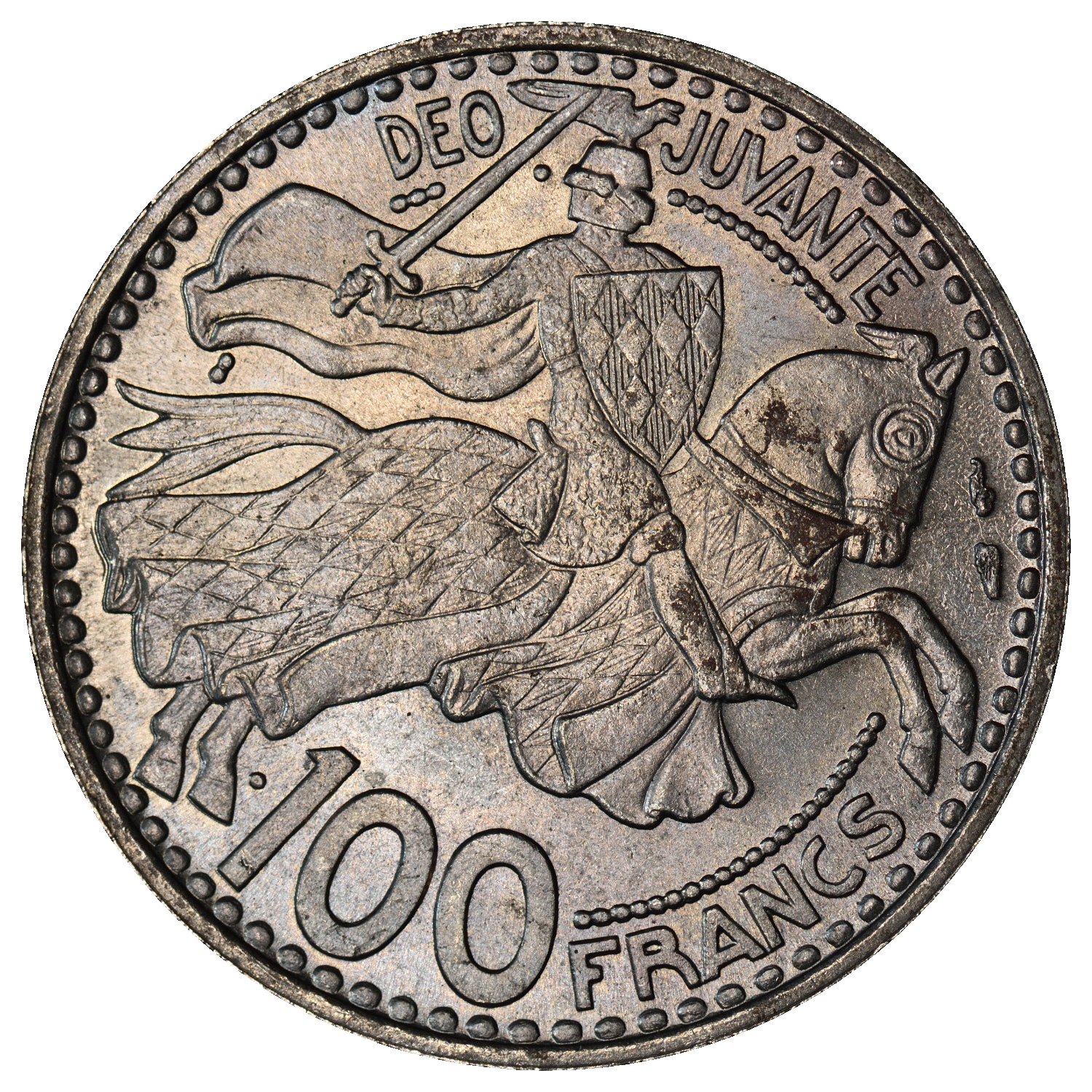
Armored horseman above value
DEO JUVANTE · 100 FRANCS
Placeholder filenames — swap in your own photographs (DSC_####.jpg pairs).
Denomination
100 Francs
Country
Principality of Monaco
Year
1950 (only date)
Monarch
Rainier III
Catalogue
KM# 133
Metal
Copper-Nickel (75/25)
Diameter
30 mm
Weight
12.0 g
Edge
Reeded
Thickness
2.15 mm
Mint
Paris — Monnaie de Paris
Forms
3 (see below)
The Three Forms of the 1950 Issue
Cupronickel — circulation
500,000 struck · The standard, common form encountered in the market · Numista rarity index 11/100 (very common) · This is the coin priced in the table below unless noted otherwise
Cupronickel — essai/special strike
A smaller special-finish or trial batch reported at roughly 2,700 pieces plus a further 1,700-piece essai set, per cnumis · Figures for this batch are less consistently reported across catalogues than the main 500,000 mintage — treat as approximate
Silver essai (pattern)
Trial strike in silver, reported at ~500 pieces · A genuine pattern piece, not a circulation issue · Scarce and collected separately from the base-metal type
Gold essai (pattern)
Trial strike in gold, reported at ~500 pieces · The rarest and most valuable form of the design · cnumis quotes roughly €2,000–2,500 for a mint-state example — a single-source figure, worth confirming against an auction record before relying on it
Note: this issue does not have a die-alignment/signature variety structure — there is only one design and one date. The meaningful distinctions here are of metal and finish (circulation cupronickel vs. essai cupronickel vs. silver/gold patterns), not conventional die varieties. Mintage breakdowns for the essai batches vary between sources; the 500,000-piece circulation mintage is the figure most consistently reported.
History & Context
Design
Forms & Varieties
Mint & Production
Valuation
Collecting Notes
| Section | Topic | Notes | ||||||||||||||||||
|---|---|---|---|---|---|---|---|---|---|---|---|---|---|---|---|---|---|---|---|---|
| History & Context | ||||||||||||||||||||
| History | A New Prince, an Empty Treasury |
Rainier III became Sovereign Prince of Monaco on 9 May 1949, at age 25, on the death of his maternal grandfather, Prince Louis II (his mother, Princess Charlotte, had renounced her own succession rights in 1944, making Rainier the direct heir). By most accounts he inherited a principality in real financial difficulty: the treasury was nearly empty, and Monaco's traditional pre-war clientele of wealthy European gamblers had not returned in the numbers the Société des Bains de Mer casino needed. The 1950 100 Francs was struck the year after this succession — one of the first substantial coin issues of the new reign, and a small but tangible sign of a principality trying to re-establish its footing after the war. Rainier's now-famous 1956 marriage to Grace Kelly, and the wave of international attention it brought Monaco, lay six years in the future when this coin was struck — this issue belongs to the leaner, less glamorous opening years of his reign. | ||||||||||||||||||
| History | Monaco's Postwar Currency |
The Monégasque franc circulated at par with the French franc throughout this period and was not a fully independent currency — Monaco's coinage was, and remained, closely tied to French monetary policy and to the Paris Mint's production capacity. The 100 Francs of 1950 was part of an expanded new set of Rainier-era denominations (alongside aluminum-bronze 10, 20 and 50 Franc pieces) that replaced the coinage of the Louis II years. Ten years later, in 1960, both the French and Monégasque francs were revalued at 100 old francs to 1 new franc — meaning the "100 Francs" denomination on this coin represents old francs, a unit that no longer exists in that form. Because Monaco's coinage shadowed France's so closely, this coin is best read as a chapter in French Mint history as much as a purely Monégasque one — struck by the same mint, under the same director's privy mark, to the same technical standards as contemporary French coinage. | ||||||||||||||||||
| History | "Deo Juvante" — the Grimaldi Motto |
The reverse legend DEO JUVANTE ("With God's help") is the historic motto of the House of Grimaldi, traditionally traced to Lambert Grimaldi in the mid-15th century, and it appears on Monégasque coinage across many reigns, not just Rainier III's. Its presence here links a very ordinary mid-20th-century circulation coin to a dynastic identity that predates it by five hundred years — a detail worth noting for anyone building a Monaco type set, since the same motto recurs across the whole series regardless of denomination or era. I don't have a confirmed source tying the specific mounted, armored-knight image on this coin's reverse to a named historical figure or event — cnumis catalogues the type simply as "the Knight" design. Treat any more specific story you encounter about this particular image with caution unless it cites a primary source. | ||||||||||||||||||
| Design | ||||||||||||||||||||
| Design | Obverse | The head of Prince Rainier III, facing left, fills most of the field. The legend reads RAINIER III PRINCE DE MONACO, with the engraver's signature P. TURIN and the date 1950 worked into the design near the truncation. This is one of the earliest coin portraits of Rainier III, produced within a year of his accession. | ||||||||||||||||||
| Design | Reverse | An armored figure on horseback (a mounted knight) is set above the denomination, with DEO JUVANTE arched above and 100 FRANCS below. Both catalogue descriptions I found (cnumis, coin-identifier) describe the same composition — "armored equestrian" / "armored rider on horseback" — and cnumis labels the type informally as "the Knight." It is a martial, heraldic image rather than a plain value-in-wreath design. | ||||||||||||||||||
| Design | The Engraver: Pierre Turin |
Pierre Turin (1891–1968) was one of the most prolific French Mint engravers of the interwar and postwar decades. He won the Premier Grand Prix de Rome for medal engraving in 1920, and his best-known work — the "Turin type" Marianne — appeared on French 10 Franc coins into the late 1940s and 20 Franc coins into 1939, with versions used across French colonial coinage as well. His portfolio extended to Monaco, Algeria, and French Indochina, of which this 1950 Monaco piece is one example, produced near the end of a long and influential career. | ||||||||||||||||||
| Forms & Varieties in Detail | ||||||||||||||||||||
| Variety | One Design, Three Metals |
Rather than a set of die varieties sharing one metal but differing in signature or alignment, the 1950 Monaco 100 Francs has a single, unchanging design and date — the meaningful distinctions are in what it was struck in and for whom. The overwhelming majority encountered in the market is the ordinary copper-nickel circulation coin. Silver and gold versions exist only as essais (pattern/trial strikes for the Mint's own records or presentation), not as coins that ever circulated. If you're offered a "silver" or "gold" 1950 Monaco 100 Francs, treat it as an essai claim that needs verification — these are genuinely scarce (about 500 pieces each, per cnumis) and worth confirming through a specialist auction house or certification service before paying a pattern-level premium. | ||||||||||||||||||
| Variety | Standard Cupronickel (500,000 struck) |
The coin you are most likely to encounter. Common, inexpensive in circulated grades, and the baseline against which the essai/pattern forms are priced at a premium. | ||||||||||||||||||
| Variety | Essai / Special-Finish Cupronickel |
cnumis reports a further small batch — around 2,700 pieces described across several finish grades, plus a separate 1,700-piece essai set — beyond the main 500,000 mintage. I could not cross-confirm these exact figures against a second independent catalogue, so treat them as approximate pending verification. | ||||||||||||||||||
| Variety | Silver & Gold Essais | Pattern strikes in silver and in gold, each reported at roughly 500 pieces. These are the genuinely rare forms of this type and the ones most likely to be misrepresented or overpriced without proper attribution — see the caution above. | ||||||||||||||||||
| Mint & Production | ||||||||||||||||||||
| Mint | Paris Mint — Monnaie de Paris |
Struck at the Monnaie de Paris, carrying the winged-figure privy mark associated with Lucien Bazor, the Mint's chief engraver (Graveur général) from 1931 to 1958. Monaco's reliance on the French state mint reflects both a practical arrangement — Monaco has never operated its own mint — and the close political and monetary relationship between the two states. The Monnaie de Paris later relocated its coin-striking operations to Pessac, near Bordeaux (from 1973), but in 1950 production was still centered in Paris itself. | ||||||||||||||||||
| Mint | Technical Specifications |
30 mm diameter, 12.0 g, 2.15 mm thick, reeded edge, struck in coin alignment (↑↓). At 75% copper / 25% nickel, this is the same general cupronickel standard France and many of its associated mints used for larger-denomination postwar coinage — a practical substitute for silver in coins meant for everyday circulation rather than store-of-value use. | ||||||||||||||||||
| Valuation | ||||||||||||||||||||
| Value | Market Overview | With a circulation mintage of 500,000 and a Numista rarity index of 11/100, the standard cupronickel 1950 100 Francs is a common coin, and pricing reflects that — this is a type-set or "first coin of Rainier III's reign" piece, not a scarce date. Demand comes mainly from Monaco specialists and Rainier III collectors rather than a broad international market. The essai/pattern forms in silver and gold are a completely different pricing tier, driven by genuine scarcity rather than condition alone. Market references (standard cupronickel): Numista catalogue pricing, roughly $5–$9 across circulated-to-uncirculated grades; a separate world-coin price guide (coin-identifier.com, appears Numista-derived) gives Fair $2 / VF $4 / XF $8 / UNC $18; a third source gives a wider $5.95–$128.64 band without specifying which grades that spans. | ||||||||||||||||||
| Value | Price Guide — Standard Cupronickel (approx., 2025–26) |
Flagging a discrepancy: one source (cnumis) lists this same standard cupronickel coin at roughly €200 (grade F12) rising to about €11,500 (MS 65) — one to two orders of magnitude above every other source checked, and difficult to reconcile with a 500,000-piece mintage and an 11/100 rarity index. This may reflect a data error on that site, a mismatch between the pattern/essai pricing and the common-coin listing, or something specific to the European market I haven't been able to confirm. I'd treat the cnumis figures as unverified and would not price a coin off them without cross-checking a realized auction result first.
|
||||||||||||||||||
| Value | Essai / Pattern Premiums |
|
||||||||||||||||||
| Collecting Notes | ||||||||||||||||||||
| Collect | Confirm the Metal First |
Because the essai forms in silver and gold share the exact same design as the common cupronickel coin, the single most important check on this type is composition, not grade. A quick specific-gravity or weight check (12.0 g is the cupronickel standard) will rule out most misattributions before you spend time grading. | ||||||||||||||||||
| Collect | What to Look For | Key grading points: (1) Rainier III's hair and profile — the highest-relief area, and the first to show wear. (2) The horseman's armor and the horse's musculature on the reverse — fine detail here separates EF from AU/UNC. (3) The reeded edge — check for filing or alteration, as with any reeded-edge coin offered as a "pattern." (4) The Bazor wing privy mark — confirms genuine Paris Mint production. | ||||||||||||||||||
| Collect | Problems to Avoid | Common problems: (1) Cleaning — copper-nickel coins are frequently over-polished to look "brighter than UNC"; check for hairlines and unnatural surfaces. (2) Essai misrepresentation — given the same design exists in three metals, verify any silver or gold example's provenance before paying a pattern premium. (3) Inconsistent online pricing — as the discrepancy flagged above shows, at least one aggregator's figures for this exact coin are wildly out of step with the rest of the market; don't anchor a purchase or sale price to a single website. | ||||||||||||||||||
| Collect | Collection Contexts | This coin fits naturally into: a Rainier III type set (1950 to the euro-era commemoratives of his later reign); a Monaco by denomination collection alongside the companion 1950 10, 20 and 50 Franc aluminum-bronze pieces; a Paris Mint foreign/associated coinage collection; or a narrower essai and pattern specialist collection, for those chasing the silver and gold forms specifically. | ||||||||||||||||||
| Collect | Related Coins | Companions from the same 1950 Rainier III series: the 10, 20 and 50 Francs (aluminum-bronze, same year, same new-reign context) round out a complete first-issue set for the new Prince. | ||||||||||||||||||
The 1950 Monaco 100 Francs carries no wartime drama — no retreating army, no government in exile. Its story is quieter: a young, untested Prince, a nearly empty treasury, and a Mint order placed in Paris to put a new sovereign's portrait into ordinary people's pockets. It is a coin about a principality quietly re-establishing itself, one hundred francs at a time.
Sources: Numista catalogue entry #4924 (KM#133) — specifications, mintage, pricing · cnumis.com — 100 Francs Rainier III (Knight, 1950) — mintage breakdown by form, essai/pattern pricing · NGC Price Guide — Monaco 100 Francs KM#133 (1950) · coin-identifier.com — KM#133 grade/price table · allnumis.com — Monaco 100 Francs 1950 catalogue entry · Numista artist page — Pierre Turin biography · Wikipedia — Monégasque franc; Rainier III, Prince of Monaco · gouv.mc (Government of Monaco) — "Deo Juvante" motto, official history and heritage page