May 29, 2026
Japan 50 Sen, 1917 (Taisho Year 6) Emperor Yoshihito — Silver Sunburst Type — Osaka Mint — Last Issue
Y# 37.2 · JNDA 01-14 · Silver .800 · 27.27 mm · 10.13 g · Reeded edge · ASW 0.2605 troy oz · Mintage: 9,963,232
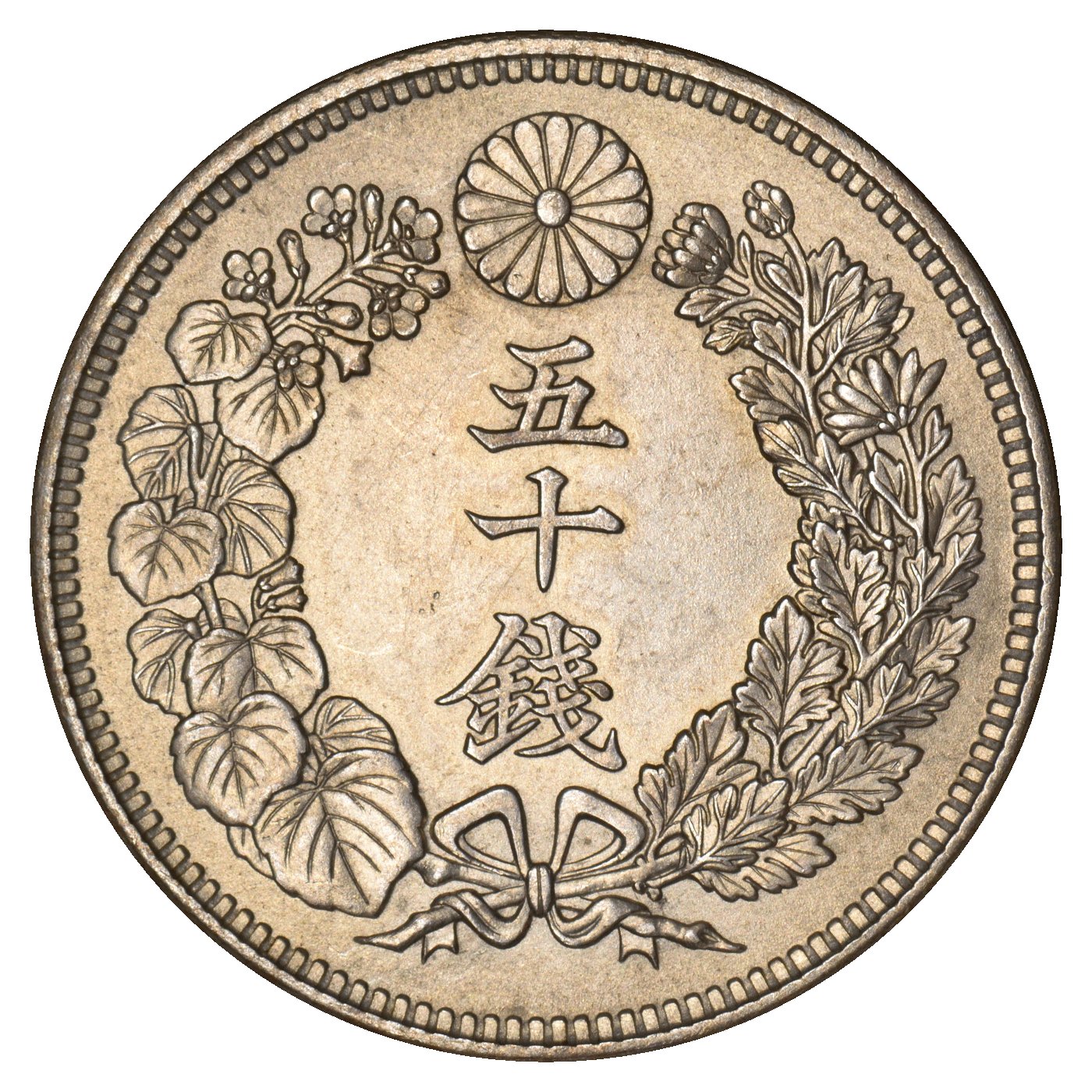
菊御紋 — Imperial chrysanthemum
大日本 / denomination
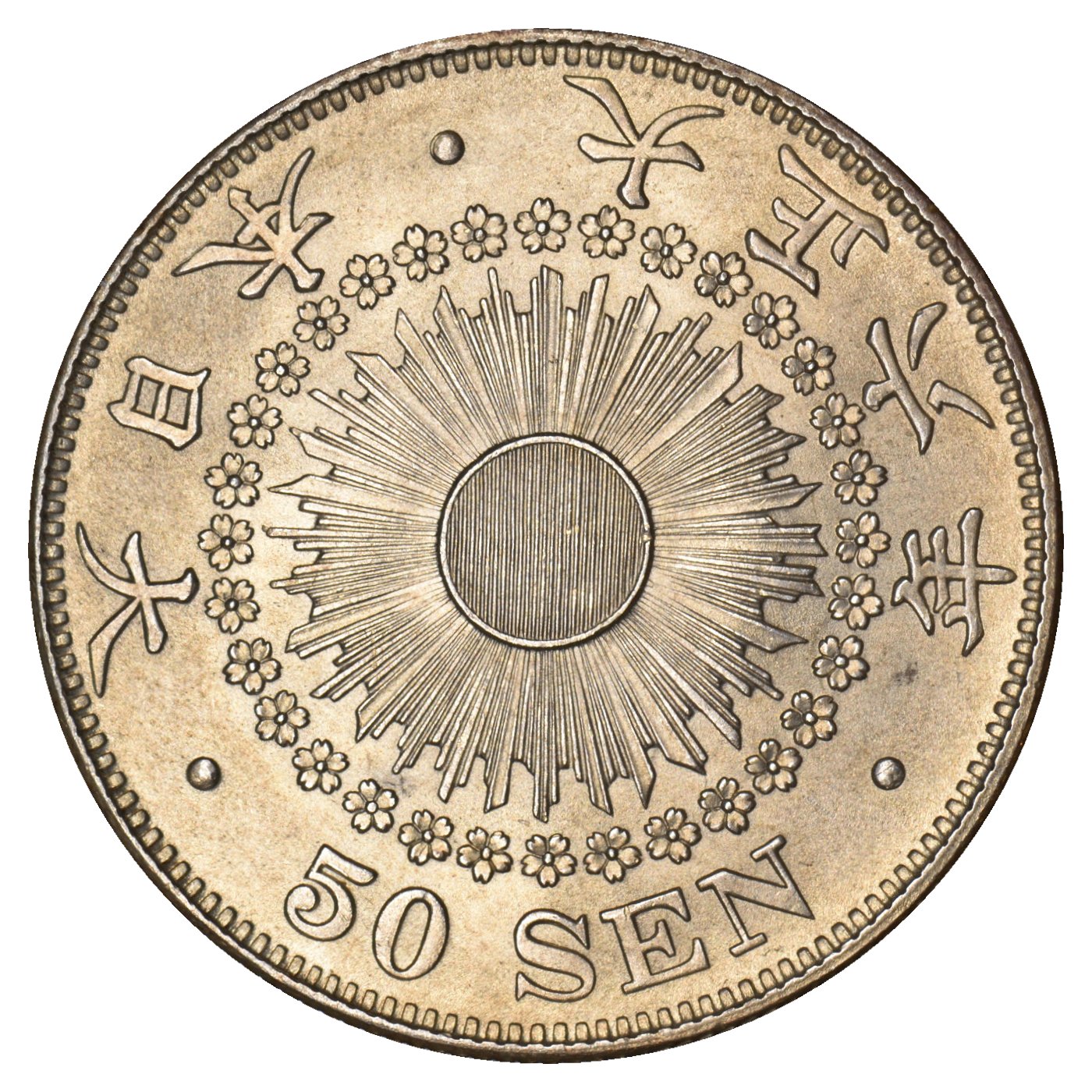
旭日 & 桐 — sunburst & paulownia
大正六年 — Taisho Year 6
Denomination
五十銭
Gojussen — Fifty Sen
Country / Emperor
大日本 / 大正
Dai Nippon / Taishō
Year (Era Year)
大正六年
Taishō 6-nen (1917)
Obverse symbol
菊
Kiku — Imperial chrysanthemum
Reverse symbols
旭日 / 桐
Kyokujitsu / Kiri — Sunburst / Paulownia
Denomination
50 Sen (五十銭)
Country
Japan (Empire)
Era Year / AD Year
Taisho 6 / 1917
Emperor
Yoshihito (Taisho)
Catalogue
Y# 37.2 · JNDA 01-14
Metal
Silver .800 fine
Diameter
27.27 mm
Weight
10.13 g
Edge
Reeded
ASW
0.2605 troy oz
Mint
Osaka Mint (大阪造幣局)
Mintage
9,963,232 — Final year of type
History & Context
Design
The Series & Final Year Status
Mint & Production
Valuation
Collecting Notes
| Section | Topic | Notes | ||||||||||||||||||||||||||||||||||||||||
|---|---|---|---|---|---|---|---|---|---|---|---|---|---|---|---|---|---|---|---|---|---|---|---|---|---|---|---|---|---|---|---|---|---|---|---|---|---|---|---|---|---|---|
| History & Context | ||||||||||||||||||||||||||||||||||||||||||
| History | Japan in 1917 | By 1917 Japan's wartime economic boom had reached its peak. Japan was supplying munitions, ships, and manufactured goods to the Allied powers at enormous profit; its trade surplus with Europe and America was transforming the country from a debtor to a creditor nation almost overnight. The Japanese economy grew by approximately 40% during the war years 1914–1918, and industrial output — steel, textiles, chemicals — expanded dramatically. This prosperity is directly reflected in the 1917 50 Sen: a mintage of nearly 10 million pieces driven by the coin demand of a booming commercial economy. 1917 also saw Japan deploy warships to the Mediterranean at Allied request — a remarkable demonstration of Japan's new great-power status. Japanese destroyers escorted Allied troop and supply convoys, marking Japan's first operational engagement in a European theatre of war. | ||||||||||||||||||||||||||||||||||||||||
| History | The Silver Shortage of 1917 |
The very success of the wartime economy that drove the 1917 mintage to nearly 10 million pieces also contained the seeds of the type's end. By 1917 global silver prices were rising sharply as wartime demand consumed metal stocks across all belligerent and neutral nations. Japan, like every other silver-coining nation, faced a calculation: the metal content of its coins was approaching their face value, creating incentives for melting. Within months of the last 1917 50 Sen being struck, the Japanese government had decided to reduce the silver content and size of the denomination — ending the heavy-silver sunburst type permanently. 50 Sen paper notes were issued from 1917 to cover the gap between the last issue of the heavy silver type and the introduction of the lighter .720 silver type (Y#46) in Taisho 11 (1922). The five-year absence of a silver 50 Sen coin reflects the severity of the wartime silver shortage. | ||||||||||||||||||||||||||||||||||||||||
| History | The Taisho Democracy |
The mid-Taisho period — of which 1917 is a representative year — is associated with the flowering of "Taisho Democracy": party politics, a free press, labour unions, urban consumer culture, early feminism, and cultural experimentation. Tokyo and Osaka were cosmopolitan cities; department stores stocked Western goods; cinema and jazz arrived; university students debated liberalism and socialism. The 50 Sen coin of 1917 circulated in this environment — used in theatres, department stores, and urban markets as much as in the rice paddies and fishing villages that had been the primary users of the 50 Sen in earlier decades. | ||||||||||||||||||||||||||||||||||||||||
| Design | ||||||||||||||||||||||||||||||||||||||||||
| Design | Obverse | Identical in design to the 1915 (T4): the Imperial chrysanthemum seal (菊御紋, kiku go-mon) centred, with 大日本 (Dai Nippon — "Great Japan") above and 五十銭 (gojussen — "fifty sen") below. The 16-petalled chrysanthemum, symbol of the Imperial Family, is unchanged across all six dates of the Taisho sunburst series. The design continuity across all six years (T1–T6, 1912–1917) means that the only date identifier on the obverse is absent — the date appears only on the reverse. This makes correct reverse reading essential for dating. | ||||||||||||||||||||||||||||||||||||||||
| Design | Reverse | The sunburst (旭日, kyokujitsu) and paulownia (桐, kiri) reverse, with the era date 大正六年 (Taisho Year 6). The design is identical to the 1915 reverse — it is the year character that changes: 六 (six, pronounced roku) replaces 四 (four, pronounced shi). Heritage Auctions describe the 1917 (T6) MS-65 PCGS example as "heavily toned in cobalt, pink and olive shades" — a description that captures the spectacular natural toning that aged Taisho silver can develop and that makes gem-quality examples so desirable. Note the JNDA reference for the 1917 is JNDA 01-14, while the 1915 is JNDA 01-15 — a reversal from what one might expect. The JNDA numbering runs backwards through the dates within the type. | ||||||||||||||||||||||||||||||||||||||||
| Design | Identifying 1917 vs 1915 |
The single difference between the 1915 (T4) and the 1917 (T6) is the year character on the reverse. The third character of the date reads: 六 (roku — six) for 1917; 四 (shi — four) for 1915. 六 has a distinctive shape: one horizontal stroke at top, a small downward stroke, then two diverging strokes spreading downward-left and downward-right like a person standing. 四 is a boxlike character with two internal horizontal strokes. The value difference is significant — the 1915 commands a 3–5× premium over the 1917 at equivalent grades — so correct identification matters. Quick test: 大正六年 = Taisho 6 = 1917. 大正四年 = Taisho 4 = 1915. If the third character after 大正 has an open, spreading base (like人), it is 六. If it is a closed box shape, it is 四. | ||||||||||||||||||||||||||||||||||||||||
| Design | Toning on the 1917 |
The 1917 is particularly well known for the quality of its natural toning in high grades. Heritage Auctions' description of their PCGS MS-65 as "heavily toned in cobalt, pink and olive shades" is one of the more evocative grading descriptions in recent Japanese coin auction literature — and it accurately reflects how this silver, with its .800 copper-alloy composition, ages with exceptional colour. Original-toning examples in MS condition are actively sought by collectors and command substantial premiums over bright or dipped examples of the same grade. | ||||||||||||||||||||||||||||||||||||||||
| The Taisho 50 Sen Series — Final Year Status of 1917 | ||||||||||||||||||||||||||||||||||||||||||
| Series | The Complete Taisho Sunburst Series |
|
||||||||||||||||||||||||||||||||||||||||
| Series | Why 1917 is the Final Year |
The silver shortage caused by World War I ended the heavy-silver Taisho sunburst type after just six years. Rising silver prices made the .800 fine, 10.13g planchet increasingly expensive to produce at face value. Rather than debase the silver immediately, the Japanese government suspended silver 50 Sen coinage entirely after 1917 and issued paper 50 Sen notes instead. When silver 50 Sen coins resumed in Taisho 11 (1922), they were struck to a new, lighter standard: .720 fine silver, 4.95g weight, 23.5mm diameter — almost exactly half the silver content of the original type. This halving of silver content mirrors what happened across all major silver-coining nations after WWI — the Latin Union abandoned its silver standards, Britain reduced silver in its coins from .925 to .500 in 1920, and Japan reduced from .800 to .720 in 1922. The 1917 50 Sen is Japan's last coin of the old silver order. | ||||||||||||||||||||||||||||||||||||||||
| Series | 1917 vs 1915: Placing the Coin |
1917 (T6) — This coin
1915 (T4) — Key date
|
||||||||||||||||||||||||||||||||||||||||
| Mint & Production | ||||||||||||||||||||||||||||||||||||||||||
| Mint | Osaka Mint (大阪造幣局) |
All Taisho 50 Sen sunburst type coins were struck at the Osaka Mint (大阪造幣局, Ōsaka Zōheikyoku). The 1917 issue is confirmed by Heritage Auctions as "Osaka mint, KM-Y37.2, JNDA 01-14." No mint mark appears on the coins; attribution is through catalogue records and institutional history. The Osaka Mint in 1917 was operating at high capacity, driven by wartime coin demand — the nearly 10 million pieces of the 1917 issue represent a significant production commitment. | ||||||||||||||||||||||||||||||||||||||||
| Mint | Silver Content & Toning |
The .800 fine silver alloy (80% silver, 20% copper) was used throughout the Y#37 series. This copper-rich alloy ages differently from the .835 or .925 silver used in European coinage — the copper component accelerates and intensifies toning, producing the spectacular multi-colour range (cobalt, pink, olive, amber) that Heritage Auctions describes. The 10.13g planchet at 27.27mm strikes with excellent relief at the Osaka Mint's quality standards. Deeply toned, original-surface MS examples of the 1917 are among the most visually striking coins in 20th-century Japanese numismatics. The Heritage Auctions lot 64561 description: "Heavily toned in cobalt, pink and olive shades" — this multi-colour toning on a PCGS MS-65 example represents the ideal condition for this type from a collector's aesthetic standpoint. | ||||||||||||||||||||||||||||||||||||||||
| Mint | Mintage in Context | The 1917 mintage of 9,963,232 is the second highest of the Taisho sunburst series (after the 1916 at approximately 11,800,000) and reflects the peak of the wartime economic boom. The 1917 is the most available date in the series at all grades — the combination of high original mintage and the coin's relatively recent struck (108 years ago) means more survivors in all conditions. For a collector building a type set who wants the best example of the sunburst design regardless of specific date, the 1917 offers the best selection and the most competitive pricing. | ||||||||||||||||||||||||||||||||||||||||
| Valuation | ||||||||||||||||||||||||||||||||||||||||||
| Value | Market Overview | The 1917 (T6) 50 Sen is the most accessible date in the Taisho sunburst series — the standard type example that collectors acquire first, and the coin most commonly offered by Japanese and international dealers. In circulated grades it is genuinely affordable at $15–35. The final-year status adds modest collector interest above a purely "common date" assessment, though the premium is modest compared to the 1915 key date. The real interest concentrates in MS condition, where exceptional toning examples command strong auction results. Market anchors: Stack's Bowers PCGS MS-66 at $264 (November 2022); Heritage PCGS MS-65 sold (price not public but consistent with MS-65 values); PCGS MS-64 T5 (1916) at $67.17 (eBay Japan, 2025, useful as a nearby common-date benchmark); raw circulated examples at $15–20 (eBay Japan seller, 2025). | ||||||||||||||||||||||||||||||||||||||||
| Value | Price Guide (approximate, 2025–26) |
|
||||||||||||||||||||||||||||||||||||||||
| Value | Toning Premium | Original natural toning is the single most important value driver for the 1917 50 Sen in MS grades. Heritage's description of their MS-65 as showing "cobalt, pink and olive shades" represents the premium end of the toning spectrum. A 1917 MS-65 with spectacular multi-colour original toning may realise $400–600+ at specialist auction. The same coin in MS-65 but bright white (dipped) might fetch $100–150. Buyers seeking the best value should focus on original-surface examples with natural toning, not the brightest coins. The .800 fine silver alloy's high copper content makes these coins especially prone to developing spectacular toning over time. An untouched, original-surface coin stored in a paper envelope for 100 years is the ideal collector scenario. | ||||||||||||||||||||||||||||||||||||||||
| Collecting Notes | ||||||||||||||||||||||||||||||||||||||||||
| Collect | Reading the Date: 六 vs 四 |
The critical identification step for any Taisho 50 Sen is reading the year character. For 1917: the reverse should read 大正六年. The character 六 (roku — six) has: one horizontal stroke at top, a short vertical stroke descending from it, then two diagonal strokes spreading downward-left and downward-right, like a standing figure. For comparison, the 1915 key date reads 大正四年, where 四 is a rectangular enclosure with two internal horizontal lines. Confusing these two dates is the single most consequential error a buyer can make — the 1915 commands 3–5× the price of the 1917 at equivalent grade. | ||||||||||||||||||||||||||||||||||||||||
| Collect | The Best Use of the 1917 |
The 1917 is the ideal coin for: (1) A type example of the Taisho sunburst design — as the most available date, it offers the best selection of high-grade, well-toned, certified examples at competitive prices. (2) A set-filler while saving for the 1915 key date — acquiring the 1917 in EF or AU gives a fine representative piece to hold while building toward the complete six-date run. (3) The best value gem in the series — an MS-65 or MS-66 1917 is substantially cheaper than the equivalent key-date 1915, and for display or aesthetic pleasure, the quality of the coin is identical. | ||||||||||||||||||||||||||||||||||||||||
| Collect | Problems to Avoid | The same issues apply as for the 1915: (1) Date misread — verify 六 (1917) vs 四 (1915). (2) Cleaning / dipping — a dipped 1917 in "brilliant" condition is worth less than an original-surface example with natural toning at the same technical grade. (3) Chopmarks — Chinese merchant verification stamps struck into the coin surface; add historical interest but reduce collector value significantly. (4) Artificial toning — applied to simulate the spectacular natural toning of a genuine cabinet coin; artificial toning is typically too uniform and sits on the high points rather than in recesses; genuine toning develops deepest in the fields. | ||||||||||||||||||||||||||||||||||||||||
| Collect | Collection Contexts | The 1917 (T6) 50 Sen fits into: the complete Taisho 50 Sen type set (six dates, T1–T6, as the final-year closer); a Japanese imperial silver collection by denomination; a World War I era global silver thematic set (alongside the 1916 Austrian 1 Corona and 1915 Serbia 1 Dinar covered in this series); a last-year-of-type collection (comparable to the 1916 Austrian 1 Corona and 1901 Ceylon quarter cent in this series); or as a type example for those who want one representative sunburst 50 Sen without pursuing the complete date run. | ||||||||||||||||||||||||||||||||||||||||
| Collect | Related Coins | The natural companions are: the other five dates of the Taisho 50 Sen Y#37.2 series (T1/1912, T2/1913, T3/1914, T4/1915 key date, T5/1916); the later Taisho 50 Sen Y#46 (.720 silver, 23.5mm, 1922–1926); the Showa 50 Sen Y#50 (1928–1938, same .720 standard, phoenix and paulownia reverse). The 1915 (T4) article in this series gives the key date context; the complete run T1–T6 forms a coherent and achievable six-coin type set with clear collector narrative from Japan's Meiji legacy through the Taisho democracy to the silver-shortage discontinuation. | ||||||||||||||||||||||||||||||||||||||||
The 1917 50 Sen is the last of the heavy-silver sunburst type — the final piece struck before wartime silver prices forced Japan to abandon the .800 fine, 10-gram planchet that had defined the 50 Sen denomination for forty-seven years. Nearly 10 million were struck in this final year; gem survivors with their extraordinary multi-colour toning are among the most beautiful Japanese coins of the 20th century.
Sources: Krause, C. L. & Mishler, C. Standard Catalog of World Coins — Y#37.2 · JNDA catalogue — 01-14 · Numista catalogue entry #14252 · Heritage Auctions lot #64561 — Taisho 6 (1917) MS-65 PCGS, "cobalt, pink and olive shades," mintage 9,963,232 · Stack's Bowers lot #75350 — Taisho 6 (1917) MS-66 PCGS sold $264, November 2022 · eBay Japan seller — raw circulated T6 at ~$17 (2025) · eBay P&M Japan — PCGS MS-64 T5 (1916) sold $67.17 (July 2025) · Wikipedia — 50 sen coin (Japan); Emperor Taishō; Taisho Democracy · Osaka Mint Bureau historical records