Mewar Princely State Rupee — VS 1985 (1928 AD) One Rupee — Silver — Maharana Fateh Singh — चित्रकूट उदयपुर / दोस्ती लंधन — Calcutta Mint
Y#22 (Y#22.1 thin legend · Y#22.2 thick legend) · N#36677 · Silver · 30 mm · 10.85 g · Vikram Samvat calendar · Mintage approx. 14,906,000 (1928 striking)
Obverse — Chitrakoot & Udaipur
- Script: Devanagari throughout; no portrait
- Upper legend: चित्रकूट (Chitrakoot)
- Lower legend: उदयपुर (Udaipur)
- Significance: Chitrakoot is a sacred site; Udaipur is the state capital
- No portrait: Unlike the Bikanir issue, no effigy of ruler or suzerain appears
Reverse — Dosti London & Date
- Script: Devanagari / Gujarati numeral for date
- Upper legend: दोस्ती (Dosti — Friendship)
- Middle legend: लंधन (London)
- Date: ް (VS 1985) in mixed Gujarati/Devanagari numerals
- Closing mark: विः (Vih. — abbreviation for Vikram Samvat)
- Two varieties: Thin vs thick rendering of the VS 1985 numeral legend
A Coin Without a Portrait — Sacred Place Names and a Declaration of Friendship
The Mewar 1928 rupee is one of the most unusual princely state issues of the late colonial period. Where most comparable coins feature the portrait of the reigning monarch or suzerain — as the Bikanir rupee does with both Victoria and Ganga Singh — this coin carries no portrait at all. Both faces are entirely typographic in Devanagari script. The obverse names two places: Chitrakoot, a site of deep Hindu religious significance (associated in tradition with the Ramayana), and Udaipur, the capital of the Mewar state. The reverse names a political relationship: Dosti London — Friendship (with) London — a declaration of alliance with the British Crown expressed not through an imperial portrait but through a form of words. The date VS 1985 (= 1928 AD) follows, with the Vikram Samvat calendar abbreviation. The coin is thus a statement of identity — sacred geography and political loyalty — rendered entirely in indigenous script, without imperial imagery. This is the “Dosti London” series as it is commonly known in the Indian numismatic trade. The use of the Vikram Samvat calendar rather than the Gregorian calendar for the date is characteristic of Mewar coinage throughout this period. VS 1985 = approximately 1928–1929 AD (the Vikram Samvat year spans parts of two Gregorian years). The coin is conventionally dated 1928 AD in western catalogues.
Maharana Fateh Singh — The Last Traditionalist Ruler
Fateh Singh (16 December 1849 – 24 May 1930) was the Sisodia Rajput ruler of Mewar (Princely State of Udaipur) from 1884 to 1930 — a reign of forty-six years. He was born at Shivrati, son of Maharaj Dal Singh of the Shivrati branch of the Mewar dynasty, and came to the throne by adoption: first adopted by his elder brother Gaj Singh (who had no heir), and subsequently by Maharana Sajjan Singh of Udaipur, who also died without issue in 1884, making Fateh Singh the Maharana. He is remembered in Mewar and Rajputana as a ruler of firm traditionalist conviction who resisted British interference with unusual persistence. His refusal to attend the 1903 Delhi Durbar (convened for the Coronation of Edward VII) and the 1911 Delhi Durbar (for George V) was a deliberate act of royal non-compliance that drew significant British official displeasure. His association with figures of known anti-British sentiment led to the curtailment of his powers on 28 July 1921, when effective authority was transferred to his son and heir Bhupal Singh, though Fateh Singh retained the titular role of Maharana until his death in 1930. The 1928 rupee was therefore struck during the final years of his nominal reign, after effective power had already passed to his son. Wikipedia’s infobox gives his reign end as 1929 for the transfer of the titular title; other sources give 1930 as his death. The practical situation — powers curtailed 1921, died 1930 — is well established. The coin is attributed to Fateh Singh in all major catalogues.
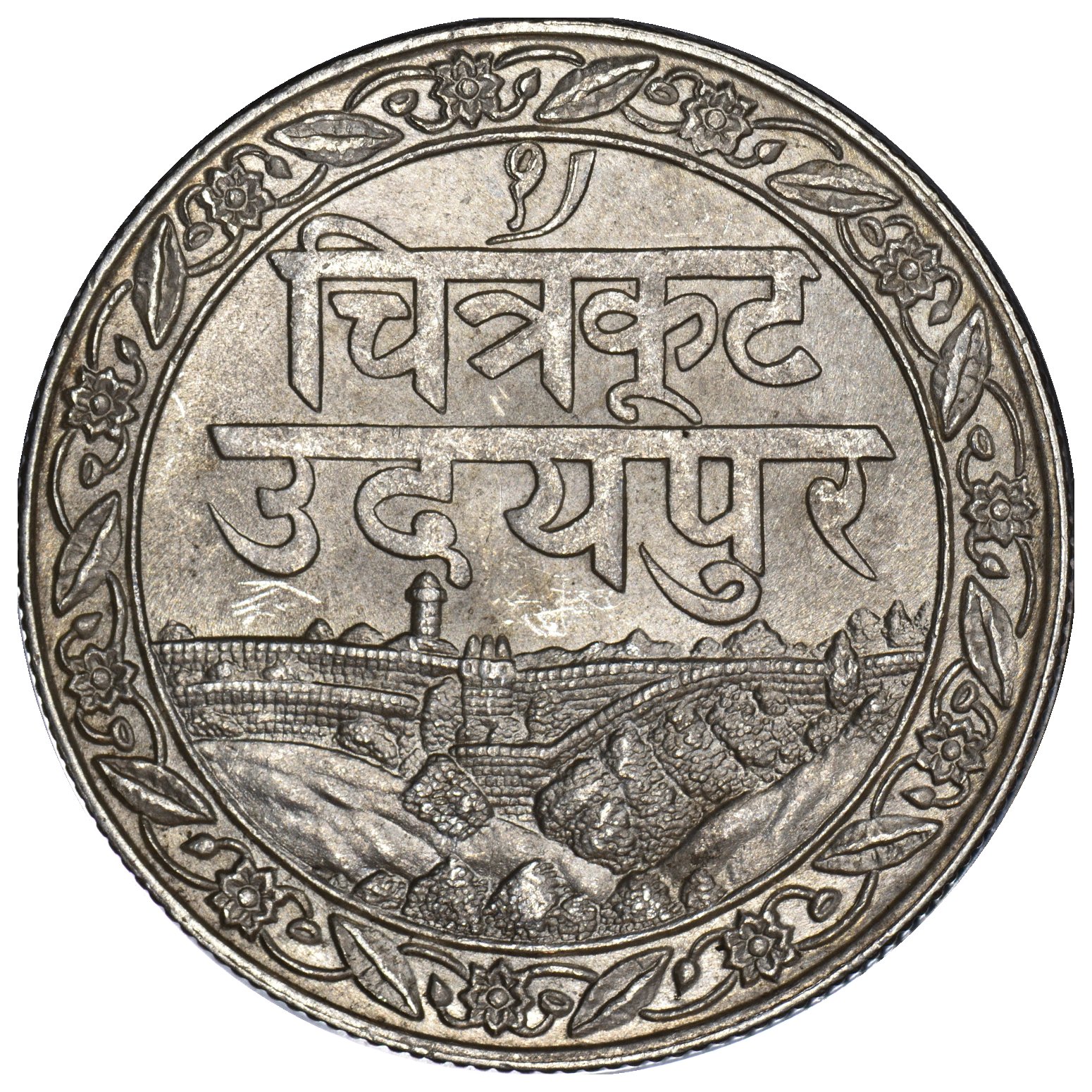
चित्रकूट — उदयपुर
Chitrakoot — Udaipur
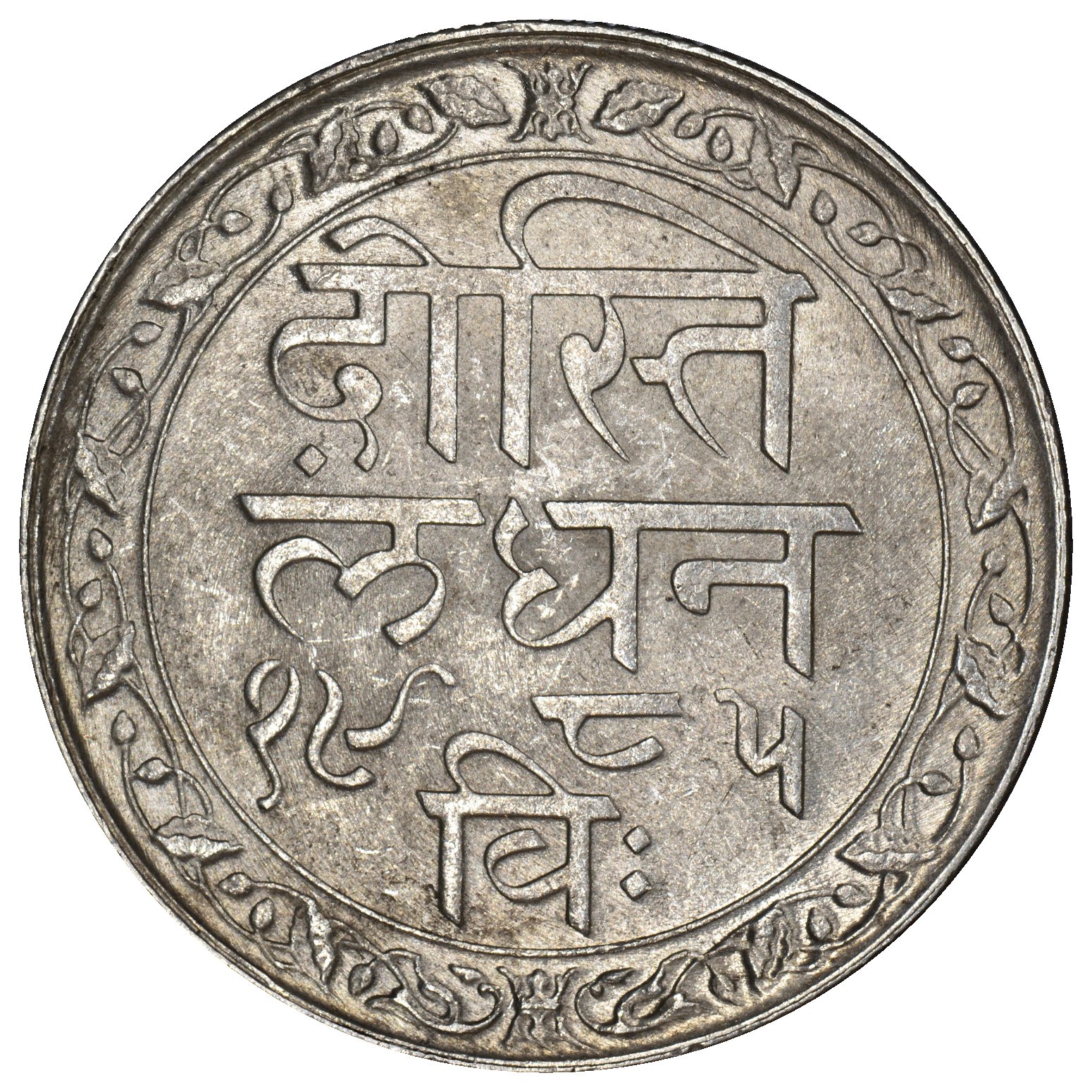
दोस्ती लंधन — VS 1985
Dosti London — 1928 AD
| Section | Topic | Notes | ||||||||||||||||||
|---|---|---|---|---|---|---|---|---|---|---|---|---|---|---|---|---|---|---|---|---|
| History & Context | ||||||||||||||||||||
| History | Mewar — The Senior Rajput State |
Mewar was not merely one of many Rajput princely states — it was in many respects the most prestigious. The ruling Sisodia dynasty claimed descent from the sun god Surya through Rama, making it the senior lineage in the Rajput hierarchy. The state’s capital was Udaipur, known as the “City of Lakes,” set in the southern Aravalli Range. Mewar had a long tradition of resistance to outside domination: it had famously resisted Mughal suzerainty longer than almost any other Rajput state, and its historic capitals of Chittorgarh and Kumbhalgarh carry memories of prolonged sieges. By the late nineteenth and early twentieth century, this tradition of independence expressed itself in Fateh Singh’s difficult relationship with the British political authorities — who found him uncooperative in ways that smaller, less prestigious states could never have attempted. | ||||||||||||||||||
| History | The Vikram Samvat Calendar |
The date on the coin — VS 1985 — is in the Vikram Samvat calendar, a lunisolar calendar widely used across northern and western India, particularly in Rajasthan and Gujarat. The Vikram Samvat year runs approximately 56–57 years ahead of the Gregorian year: VS 1985 corresponds approximately to 1928–1929 AD (the VS year spans parts of two Gregorian calendar years). By convention in western numismatic catalogues, the coin is dated 1928 AD. The use of the VS calendar rather than the Gregorian or Hijri calendar is entirely consistent with Mewar coinage tradition across all denominations of this series. The calendar abbreviation विः (Viḥ.) on the reverse identifies the calendar system used. Conversion of VS dates to AD: subtract approximately 56 or 57 (depending on the Gregorian month) from the VS year. VS 1985 − 57 = 1928. Worth confirming the exact Gregorian range if a precise date of striking is needed for research purposes. | ||||||||||||||||||
| History | “Dosti London” — What the Legend Means |
Dosti (दोस्ती) is the Hindi/Urdu word for friendship. London (लंधन) refers to the British Crown and Government as represented from London rather than from Calcutta or Delhi. The phrase Dosti London — Friendship (with) London — is a standard declaration of political loyalty and alliance appearing on Mewar coinage of this period across all denominations from the full rupee down to the 1/16 rupee. It is the verbal equivalent of the Victoria portrait on the Bikanir coin: a formal acknowledgement of the suzerain relationship expressed entirely in indigenous script without imperial imagery. The same formula appears on earlier undated Swarupshahi series coins (c.1858–1920) and continues across the Fatteh Singh dated series of 1928. | ||||||||||||||||||
| The Ruler — Maharana Fateh Singh | ||||||||||||||||||||
| Ruler | Fateh Singh — Accession & Character |
Born 16 December 1849, Fateh Singh came to the Mewar throne through two successive adoptions: first by an elder brother, then by Maharana Sajjan Singh, who died without heir on 23 December 1884, making Fateh Singh the 76th (or thereabouts — worth verifying the ordinal) Maharana of Mewar. He received the GCSI (1887), GCIE, and GCVO. He built the Connaught Dam on Lake Dewali in 1889 to mark the visit of the Duke of Connaught, which enlarged the lake, later renamed Fateh Sagar Lake. He modernised the administration, opened schools and dispensaries, and had a genuine reforming record in practical governance. At the same time, his refusal to compromise on questions of Mewar’s dignity and autonomy made him a persistent difficulty for British Residents and political officers. The exact ordinal number of Fateh Singh as Maharana varies across sources and depends on how one counts earlier rulers. Not verified here to a primary source. | ||||||||||||||||||
| Ruler | The 1921 Deposition and the Final Years |
On 28 July 1921, under the pretext of social unrest in Mewar, the British authorities formally curtailed Fateh Singh’s powers and transferred effective governance to his son Bhupal Singh (born 1884, who had been paralysed since the age of five). Fateh Singh retained the title of Maharana but exercised no real authority from that point. He died on 24 May 1930. The 1928 rupee was therefore struck seven years after his political deposition, during the final years of his nominal reign under his son’s effective authority. The coins of this series continue to bear his name in the catalogues because he was the titular ruler — but the administrative reality behind the coin’s issue was Bhupal Singh’s regency. | ||||||||||||||||||
| Design Detail | ||||||||||||||||||||
| Design | Obverse — Chitrakoot and Udaipur |
The obverse carries two place names in Devanagari script, one above the other:
चित्रकूट (Chitrakoot): A location of profound religious significance in Hindu tradition, associated with the period of Rama’s forest exile in the Ramayana. The name on the coin connects the state’s coinage to a sacred geography that transcended the merely political. There is a Chitrakoot Ghats area in the general Mewar region; this usage places the coin in a devotional as much as a territorial context. उदयपुर (Udaipur): The capital city of Mewar, founded by Maharana Udai Singh II in 1559, known for its lakes, palaces, and position as the cultural heart of the Sisodia dynasty. The specific geographical reference of “Chitrakoot” in the Mewar context is worth clarifying against a specialist Mewar numismatic source. Chitrakoot is most famous as a site in Uttar Pradesh/Madhya Pradesh near the Vindhyas, associated with Rama’s exile — but there are also local sacred sites with the same name in Rajasthan. The usage on Mewar coinage may have multiple layers of meaning. Source: Numista catalogue N#36677 notes the coin legend as “Chitrakoot / Udaipur”. |
||||||||||||||||||
| Design | Reverse — Dosti London and the VS Date |
The reverse carries three lines of Devanagari / mixed-script text:
दोस्ती (Dosti — Friendship) लंधन (London) ߁ ް (VS 1985 — in mixed Gujarati and Devanagari numerals) विः (abbreviation for Vikram Samvat) The date numerals use a mixture of Gujarati-script digits (߁ = 1, ް = 9) and Devanagari digits ( = 8, = 5 — verify exact rendering), which is characteristic of this series and of Gujarati-influenced Rajasthani commercial script conventions. The exact script mix in the numeral ߁ް (1985) is noted in the Numista catalogue. Gujarati and Devanagari share some numerals but differ in others; the blending in Mewar coinage reflects the regional scribal tradition. The catalogue also identifies this as the distinguishing feature between the two varieties: thin vs thick rendering of these numerals. |
||||||||||||||||||
| Design | No Portrait — A Deliberate Absence |
The complete absence of any portrait — of the Maharana, of the British monarch, or of any human figure — is the most striking design characteristic of this coin in comparison with both imperial rupees and most other princely state machine-struck issues. It reflects Mewar’s distinctive coinage tradition, in which place-names and devotional references served as the primary identity markers rather than royal effigies. This tradition has roots in Mewar’s earlier undated series (Swarupshahi and Chittor mint issues) and was maintained consistently into the Fatteh Singh milled coinage. The absence of a Victoria or George V portrait also means this coin carries no direct acknowledgement of the reigning British monarch — the “Dosti London” formula performs that function in words rather than in imagery. | ||||||||||||||||||
| The Two Varieties — Y#22.1 and Y#22.2 | ||||||||||||||||||||
| Varieties | Thin Legend — Y#22.1 |
Y#22.1 is characterised by a thin rendering of the VS 1985 numeral legend on the reverse. The numeral strokes are narrower and more delicate. This is the more commonly encountered variety among Numista users (frequency: approximately 73% of owners report this variety). Under magnification the distinction is clear; at Fine or better grades it should be visible to the naked eye on a well-preserved example. Numista reports Y#22.1 as the more common variety. Worth confirming that the “thin/thick” distinction applies specifically to the numeral legend strokes rather than to any other part of the design; the catalogue images should be the primary reference for attribution. | ||||||||||||||||||
| Varieties | Thick Legend — Y#22.2 |
Y#22.2 is characterised by a thick rendering of the VS 1985 numeral legend. The numeral strokes are broader and heavier. This variety is less common among reported examples. Both varieties share the same date, ruler, design, dimensions, and Calcutta Mint attribution — the distinction is entirely in the die engraving of the date numerals. Whether Y#22.2 commands a premium over Y#22.1 in the current market is worth checking against recent auction and dealer data. The Numista valuation table does not appear to differentiate prices between the two varieties, but specialist buyers may pay more for the less-common thick legend type. | ||||||||||||||||||
| Mint & Production | ||||||||||||||||||||
| Mint | Calcutta Mint & Mintage Figures |
The coin was struck at the Calcutta Mint. The Numista catalogue records a mintage of approximately 14,906,000 for the 1985 VS (1928 AD) striking, making this a very large issue — far more common in the market than the Bikanir 1892 rupee. A further 8 million pieces were reportedly struck at Calcutta in 1931, presumably from the same or closely related dies (no new date was added in 1931 — the coins continued to carry the VS 1985 date). This gives a potential total production for the VS 1985 rupee series in excess of 22 million pieces. The 1931 Calcutta striking of 8 million pieces is noted in the Numista catalogue comments. Worth verifying: whether the 1931 coins are identical to the 1928 coins or carry any distinguishing die characteristic. I am not certain whether a separate mintage entry exists for the 1931 striking in Krause or Yeoman. | ||||||||||||||||||
| Mint | Weight & Module — Below Imperial Standard |
At 10.85 g and 30 mm diameter, the Mewar 1928 rupee is slightly lighter than the imperial British India rupee (11.66 g) and lighter also than the Bikanir 1892 rupee (11.45 g). The diameter is similar (imperial: 30.6–30.8 mm; Mewar: 30 mm). The fineness is not stated in the Numista catalogue entry for this coin. If the silver content is lower than .917, the bullion floor will differ from the imperial rupee accordingly. This is an important point for collectors: the Mewar rupee is not to the same silver standard as the imperial rupee. Verify the exact fineness and weight standard against Yeoman’s Y# catalogue or Krause before attributing a specific silver content or bullion floor to this coin. | ||||||||||||||||||
| Valuation | ||||||||||||||||||||
| Value | Price Guide |
|
||||||||||||||||||
| Collecting Notes | ||||||||||||||||||||
| Collect | Who Collects This Coin and Why |
The Mewar 1928 rupee attracts collectors for reasons quite different from the Bikanir issue. Its appeal lies in its distinctive design character — the complete absence of any portrait, the Devanagari-only legends, and the “Dosti London” formula — rather than in scarcity or silver content. Collectors of Rajputana princely states pursue it as a core Mewar representative. Collectors of script coins value the all-Devanagari type. Collectors interested in Mewar state history find the Fateh Singh series compelling for his biography. The two-variety distinction (Y#22.1 / Y#22.2) makes it attractive to specialists who build variety sets. And the coin’s modest price point makes it accessible to new collectors building a princely states type set without high outlay. | ||||||||||||||||||
| Collect | What to Look For — Grading Points |
Key grading points: (1) The Devanagari script on both faces — the fineness of individual letter strokes; on well-struck examples the serifs and crossbars of Devanagari characters should be crisp in VF and above. (2) The VS 1985 numeral group — the primary variety-attribution feature; confirm thin or thick rendering under magnification. (3) The विः abbreviation on the reverse — a small but diagnostically useful detail; should be legible in VF. (4) Surface quality — as a high-mintage issue, cleaned and polished examples are very common; always check for artificial brightness or hairlines. (5) Strike evenness — machine-struck but the all-script reverse means all grading points are typographic rather than portrait-based; look for weakness in the upper central legend of each face. | ||||||||||||||||||
| Collect | Problems to Avoid | (1) Cleaned examples — very common at this price point; artificial brightness and loss of surface tone are the primary issues. (2) Misidentification of the date calendar — the VS 1985 date is sometimes misread by inexperienced buyers as a 1985 AD coin; it is emphatically not. (3) Failure to attribute the variety — if buying specifically for variety, confirm thin vs thick numeral under magnification before committing. (4) Conflation with the earlier Swarupshahi series — the undated earlier Mewar rupees (c. 1858–1920, Y#11) carry similar “Dosti London” and “Chitrakoot Udaipur” legends but are smaller (approximately 28–29 mm), hand-struck rather than machine-struck, and have a different character; they are not the same coin. Always confirm the 30 mm machine-struck module for the Fatteh Singh 1928 issue. | ||||||||||||||||||
| Collect | Related Coins | Natural companions: the Mewar half rupee Y#21 (VS 1985 / 1928), quarter rupee Y#20, eighth rupee Y#19, and sixteenth rupee Y#18 — all from the same Fatteh Singh milled series at Calcutta, all carrying the same Dosti London / Chitrakoot Udaipur legends in smaller modules, forming a complete denomination set; the earlier Swarupshahi undated rupee Y#11 (c. 1858–1920) — showing the hand-struck predecessor type; the Bhupal Singh copper 1 Anna Y#17 (VS 2000 / 1943) — the successor ruler’s copper issue; and the Bikanir 1892 rupee (KM#72) as a direct Rajputana princely state comparison — same year, same mint, radically different design philosophy. | ||||||||||||||||||
Sources: Numista catalogue N#36677 (Y#22.1 and Y#22.2 — confirmed specifications, mintage, legend transcription, variety descriptions, and calendar note) · Yeoman, R.S. Modern & Current World Coins — Y#22 reference (verify fineness and full weight standard in current edition) · Wikipedia: Fateh Singh of Mewar — biographical data · Wikipedia: Bhupal Singh — 1921 deposition context · Eternal Mewar Foundation (eternalmewar.in) — biographical context · Silver spot price reference: ~$75/oz USD (verify current price before use) · Important: The silver fineness of the Mewar Fatteh Singh rupee series has not been confirmed from a primary source in this guide. Do not assume .917 fine without verification against Yeoman or Krause. Mintage figures are from Numista and should be verified against a primary catalogue source before citation.