Bikanir Princely State Rupee — 1892 One Rupee — Silver .917 — Maharaja Ganga Singh Bahadur & Victoria Empress — Struck at the Calcutta Mint
KM#72 · Silver .917 fine · 30.4 mm · 11.45 g (Numista; worth verifying against Krause) · ASW approx. 0.3370 troy oz · Calcutta Mint · Years struck: 1892–1897
Obverse — Victoria Empress
- Portrait: Crowned bust of Victoria facing left
- Legend: VICTORIA EMPRESS
- Style: Same veiled and diademed portrait as the imperial rupee series
- Source: Portrait die supplied from / consistent with Calcutta Mint imperial type
- Note: The obverse honours the suzerain; the reverse honours the local ruler
Reverse — Maharaja Ganga Singh
- Upper legend (English): ONE RUPEE
- Lower legend (English): BIKANIR STATE
- Central field: Bilingual inscription: Maharaja Ganga Singh Bahadur in Devanagari (above dividing line) and Persian/Arabic script (below)
- Date: ١٨٩٢ (1892) in Arabic-Indic numerals, preceded by the ‘ain sign denoting AD (Anno Domini / Iswy)
A Dual-Authority Coin — Imperial Suzerainty and Princely Sovereignty on One Flan
The 1892 Bikanir rupee is a numismatically distinctive object because it carries two authorities simultaneously. The obverse is entirely imperial: the crowned and veiled bust of Victoria Empress, identical in character to the portrait on the concurrent British India rupee series. The reverse is entirely local: the name of the ruling Maharaja of Bikanir in two scripts — Devanagari and Arabic — with the state name in English below, and the date in Arabic-Indic numerals above the Persian legend. This dual face reflects the political reality of the princely states under the Raj: internally sovereign in their own affairs (coinage, taxation, administration), externally subordinate to the Crown. The coin is therefore not a British India coin in the strict sense, but a princely state issue struck under British suzerainty — a category that attracts a distinct collector following precisely because of this layered political character. The ‘ain (ع) symbol preceding the date on the reverse is a standard marker in this coinage indicating Iswy (Arabic for “of Jesus”), distinguishing the Christian / Gregorian year from the Hijri or Vikram Samvat year. Worth verifying: whether the Devanagari inscription is a direct transliteration of the Arabic or carries slightly different titulature. Source: Numista catalogue N#36428.
Maharaja Ganga Singh Bahadur — Ruler at the Time of Issue
Ganga Singh (13 October 1880 – 2 February 1943) succeeded his elder brother Dungar Singh as the 21st Maharaja of Bikanir on 16 December 1888, at the age of eight. Because he was a minor, the state was administered under British supervision. He did not assume full ruling powers until 1898 after administrative training, including education at Mayo College, Ajmer. The 1892 rupee was therefore struck during his minority — he was eleven years old when it was issued — which is reflected in the coin’s titulature: Ganga Singh Bahadur, without the fuller honorifics he would later receive. Ganga Singh went on to become one of the most significant Indian princes of the early twentieth century: a modernising reformist, the first Indian prince to fight for the British overseas in the Boer War and China campaign, a member of the Imperial War Cabinet during World War I, and the first Indian signatory of the Treaty of Versailles (1919). The 1892 rupee catches him at the very beginning of what would be a fifty-five-year reign. There is a minor discrepancy in sources over his accession year: most give 1888 (December), one older encyclopaedia gives 1887. The Wikipedia article gives 1888 as confirmed by his brother Dungar Singh’s death date. Worth treating 1888 as correct unless a primary source gives 1887.
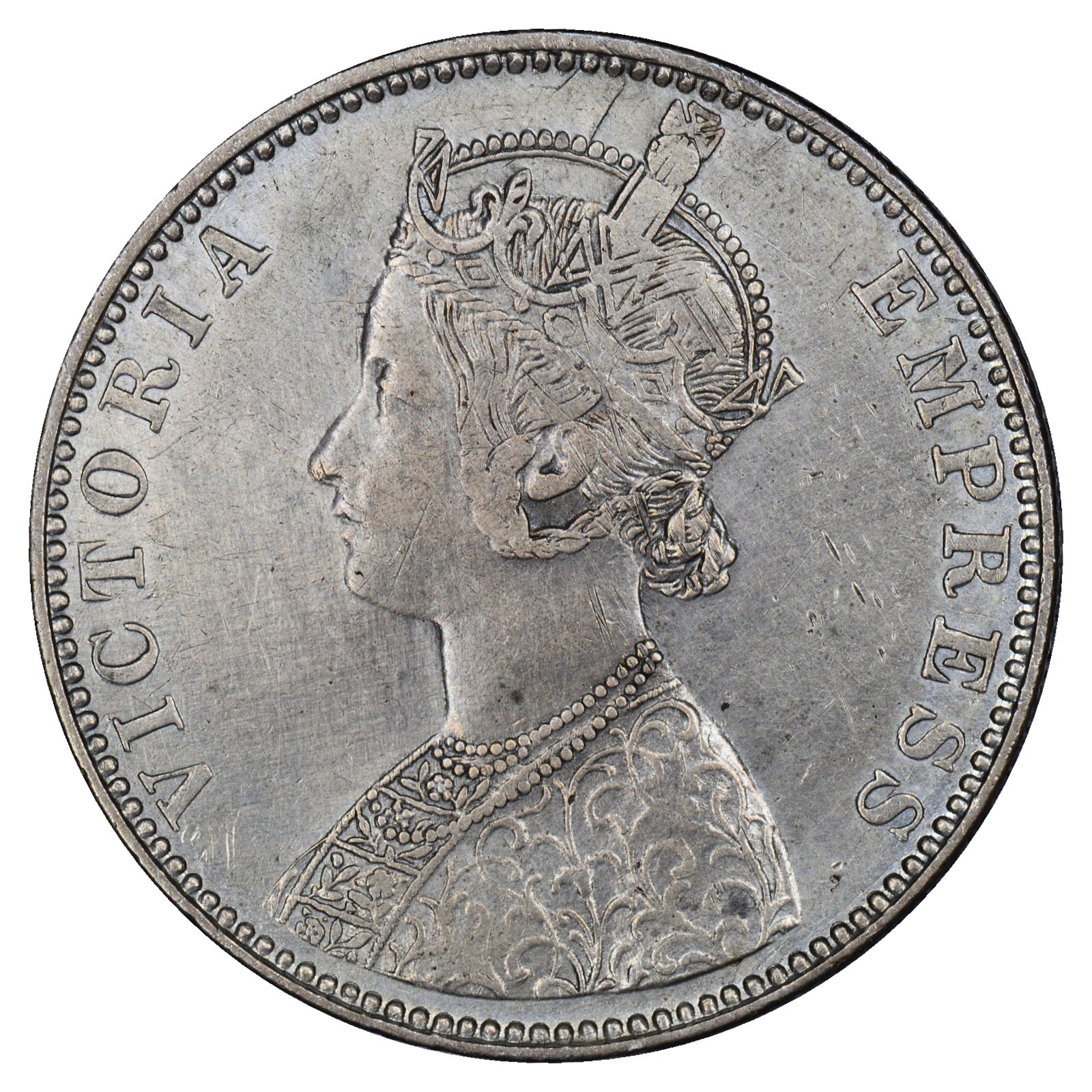
Victoria Empress
Crowned bust, left
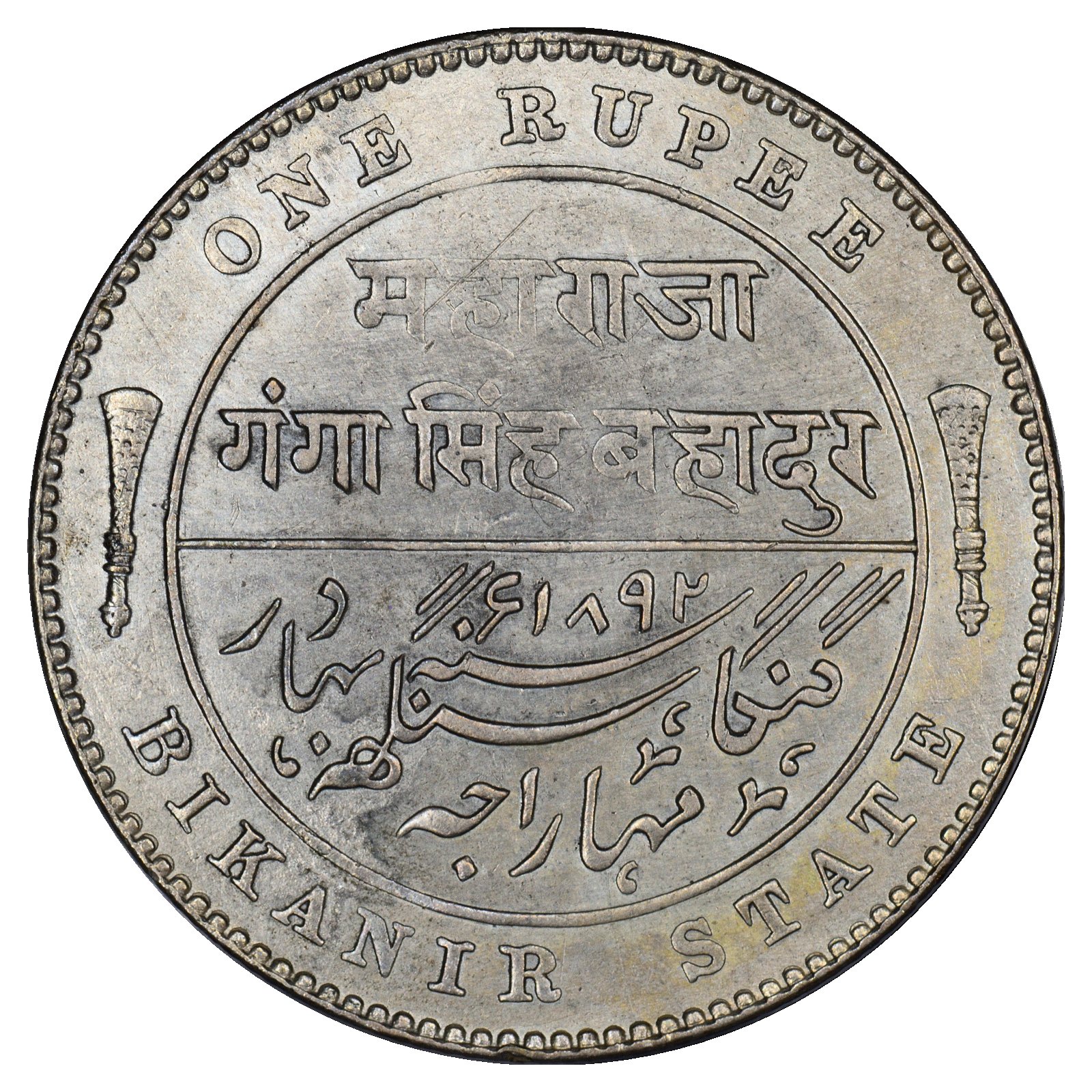
Maharaja Ganga Singh Bahadur
Devanagari & Arabic / ONE RUPEE / BIKANIR STATE
| Section | Topic | Notes | ||||||||||||||||||
|---|---|---|---|---|---|---|---|---|---|---|---|---|---|---|---|---|---|---|---|---|
| History & Context | ||||||||||||||||||||
| History | Bikanir State — Location & Background |
Bikanir (also spelled Bikaner) was a princely state in the Rajputana Agency, situated in the northern Thar Desert in what is now the state of Rajasthan, India. Founded in 1488 by Rao Bika, a son of the founder of Jodhpur, it was ruled by the Rathore clan of Rajputs throughout its history. By the nineteenth century it was one of the larger Rajputana states in area, though arid and sparsely populated relative to its neighbours. Its capital, Bikaner city, was a significant caravan trade hub on the routes between Central Asia and the subcontinent. The state had a treaty relationship with the British, formalised progressively through the nineteenth century, which placed it under British suzerainty while preserving internal autonomy including the right to strike coinage. | ||||||||||||||||||
| History | The Princely State Coinage System |
Under the political arrangements of the British Raj, larger and more significant princely states retained the right to strike their own coinage for internal circulation. Bikanir exercised this right across a series of issues from the pre-British period through to the modern milled coinage of the Ganga Singh era. The earlier Bikanir issues (pre-1892) were hand-struck in the traditional Indian manner, of smaller and irregular module — the rupees of Sardar Singh and Dungar Singh (KM#45 and KM#54) are distinctly smaller at approximately 22 mm and of varying diameter. The introduction of machine-struck coinage at the Calcutta Mint in 1892 was a modernising departure: for the first time, Bikanir rupees were of the same module (30.4 mm), weight, and fineness as imperial British India rupees — though with a distinct reverse design naming the local ruler. The shift from hand-struck to machine-struck (milled) coinage for Bikanir in 1892 is historically significant. The Calcutta Mint produced the coins on behalf of the state — this was a common arrangement for princely state issues of this period. | ||||||||||||||||||
| History | 1892 — The Coin in Context |
In 1892, Ganga Singh had been Maharaja for four years but was still a minor under British supervision (he was eleven). The global silver crisis that was affecting the imperial rupee simultaneously affected Bikanir’s monetary position: the value of silver was falling and the exchange rate between the rupee and sterling was deteriorating. The Indian mints would close to free silver coinage in 1893. The 1892 Bikanir rupee is therefore among the last issues struck before that monetary watershed, though as a princely state issue produced at government direction rather than free-market demand, the closure of the mints to free coinage affected it differently than the imperial series. | ||||||||||||||||||
| The Ruler — Maharaja Ganga Singh Bahadur | ||||||||||||||||||||
| Ruler | Ganga Singh — Early Life & Accession |
Born 13 October 1880, Ganga Singh was the youngest of three sons of Maharaj Lal Singh. His eldest brother Dungar Singh had been ruler of Bikanir from 1872, dying without surviving issue on 19 August 1887 (aged 32). Ganga Singh, who had been adopted by Dungar Singh as his son and heir, succeeded him on 16 December 1888 as the 21st Maharaja. He was eight years old at accession. His early years were spent under the guardianship of British political officers, then at Mayo College, Ajmer (1889–1894), the elite school established for the sons of Indian princes. He received administrative training from 1895–1898 before being invested with full governing powers. At the time the 1892 rupee was struck he was a child ruler whose name appeared on the coinage as a symbol of dynastic continuity rather than active governance. One older encyclopaedic source gives his accession year as 1887 (the year of Dungar Singh’s death); most sources including Wikipedia give the formal succession as 1888. The discrepancy may reflect the date of Dungar Singh’s death versus the formal installation of the new Maharaja. Treat 1888 as the confirmed succession year unless a primary source clarifies otherwise. | ||||||||||||||||||
| Ruler | Ganga Singh — Later Significance |
Although only eleven when this coin was struck, Ganga Singh went on to an extraordinary career. He modernised Bikanir extensively: establishing a Chief Court (the first in Rajputana), a Representative Assembly (1913), and a High Court (1922). He fought with the British in China (1901) commanding the famous Ganga Risala camel corps, served in Somaliland (1903), and placed Bikanir’s full resources at Britain’s disposal during World War I, serving on the headquarters staff in France. He was the only non-white member of the Imperial War Cabinet during World War I, and on 28 June 1919 became the first Indian signatory of the Treaty of Versailles. He built the Gang Canal (completed 1927), the first major irrigation project in independent India’s future Rajasthan, transforming large areas of desert into agricultural land. He died on 2 February 1943 after a fifty-five year reign. The 1892 rupee is numismatically interesting precisely because it names this man at age eleven — before any of the above achievements. It is the earliest coinage to bear his name. | ||||||||||||||||||
| Design Detail | ||||||||||||||||||||
| Design | Obverse — Victoria Empress |
The obverse carries a crowned bust of Victoria facing left, with the legend VICTORIA EMPRESS running around the circumference. The portrait is consistent with the “Empress” type used on imperial British India coinage from 1877 onward. Note that this is a crowned bust — unlike the veiled and diademed bust of the concurrent British India imperial rupee. Whether the obverse die was a distinct Bikanir-specific design or derived directly from an imperial die is worth verifying against Pridmore or a specialist catalogue. I am not fully certain whether the Bikanir obverse portrait is identical to or a variation of the concurrent imperial rupee obverse. The Museums Victoria catalogue describes it as “crowned bust of Queen Victoria facing left, around, VICTORIA EMPRESS” — the word “crowned” (rather than veiled or diademed) may indicate a distinct portrait type. Confirm from a high-resolution image or specialist catalogue. | ||||||||||||||||||
| Design | Reverse — Bilingual Legend |
The reverse is divided by a horizontal line into two zones: Above the line: The name of the Maharaja in Devanagari script: महाराजा गंगा सिंह बहादुर (Maharaja Ganga Singh Bahadur) Below the line: The same name and title in Persian/Arabic script, followed by the date ١٨٩٢ (1892) in Arabic-Indic numerals preceded by the ‘ain (ع) marker indicating the Iswy (AD/Christian) calendar year. Outer legend: ONE RUPEE above, BIKANIR STATE below, in English Roman lettering. The ‘ain before the date is a well-documented feature of this coin series, noted in the Numista catalogue. It is not a die error or damage — it is the conventional Arabic marker for “Christian year” used in South Asian numismatic tradition to distinguish the Gregorian date from Hijri or Samvat dating. Worth pointing out when attributing the coin to buyers unfamiliar with the convention. |
||||||||||||||||||
| Design | Edge & Striking |
The edge is reeded (milled), consistent with machine-struck coinage. The coin is medal-aligned (↑↑). The shift to machine striking in 1892 brought Bikanir coinage into conformity with the technical standards of the Calcutta Mint and made the module, weight, and edge uniform across the series — a marked contrast to the earlier hand-struck Bikanir issues which show variation in diameter and surface quality. Strike quality on the 1892 machine-struck issues is generally good, though the reverse legend — particularly the upper central lettering of BIKANIR STATE — is noted as an occasional weakness on circulated examples. | ||||||||||||||||||
| Mint & Production | ||||||||||||||||||||
| Mint | Calcutta Mint — No Mint Mark |
The 1892 Bikanir rupee was struck at the Calcutta Mint on behalf of the Bikanir state. No mint mark appears — consistent with Calcutta practice for this period. The coin would have been struck from dies prepared at or for the Calcutta Mint, with the reverse design incorporating the state-specific bilingual legend. Attribution to Calcutta is confirmed by the Museums Victoria collection record and is consistent with the known practice of major princely states commissioning the Calcutta Mint (and later also the Bombay Mint) to produce their milled coinage. | ||||||||||||||||||
| Mint | Series Duration — 1892–1897 |
KM#72 covers the years 1892 through 1897 — six years in all, all under Ganga Singh but all during his minority. The 1892 date is the first year of the series and the first year of machine-struck Bikanir coinage. Worth verifying: whether all six years (1892, 1893, 1894, 1895, 1896, 1897) were actually struck, or whether some years saw no production — the pattern of the concurrent imperial rupee series (where 1894–1896 saw no production) does not necessarily apply to princely state issues, but is worth checking. I do not have confirmed per-year mintage data for the 1892–1897 Bikanir series. One source lists a mintage of approximately 596,000 for 1892, but I cannot confirm this from a primary source — treat as indicative only and verify against Krause or a specialist Indian princely states catalogue. | ||||||||||||||||||
| Valuation | ||||||||||||||||||||
| Value | Price Guide — 1892 Date |
|
||||||||||||||||||
| Value | Silver Content vs Numismatic Value |
At approximately $75/oz silver, the bullion floor is approximately $25.31. The numismatic premium over bullion therefore begins at roughly 1–2× in Fine, rising to 6–12× in certified MS-63. The coin is not common in high grades — the NGC census reference of 15 at MS-63 with none higher suggests genuine condition rarity at the top end. At lower grades it is collectible but not scarce. Verify current silver spot price and NGC census numbers before using these figures in any transaction context. | ||||||||||||||||||
| Collecting Notes | ||||||||||||||||||||
| Collect | Who Collects This Coin and Why |
The 1892 Bikanir rupee appeals to several distinct collector audiences. British India collectors pursue it as a companion to the imperial rupee series — same year, same mint, different authority. Princely states specialists collect it as part of a systematic run of Rajputana or Bikanir state issues. Ganga Singh admirers seek it as the earliest coinage bearing his name — well before his fame as a statesman. Bilingual / multilingual coinage collectors value it for the three-script reverse (Devanagari, Arabic, Roman). And dual-authority coin collectors — coins showing imperial and local rulership simultaneously — consider it an excellent example of the genre alongside similar princely state issues from Hyderabad, Travancore, and Jaipur. | ||||||||||||||||||
| Collect | What to Look For — Grading Points |
Key grading points for this coin: (1) The portrait on the obverse — first point of wear; the hair and crown details flatten early. (2) BIKANIR STATE on the reverse lower legend — noted in the trade as prone to weakness, particularly in the upper central letters; a coin with full sharp letters here commands a premium. (3) The Devanagari inscription — fine script detail; should be fully legible in VF and above. (4) The Arabic date — the Arabic-Indic numerals and ‘ain marker should be sharp; these are a distinctive attribution feature and should be fully readable. (5) The dividing line — should be crisp and fully raised. (6) The edge — reeding should be full and uniform; partial reeding may indicate a collar issue or edge damage. | ||||||||||||||||||
| Collect | Problems to Avoid | (1) Cleaning — very common in Indian silver; look for artificial brightness or hairlines under raking light. (2) Weak strike on BIKANIR STATE — do not confuse a strike weakness with wear; a weakly-struck EF will have soft upper letters but otherwise fresh surfaces. (3) Confusing earlier hand-struck Bikanir rupees with this issue — the 1892 machine-struck coin is 30.4 mm and fully round; earlier Bikanir issues are smaller (around 20–22 mm) and irregular. (4) Misidentifying the date — the ‘ain before ١٨٩٢ is sometimes confused by inexperienced buyers; the date is 1892 AD, not a Hijri date. (5) Banker’s marks — punch marks from bazaar or treasury use reduce collector value and should be disclosed. | ||||||||||||||||||
| Collect | Related Coins | Natural companions: the 1892 British India imperial rupee (KM#473 / Empress type — same year, same mint, imperial rather than princely authority; an obvious pair); the later Bikanir rupees 1893–1897 (completing the KM#72 series); the earlier hand-struck Bikanir rupees of Dungar Singh (KM#54, pre-1888 — shows the technological contrast); and princely state rupees of comparable Rajputana states — Jaipur, Jodhpur, and Alwar — which offer useful parallel issues for thematic collection building. The coin also pairs naturally with any portrait or commemorative piece featuring the adult Ganga Singh, who appears widely in British and Indian official photography and portraiture of the 1900s–1930s. | ||||||||||||||||||
Sources: Museums Victoria collection record NU 15031 / NU 33260 (CC BY 4.0) — confirmed mint, design description, and KM reference · Numista catalogue N#36428 — specifications, legend transcription, ‘ain date marker explanation · Krause, Colin R. Bruce II, Standard Catalogue of World Coins 1801–1900 — KM#72 reference (verify weight and mintage in current edition) · Caesar’s Ghost Numismatics — NGC MS-63 census reference (verify current population at ngccoin.com) · Baldwin’s Auctions — VF realised price reference · Wikipedia: Ganga Singh, Dungar Singh — biographical data · Silver spot price reference: ~$75/oz USD (verify current price before use) · Important: Mintage figures, full per-year production data for the 1892–1897 series, and confirmed die variety information have not been independently verified. Consult a specialist Indian princely states catalogue before citing specific mintage numbers.