British India Rupee — Victoria Empress — 1877–1901 One Rupee — Silver .917 — Three Mints — Twenty-Five Years of Imperial Coinage
KM# 492 · Silver .917 fine · 30.6–31.0 mm · 11.66 g · Reeded edge · Medal alignment (↑↑) · Calcutta, Bombay & Madras mints
The Royal Titles Act 1876 — Victoria Becomes Empress
On 1 May 1876, by proclamation at the Delhi Durbar, Queen Victoria assumed the additional title of Empress of India — a decision driven largely by Prime Minister Benjamin Disraeli, who sought to give British sovereignty over India a grander imperial title comparable to the Kaiser and the Tsar. The change was formalised by the Royal Titles Act 1876. From 1877 onward, the obverse legend on all British Indian coinage was changed from VICTORIA QUEEN to VICTORIA EMPRESS, creating a clean break between the 1862–1876 "Queen" series and the 1877–1901 "Empress" series. These twenty-five years of Empress coinage represent the high-water mark of Victorian imperial self-confidence — the rupee as a symbol of direct Crown rule over a subcontinent of over 280 million people.
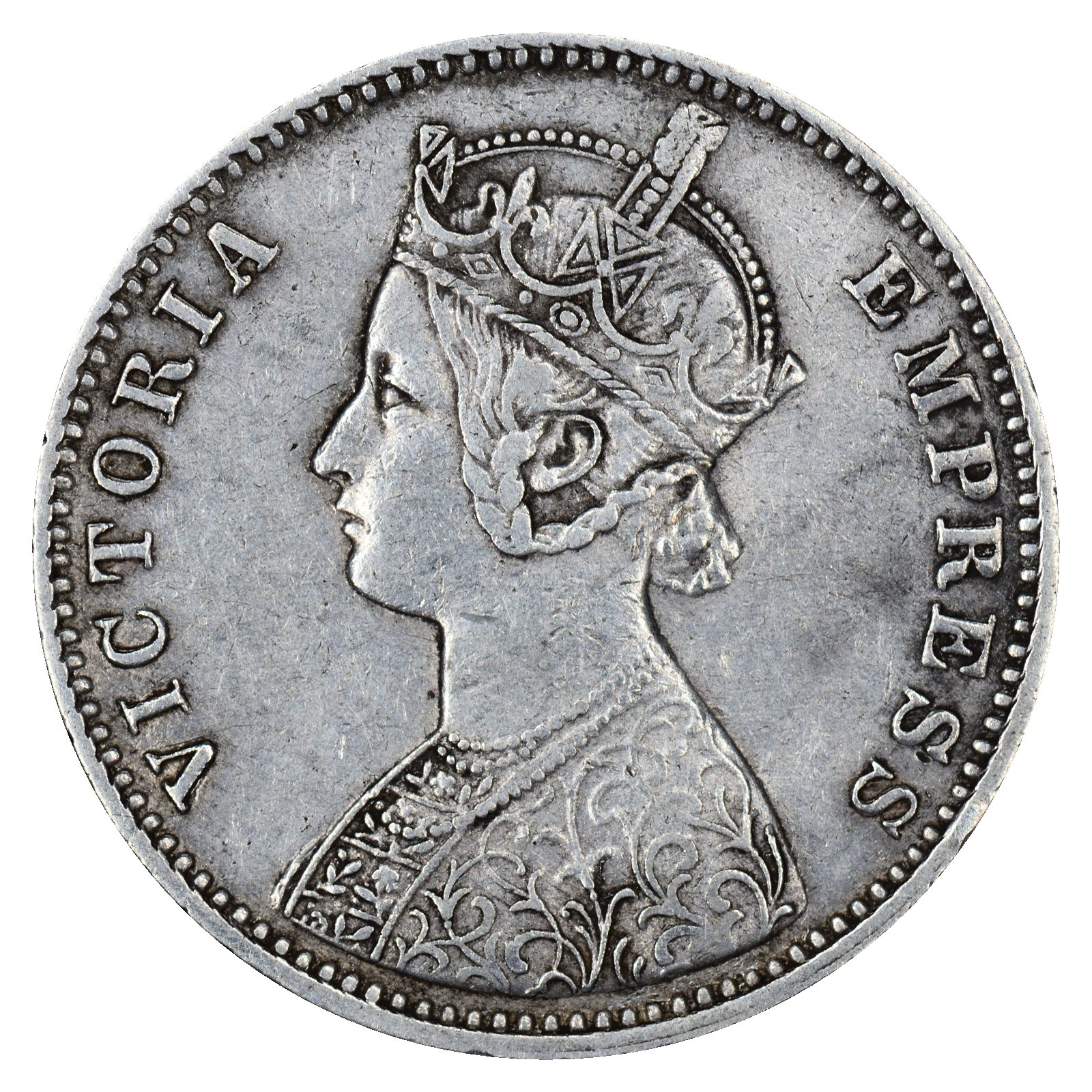
Victoria Empress, crowned
VICTORIA EMPRESS
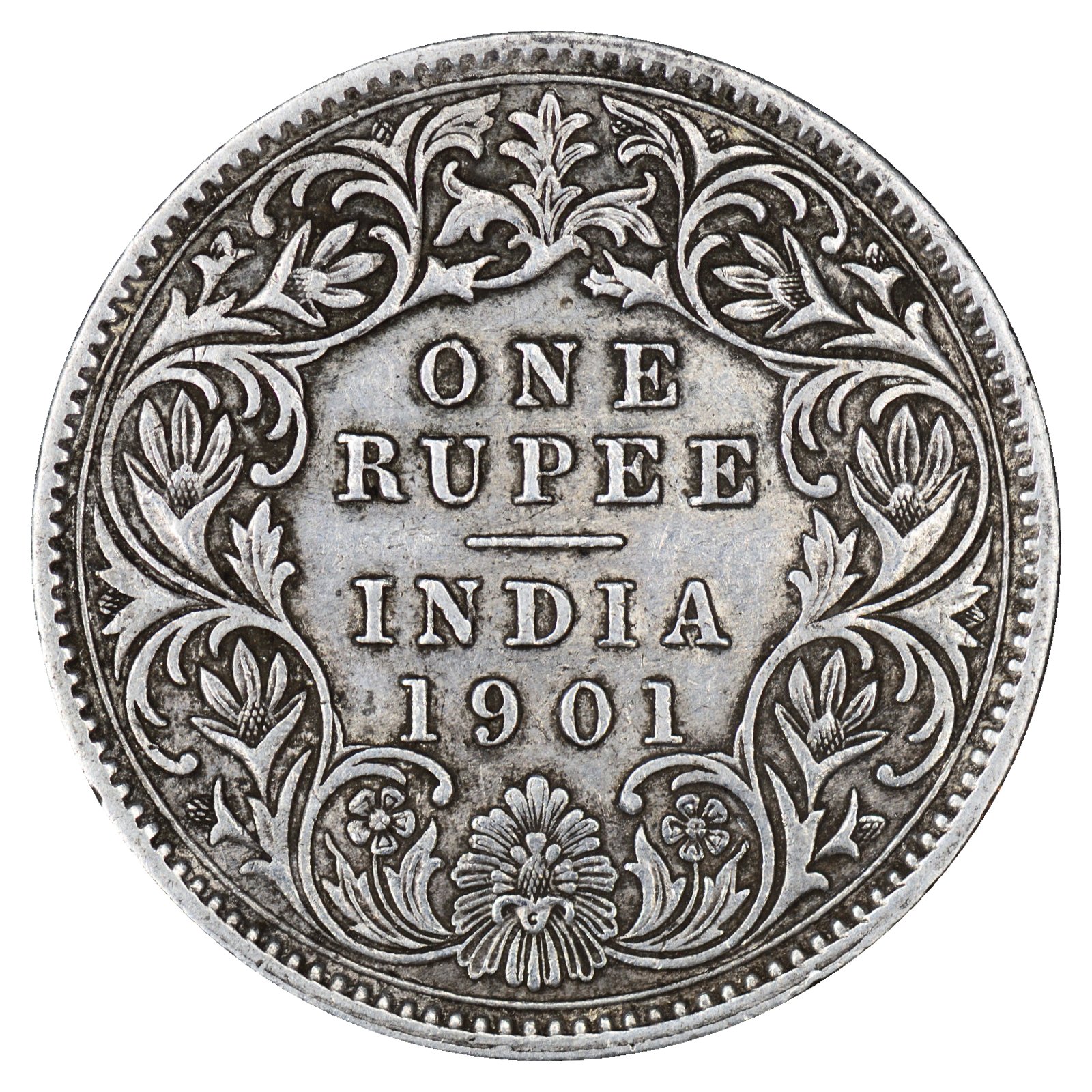
ONE RUPEE / INDIA / date
Lotus-flanked denomination
| Section | Topic | Notes | ||||||||||||||||||||||||||||||||||||
|---|---|---|---|---|---|---|---|---|---|---|---|---|---|---|---|---|---|---|---|---|---|---|---|---|---|---|---|---|---|---|---|---|---|---|---|---|---|---|
| History & Context | ||||||||||||||||||||||||||||||||||||||
| History | The Rupee in Victorian India |
The rupee — worth sixteen annas, sixty-four pice, one hundred and ninety-two pies — was the fundamental monetary unit of British India and the coin most people on the subcontinent encountered as a unit of real value. In the 1880s, a common agricultural labourer in Bengal might earn three or four rupees per month; a junior government clerk perhaps fifteen. The rupee paid land tax, settled court fees, bought cotton at a village market, and travelled vast distances through an economy that was still primarily agricultural but increasingly integrated into global commodity trade. Its silver content conferred the trust no paper currency could yet command among the majority of the population. 1 Rupee = 16 Annas = 64 Pice = 192 Pies. This subdivision survived until Indian decimalisation in 1957. The rupee of the 1877–1901 period was nominally tied to sterling at 1s 4d, but after the closure of the Indian mints to free silver coining in 1893 — a response to the collapse of silver prices globally — the actual exchange rate was pegged at 1s 4d by government intervention, which meant the rupee was effectively on a managed gold-exchange standard despite remaining a silver coin. | ||||||||||||||||||||||||||||||||||||
| History | Victoria as Empress |
Alexandrina Victoria (24 May 1819 – 22 January 1901) was Queen of the United Kingdom from 20 June 1837 and, from 1 May 1876, Empress of India. Her sixty-three-year reign — the longest of any British monarch before Elizabeth II — encompassed the transformation of Britain from a predominantly agricultural nation into the world's leading industrial power, and of the British Empire into an entity covering approximately one-quarter of the world's land surface and population. In India, her reign as Empress spanned the period from the consolidation of Crown rule after the 1857 Rebellion through to the very beginnings of the organised independence movement. She never visited India. She died at Osborne House on the Isle of Wight on 22 January 1901, and was succeeded by her son Edward VII. The final rupees dated 1901 bearing her portrait were among the last coins struck in her name. The Empress title was controversial in Britain at the time of its creation. Several senior politicians objected to what they saw as a continental, autocratic style of titulature. Victoria herself had long desired the title, partly for dynastic-prestige reasons — she outranked European emperors in length of service but not formally in title — and Disraeli's government delivered it. The change to "Victoria Empress" on the Indian coinage was therefore also a small act of political symbolism. | ||||||||||||||||||||||||||||||||||||
| History | The Silver Crisis of 1893 |
The most significant monetary event of the Empress series was the closure of the Indian mints to free silver coining on 26 June 1893. Through most of the nineteenth century, any individual could bring silver bullion to the Indian government mints and have it struck into rupees at a fixed rate (brassage only) — a system known as "free coinage." The collapse of global silver prices from the 1870s onward (driven by new silver discoveries in the American West and the demonetisation of silver by major European powers) meant the rupee was falling in value relative to gold and sterling, causing severe fiscal problems for the Indian government, which paid its London obligations in gold. The 1893 closure ended free coinage, fixed the rupee–sterling rate by government action, and in effect moved India onto a gold-exchange standard while retaining silver coinage as the physical medium. The 1893 closure had a direct effect on rupee mintage: in 1892 and earlier, mintages could be very large (tens or hundreds of millions) driven by private silver submission; after 1893, coinage was controlled entirely by government demand. This explains why some dates in the later years of the series (1893–1901) have substantially lower mintages than the high-production years of the 1880s. | ||||||||||||||||||||||||||||||||||||
| History | The Batta System and Honest Dating |
The Empress series inherited the legacy of the batta system — a practice by which certain bazaar dealers (shroffs) refused to accept government coins at face value, insisting instead on assaying each coin individually. To counteract this, the Bombay Mint had introduced an eccentric dot-dating system between 1863 and 1875 on the earlier "Victoria Queen" rupees: the actual year of minting was encoded in dots on the reverse rather than shown directly, so the same nominal date appeared on multiple years' production, preventing shroffs from discriminating between different years. By 1874, the batta system had largely disappeared, and from the 1877 Empress series onward all rupees were continuously dated — the actual year of minting appears directly on every coin without any dot-dating obfuscation. Collectors of the Empress series therefore deal with straightforward year-by-year dating, a considerable simplification over the earlier "Queen" series. | ||||||||||||||||||||||||||||||||||||
| Design | ||||||||||||||||||||||||||||||||||||||
| Design | Obverse — The Imperial Portrait |
The obverse bears a crowned and draped bust of Victoria facing left, with the legend VICTORIA EMPRESS running around the rim. The portrait is based on a mature, crowned effigy of the Queen — distinct from the young, uncrowned bust used on the earlier "Victoria Queen" issues. The portrait for the Empress series was modelled after work by William Wyon's successor generation at the Royal Mint; it is attributed in numismatic literature to work prepared at the Royal Mint for the Indian series. The Queen wears a small crown and her dress is shown in carefully rendered folds — the specific panel count and floral detail of the dress are among the key diagnostic features used to distinguish obverse types and mint attribution (see Mints section below). The initials of the engraver do not appear on the Empress rupee obverse, in contrast to British domestic coinage of the same period. The portrait was modelled from an official bust and prepared centrally, then distributed to the mints in the form of working dies. Die quality and striking pressure at each mint produced subtle but detectable differences in the portrait's appearance between Calcutta, Bombay, and Madras issues. | ||||||||||||||||||||||||||||||||||||
| Design | Reverse — ONE RUPEE |
The reverse design is formal and restrained: the denomination ONE RUPEE and the word INDIA appear in English within a central panel. Below the denomination, in Persian/Urdu script: یک روپیہ (Yek Rupiya, "One Rupee"). The date appears at the base. On either side of the central inscription, sprays of lotus flowers rise from the bottom and frame the denomination panel. Above the panel, a Royal Crown surmounts the composition. All elements sit within a raised toothed border. The reverse design remained essentially unchanged throughout the 1877–1901 series — the principal collecting distinctions on the reverse side are the mint marks (see below) and the reverse die type (I, II, IIa, III, or IV in the Pridmore–Campbell classification). The bilingual denomination — English and Urdu — is a deliberate acknowledgement of the linguistic reality of British India. The Urdu text addressed the majority of Indian users who read Persian script; the English text addressed the administrative and commercial class. The lotus flanking the denomination panel is a direct reference to the Indian flora that recurs on much of the British India coinage series. | ||||||||||||||||||||||||||||||||||||
| Design | Obverse Types — A, B, and C |
Numismatic scholars, particularly following the work of Franklin Campbell and F. Pridmore, identify three distinct obverse types for the Victoria Empress rupee, distinguishable by the rendering of the dress on the obverse:
Type A: The front of the dress has 4⅓ panels, with a flower at the centre of the bottom panel. Used at Bombay from 1877. Type B: The front of the dress has 4 panels, with a flower at the right of the bottom panel. Used at Calcutta from 1877. Type C: A later obverse type used at Calcutta and for some Bombay production; differs in subtle legend spacing and die characteristics from Types A and B. The obverse type distinction is primarily of interest to specialist collectors rather than type collectors. For general collecting of the Empress rupee, the date and mint attribution are the primary variables. The Campbell–Pridmore obverse type system is the standard reference for systematic variety study; the jfcampbell.us website provides detailed photographic comparisons for each obverse and reverse type combination. |
||||||||||||||||||||||||||||||||||||
| Design | Reverse Types — I through IV |
The Campbell–Pridmore classification also identifies five reverse types (I, II, IIa, III, IV) for the Empress rupee, distinguished by differences in the lotus flower rendering, the position and style of the crown, and the exact layout of the denomination panel. The most commonly encountered reverse types in the Empress series are Types II and III; Type I is associated with the transitional year issues of 1877. Reverse type IV is the latest issue type and is found on some of the final-year examples. Worth verifying: the exact years in which each reverse type was introduced and at which mint are documented in detail in Pridmore's The Coins of the British Commonwealth of Nations, Part IV: India and in the Campbell database at jfcampbell.us. For general collecting purposes, date and mint are sufficient; reverse types are a specialist sub-area comparable to the die varieties of early US coinage. | ||||||||||||||||||||||||||||||||||||
| Mints & Attribution | ||||||||||||||||||||||||||||||||||||||
| Mint | The Three Mints — Overview |
The Victoria Empress rupee was struck at three mints throughout the 1877–1901 period: Calcutta (no mint mark or incused C), Bombay (raised bead below date, or raised/incused B in the lotus flower), and Madras (struck 1877–1878 only; slightly larger diameter, distinctive attribution criteria). The existence of three mints creates a meaningful collecting dimension for the series: for each date, one, two, or all three mints may be represented, and examples from each mint are attributed by the mint mark system below. The Madras Mint closed its rupee production after 1878 and is not a factor for most dates in the series. Calcutta and Bombay continued producing rupees through 1901. Diameter differences are a useful secondary attribution tool: Calcutta rupees typically measure 30.6 mm or less; Bombay examples 30.7–30.9 mm; Madras examples 30.9–31.0 mm. | ||||||||||||||||||||||||||||||||||||
| Mint | Calcutta Mint — No Mark or Incused C |
Calcutta (now Kolkata) was the senior mint and the largest producer of rupees throughout the Empress series. Most Calcutta rupees carry no mint mark at all — attribution is by the absence of any symbol. However, from approximately 1882 to 1886, certain Calcutta issues carry a tiny incused "C" on a bead of the inner circle below the date on the reverse — a secondary identifier that can be detected under magnification. This incused C is faint and easy to miss; its absence does not preclude Calcutta attribution for other years. The Calcutta Mint was established in its modern form in 1829 and remained the primary Indian mint throughout the Victorian era. It is now known as the India Government Mint, Kolkata, and continues to operate. The absence of a mint mark — Calcutta's defining attribute — makes inexperienced collectors sometimes search for a non-existent identifier. If no bead, no B, and no raised dot appears on the reverse, and the diameter is 30.6 mm or under, the coin is from Calcutta. | ||||||||||||||||||||||||||||||||||||
| Mint | Bombay Mint — Bead, Dot, or B |
Bombay (now Mumbai) is identified on Empress rupees by one of several marks:
Raised bead below the date: The most commonly cited Bombay identifier — a small raised dot or bead appearing directly below the date numeral on the reverse. This is the same position as the Bombay mark used on later George V and George VI rupees, though described slightly differently. Raised or incused "B" in the top or bottom lotus flower: On some issues, a small letter B appears within one of the lotus flowers flanking the denomination panel. The presence of either the bead or the B (or both) confirms Bombay attribution. On worn Empress rupees, the Bombay bead can be very difficult to see and may require raking light and a 10× loupe for reliable attribution. Coins on which no mark can be confirmed after careful examination are generally attributed to Calcutta (by exclusion), provided the diameter is consistent. Bombay examples typically measure 30.7–30.9 mm. |
||||||||||||||||||||||||||||||||||||
| Mint | Madras Mint — 1877–1878 Only |
The Madras Mint (now Chennai) struck rupees only in the first two years of the Empress series — 1877 and 1878 — before its production was consolidated into the Calcutta and Bombay facilities. Madras rupees are identified primarily by their slightly larger diameter of 30.9–31.0 mm, which is measurably wider than Calcutta or Bombay examples. Die characteristics (legend spacing, portrait rendering, lotus detail) also differ from the other mints and are documented in the Campbell reference. The Madras Mint's rupees are therefore limited to 1877 and 1878 dates only. For collectors specifically seeking Madras examples, a calliper measurement is the most reliable primary test — any rupee measurably above 30.9 mm in diameter is a strong Madras candidate, confirmed by die characteristics under magnification. Madras examples are appreciably scarcer than Calcutta or Bombay examples and attract a modest premium among specialist collectors. | ||||||||||||||||||||||||||||||||||||
| Mint | Date Survey — 1877–1901 |
|
||||||||||||||||||||||||||||||||||||
| Valuation | ||||||||||||||||||||||||||||||||||||||
| Value | Market Overview | The Victoria Empress rupee is one of the most widely collected British India coins — accessible in circulated grades, historically significant, and carried by plentiful supply from the high-mintage years of the 1880s. Common-date examples (1880s, both mints) in VF are affordable and readily available. Collector demand increases meaningfully for: (1) post-1893 dates in any grade above VF; (2) Bombay-mint examples with a clear bead/B attribution confirmed; (3) Madras Mint examples (1877–1878 only); (4) uncirculated examples of any date; and (5) proof strikes, which were produced for presentation and are genuinely rare at any date. | ||||||||||||||||||||||||||||||||||||
| Value | Price Guide — Common Dates (USD) |
|
||||||||||||||||||||||||||||||||||||
| Value | Silver Content vs Numismatic Value |
The bullion floor of ~$25.78 at $75/oz silver means that a common-date Empress rupee in VF ($20–$35) sits very close to its intrinsic metal value — making any such example a genuine silver coin worth acquiring on both numismatic and intrinsic grounds. In EF and above, collector premiums of 1.5–4× bullion are typical for common dates; for post-1893 scarce dates in UNC, premiums of 10–20× bullion are not unusual. For proofs of any date, the premium is driven entirely by rarity and provenance, with bullion value essentially irrelevant to the price achieved. | ||||||||||||||||||||||||||||||||||||
| Collecting Notes | ||||||||||||||||||||||||||||||||||||||
| Collect | What to Look For | Key grading and attribution points: (1) The crown — the arches and cross-pattée at the summit; first to show friction. (2) The cheek and brow — smooth high-relief areas; wear flattens the cheekbone first. (3) The lotus flanking — the individual flower petals and stems; should be distinct at EF; merging at VF. (4) The Bombay bead — below the date on the reverse; requires 10× loupe and raking light; present = Bombay, absent = Calcutta (after 1878). (5) The incused C — on 1882–1886 Calcutta issues; extremely faint, on a bead of the inner circle below the date. (6) Original lustre — genuine UNC examples show full die-flow lines in raking light; cleaned coins show flat brightness without directional lustre. (7) Diameter — a calliper measurement is useful for Madras attribution (30.9–31.0 mm). | ||||||||||||||||||||||||||||||||||||
| Collect | Problems to Avoid | (1) Cleaning and polishing — extremely common in Victorian Indian silver; a bright, uniformly polished surface almost certainly indicates cleaning. Natural toning on genuine uncirculated examples is a cool silver-grey. (2) Misidentified Bombay attribution — a random die chip at the base of the reverse is not a mint mark; genuine Bombay beads are small, circular, raised, and consistently positioned below the date. (3) Confusing Empress rupees with Queen rupees — the 1862–1876 KM# 473 series uses the same reverse design but a different obverse legend (VICTORIA QUEEN); always read the obverse legend. (4) Over-grading — the reverse of the Empress rupee (particularly the lotus detail) survives wear well; grade by the obverse portrait. (5) Fake Madras examples — occasionally a Calcutta or Bombay rupee is offered as a "Madras" at a premium; always verify by diameter measurement before paying the Madras premium. | ||||||||||||||||||||||||||||||||||||
| Collect | Collection Contexts | The Victoria Empress rupee fits naturally into: a British India rupee type set by monarch (Victoria Queen 1862–1876, Victoria Empress 1877–1901, Edward VII 1903–1910, George V 1911–1922, George VI 1938–1945 — five types, five coins); a Victoria Empress date set (1877–1901, one coin per year, either mint — 25 pieces); a three-mint set (one Calcutta, one Bombay, one Madras example — three coins, the Madras being 1877 or 1878 only); a Victorian silver world coinage collection pairing it with British domestic Victorian silver, Australian shillings, and other Empress-era Commonwealth coins; or a 1877 first-year set capturing the Empress title change alongside other coins from that symbolic year. | ||||||||||||||||||||||||||||||||||||
| Collect | Related Coins | Natural companions: the Victoria Queen rupee 1862–1876 (KM# 473) — direct predecessor; same reverse format, "VICTORIA QUEEN" obverse legend, and the complex dot-dating system of the Bombay Mint; the Victoria Empress half rupee (same obverse, reduced module); the Victoria Empress quarter rupee; the Edward VII rupee 1903–1910 (KM# 508) — immediate successor; uncrowned portrait by de Saulles, same reverse format; the Victoria Empress gold mohur 1877–1891 — the premium gold denomination sharing the new Empress legend; and for thematic collectors, the 1877 British India proclamation medal struck to mark the assumption of the Empress title at the Delhi Durbar. | ||||||||||||||||||||||||||||||||||||
Sources: Krause, C. L. & Mishler, C. Standard Catalog of World Coins — KM# 492 (Victoria Empress rupee, 1877–1901) · Pridmore, F. The Coins of the British Commonwealth of Nations, Part IV: India — obverse and reverse type classification, mint attribution criteria · Campbell, J. F. — jfcampbell.us: Victoria rupee obverse types, reverse types, and mint mark documentation · chiefacoins.com — British India coinage under Victoria 1862–1901; Calcutta incused C dates 1882–1886; mint diameter measurements · Wikipedia — "Coins of British India" — mint mark description, Bombay bead and incused B, Madras attribution, closure of mints 1893 · Numista catalogue — KM# 492, N# 3719; community valuations · NGC World Coin Price Guide — India-British Rupee KM# 492 (1877–1901) · Grokipedia — "Coins of British India" — silver standard confirmation, mint mark B introduction 1883 · Heritage Auctions — British India Victoria Empress rupee realized prices 2020–2026 · Silver spot price reference: ~$75/oz USD