British India Rupee — George VI — 1938–1945 One Rupee — Silver .917 (1938–1939) & .500 (1940–1945) — Metcalfe & Spencer — Calcutta, Bombay & Lahore
High silver: KM#555 (1938–1939, .917) · Debased: KM#556 (1940–1945, .500 reeded) · KM#557 (.500 security edge) · 30.0 mm · 11.66 g · Calcutta (no mark) · Bombay (dot/diamond) · Lahore (L)
KM#555 — .917 Silver — 1938–1939 — High Silver Issue
- Years struck: 1938 and 1939 only (Calcutta and Bombay)
- Silver fineness: .917 — the traditional Indian standard, unchanged since Victoria
- ASW: 0.3437 troy oz per coin (10.69 g fine silver)
- Key date: 1939 — both mints; rarest date of the series at any grade
- Edge: Reeded throughout
- Value range: $35 – $900+ depending on date, mint, and grade
- Primary market: Specialist dealers; Heritage and Stack's Bowers auctions
KM#556 / KM#557 — .500 Silver — 1940–1945 — Debased Wartime Issue
- Years struck: 1940–1945; transitional .500 examples also exist dated 1939
- Silver fineness: .500 — halved from .917 in response to WWII silver price surge
- ASW: 0.1874 troy oz per coin (5.83 g fine silver)
- Mints: Calcutta, Bombay, and Lahore (Lahore added from 1943)
- Key varieties: Large 5 in date (1945, all three mints); reeded vs. security edge
- Value range: $28 – $750+ depending on date, mint, variety, and grade
Two Designers — Metcalfe's Crown and Spencer's Scroll
Percy Metcalfe (1895–1970), one of the leading British medallic sculptors of the inter-war period, was commissioned by the Royal Mint to provide the new obverse portrait of George VI for the Indian coinage. His left-facing crowned bust of the King — in uniform, without the full coronation robes of his predecessor — was despatched from London to the Indian mints in 1937 and first appeared on the 1938 coinage. The legend reads GEORGE VI KING EMPEROR. A. P. Spencer, Artist-Engraver at His Majesty's Mint, Calcutta, redesigned the reverse: he adapted Percy Brown's Saracenic scroll from the George V series, retaining the core vocabulary of rose, thistle, shamrock, and Indian lotus, but remodelling the arabesque frame and tightening the central denomination panel. Spencer's authorship is documented in Major F. Pridmore's 1968 paper for the British Numismatic Society: "Mr A. P. Spencer, Artist/Engraver, His Majesty's Mint, Calcutta and the re-designed Coinages of King George VI British India 1938–1947." Metcalfe's portrait speaks of a new and more modest monarchy; Spencer's scroll continues, unbroken, the visual tradition Brown established in 1911.
The 1940 Debasement — From .917 to .500
The outbreak of the Second World War in September 1939 immediately drove the global price of silver upward. By late 1939, the intrinsic value of the silver in a rupee coin was approaching its face value — precisely the condition that produces hoarding on a mass scale. The Government of India acted: from 1940, the standard for the one rupee was reduced from .917 fine to .500 fine, halving the silver content from 10.69 g to 5.83 g of pure silver per coin. A small number of transitional .500 rupees was also struck in 1939, before the official change year. The coin's weight, diameter, and design were unchanged — the debasement was invisible in the hand. The consequence for collectors is a two-tier series: the 1938 and 1939 .917 rupees carry the traditional Indian silver standard maintained since the Victorian era; the 1940–1945 .500 rupees are the wartime issues, struck in larger quantities at three mints to replace hoarded coinage. The .917 rupees, and above all the scarce 1939 date, are consistently the most sought-after pieces in the George VI series.
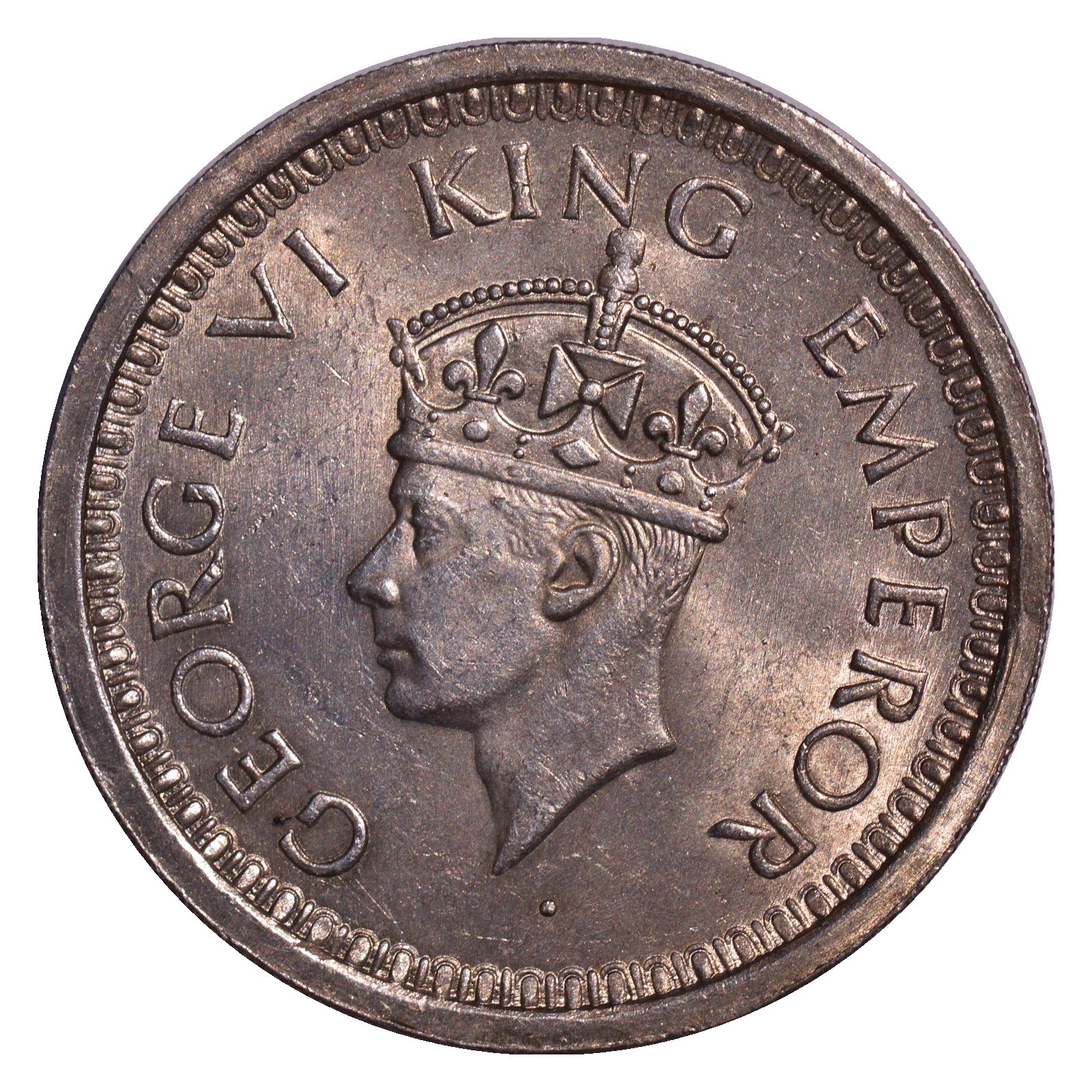
George VI — Metcalfe
GEORGE VI KING EMPEROR
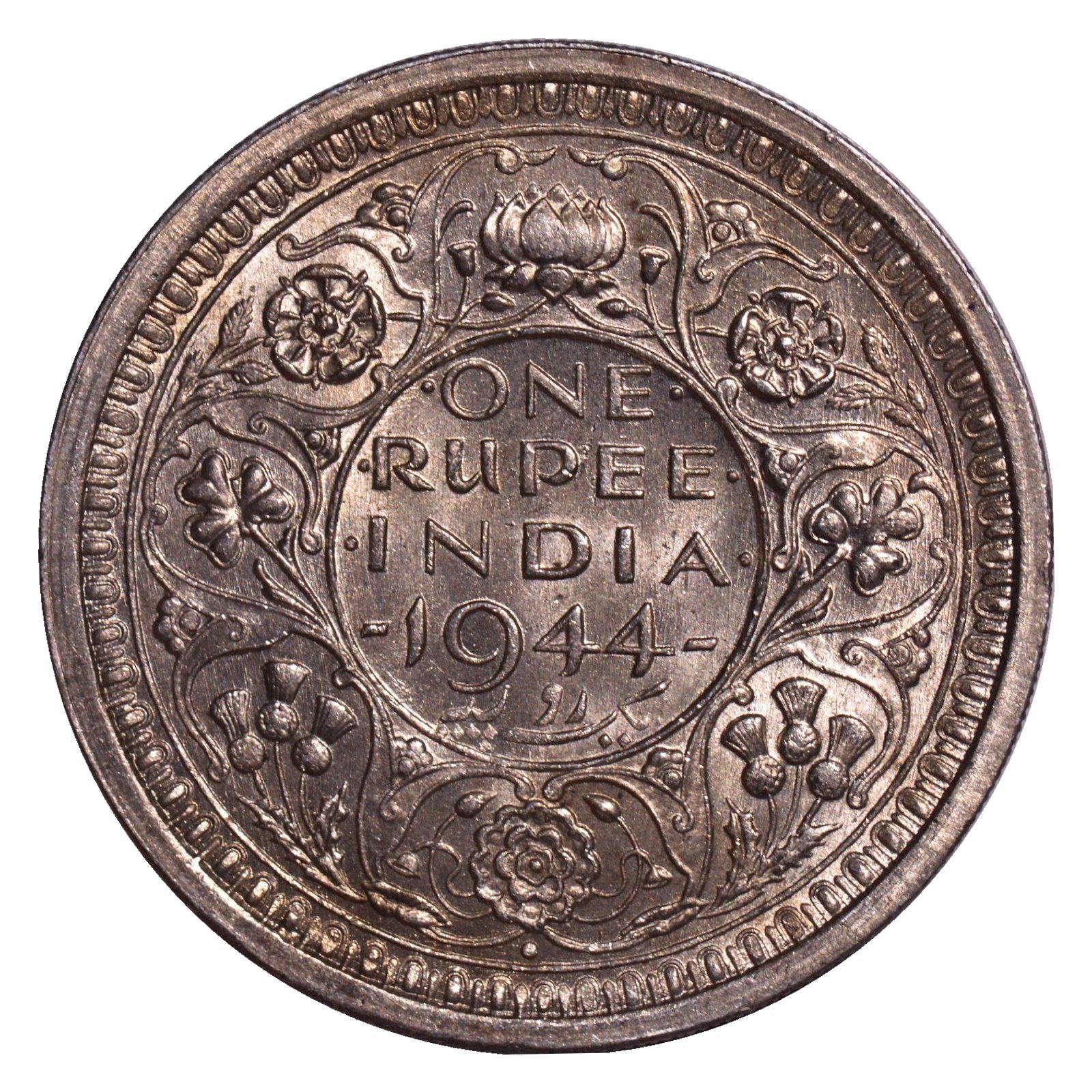
Saracenic scroll — A. P. Spencer
Dot/diamond = Bombay · L = Lahore
| Section | Topic | Notes | ||||||||||||||||||||||||||||||||||||||||||||||||||||||||||||||||||||||||||||||
|---|---|---|---|---|---|---|---|---|---|---|---|---|---|---|---|---|---|---|---|---|---|---|---|---|---|---|---|---|---|---|---|---|---|---|---|---|---|---|---|---|---|---|---|---|---|---|---|---|---|---|---|---|---|---|---|---|---|---|---|---|---|---|---|---|---|---|---|---|---|---|---|---|---|---|---|---|---|---|---|---|
| History & Context | ||||||||||||||||||||||||||||||||||||||||||||||||||||||||||||||||||||||||||||||||
| History | The Rupee — Coin of the Raj |
The rupee — worth sixteen annas, sixty-four pice, one hundred and ninety-two pies — was the principal silver denomination of British India throughout the colonial period. By the late 1930s, one rupee represented approximately one shilling and six pence sterling. For an agricultural labourer it was a day's pay; for a government clerk, perhaps a quarter-day's salary. It was the coin that paid rent, settled bazaar accounts, and was pressed into the hands of soldiers enlisting for a war that would eventually consume over 2.5 million Indian men. Its silver content remained its primary guarantee of trust — until 1940, when that guarantee was quietly halved. 1 Rupee = 16 Annas = 64 Pice = 192 Pies. This monetary system persisted until Indian decimalisation in 1957, when 1 new rupee = 100 new paise. The George VI rupee was struck throughout the final years of this old system. The bilingual reverse legend — ONE RUPEE / INDIA in English, and یک روپیہ (Yek Rupiya) in Urdu — reflects the multilingual commercial reality of a subcontinent approaching independence. | ||||||||||||||||||||||||||||||||||||||||||||||||||||||||||||||||||||||||||||||
| History | George VI — The Reluctant King |
Albert Frederick Arthur George (14 December 1895 – 6 February 1952) became King George VI on 11 December 1936, following the abdication of his elder brother Edward VIII, who surrendered the throne rather than give up Wallis Simpson. George VI had no expectation of kingship: he was reserved, afflicted by a stammer, and entirely unprepared for the public life thrust upon him. He rose to its demands nonetheless — remaining in London during the Blitz, visiting troops, and embodying the stoic endurance his country required. His was the last name to appear on the silver rupee of British India; the coinage bearing it spans the entire Second World War, from first striking to the final year of silver production in 1945. No coins bearing the portrait of Edward VIII were ever struck for British India. His reign of less than a year (January–December 1936) produced die preparations but no issued coinage for the Indian series. The collecting sequence therefore passes directly from George V rupees (last struck 1922) to George VI rupees (first struck 1938), a sixteen-year gap in rupee production. | ||||||||||||||||||||||||||||||||||||||||||||||||||||||||||||||||||||||||||||||
| History | World War II and the Silver Debasement |
The outbreak of war in September 1939 drove the global silver price sharply upward as military demand consumed metal reserves. By late 1939, the intrinsic silver value of a rupee was approaching its face value — the classic condition that produces hoarding. The Government of India responded by reducing the silver fineness from .917 to .500 from 1940 onward, while keeping the coin's weight and appearance unchanged. Simultaneously, a third mint — Lahore — was brought into production in 1943 to supplement Calcutta and Bombay's capacity, and the security edge was introduced on later issues to combat counterfeiting. The George VI rupee series is therefore a direct record of the war's impact on Indian monetary policy, pressed in silver and copper into the coin itself. In contrast, British domestic silver coinage had already been debased to .500 in 1920 following the First World War. India resisted debasement for a further twenty years before the Second World War made it unavoidable. The George V rupees (1911–1922) had all been .917; the George VI series opens at .917 and closes at .500 — a clear before-and-after record of wartime monetary pressure. | ||||||||||||||||||||||||||||||||||||||||||||||||||||||||||||||||||||||||||||||
| The Debasement & The Reverse Design | ||||||||||||||||||||||||||||||||||||||||||||||||||||||||||||||||||||||||||||||||
| Debasement | Distinguishing .917 from .500 Coins |
Both types weigh 11.66 g, measure 30.0 mm, and carry the same design. Reliable methods of distinguishing them: (1) Date — a coin dated 1938 is always .917; a coin dated 1941–1945 is always .500; a coin dated 1939 or 1940 may be either and requires verification. (2) Colour under good light — .917 coins have a cooler, brighter silver appearance; .500 coins show a slightly warmer, more copper-tinted surface tone, particularly at the rims. (3) Ring test — tapping a .917 coin on a hard surface produces a clear, sustained ring; the .500 coin produces a duller, shorter ring due to the higher copper content. (4) XRF analysis — the definitive method; used by major grading services. Many NGC and PCGS-certified George VI rupees have their composition confirmed on the label. For auction and dealer sales, the two compositions are always catalogued and priced separately. Paying a .917 premium for a .500 coin is the most common and most easily avoided error in collecting this series. Always confirm fineness for any 1939 or 1940 coin where a significant premium is being asked. | ||||||||||||||||||||||||||||||||||||||||||||||||||||||||||||||||||||||||||||||
| Spencer | A. P. Spencer's Revised Reverse |
A. P. Spencer's reverse for the George VI coinage adapts but does not abandon Percy Brown's George V Saracenic scroll. The overall vocabulary is unchanged — English rose, Scottish thistle, Irish shamrock, Indian lotus — but Spencer tightened the arabesque, adjusted the proportions of the central denomination circle, and remodelled the individual floral elements. The central legend reads ONE RUPEE / INDIA in English with the Urdu transliteration below and the date at the foot — exactly as on the George V reverse. Spencer's redesign is sympathetic rather than radical: the two reverses are part of the same continuous tradition, and the George VI reverse is best understood as a careful revision of Brown's original, not a replacement of it. Spencer's authorship of the redesign is documented in Pridmore's 1968 British Numismatic Society paper. His role is often overlooked by collectors who focus on Metcalfe's more prominent obverse contribution. A direct comparison of a George V and George VI rupee reverse under magnification reveals Spencer's changes most clearly at the lotus positions at the top and bottom of the scroll. | ||||||||||||||||||||||||||||||||||||||||||||||||||||||||||||||||||||||||||||||
| Design — Obverse, Edge & Varieties | ||||||||||||||||||||||||||||||||||||||||||||||||||||||||||||||||||||||||||||||||
| Design | Obverse — First & Second Head |
Metcalfe's obverse presents a left-facing crowned bust of George VI, smaller and less heavily robed than the MacKennal portrait of George V. The King wears his crown in uniform, with the Garter ribbon visible. The legend reads GEORGE VI KING EMPEROR. Collectors should be aware of an important obverse distinction documented across the George VI Indian coinage:
First Head (high relief): The two fleurs de lis on the royal crown are larger and extend upward to touch the beaded crest at the top of the crown. The lines rising from the centre of the crown are curved and touch the beads. Small triangles appear left and right in the centre of the crown. Second Head (low relief): The fleurs de lis are smaller and extend only to the line below the beaded crest. The central crown lines are straight and do not touch the beads. Larger triangles appear left and right in the crown centre. The First Head / Second Head distinction applies across the entire George VI Indian coinage, not just the rupee. Both heads appear on some denominations in the same year. For the rupee specifically, head variety should be confirmed under magnification when building a complete variety set. Standard date-and-mint collecting does not require distinguishing them, but specialist collectors track both. |
||||||||||||||||||||||||||||||||||||||||||||||||||||||||||||||||||||||||||||||
| Design | The Edge — Reeded vs. Security |
The George VI rupee was struck with two distinct edge types, creating separate KM numbers for the .500 series:
KM#556 — Reeded edge: Continuous fine parallel reeds, identical in concept to all preceding Indian rupee series. Used on .500 rupees from 1940 to approximately 1943. KM#557 — Security edge: An interrupted milling pattern combining sections of reeds with sections of plain edge — specifically designed to make clipping and counterfeiting more difficult. Introduced circa 1943 across several Indian denominations. Readily distinguishable from standard reeding with the naked eye. A complete set by KM number requires one example each of KM#555, KM#556, and KM#557 — that is, the .917 reeded issue, the .500 reeded issue, and the .500 security-edge issue. Both KM#556 and KM#557 examples exist for the 1943–1945 years, creating additional collecting combinations within those dates. |
||||||||||||||||||||||||||||||||||||||||||||||||||||||||||||||||||||||||||||||
| Design | Currency vs. Proof — How to Tell |
Proof rupees exist for a small number of dates in the George VI series — confirmed for 1938 (a proof held in the Royal Collection, London) and occasionally reported for other years. The proof surface differs from the currency strike in the standard way: mirror-polished fields against frosted devices, or a uniformly frosted surface on matt examples. The currency strike shows cartwheel lustre flowing outward from the devices. Under directional raking light, a genuine proof shows a different quality of surface depth that no cleaned currency coin can replicate. George VI rupee proofs are extremely rarely offered; when they appear, specialist attribution and ideally NGC or PCGS certification are advisable before paying a proof premium. Cleaned or polished .917 currency strikes in near-UNC condition are sometimes mistaken for proofs by inexperienced buyers. The key test is the quality of the field surface under magnification: a proof has die-polished fields of a different character to any business strike, however well preserved. Hairlines from cleaning are diagnostic of a cleaned coin, not a proof. | ||||||||||||||||||||||||||||||||||||||||||||||||||||||||||||||||||||||||||||||
| Mints & Production | ||||||||||||||||||||||||||||||||||||||||||||||||||||||||||||||||||||||||||||||||
| Mint | The Calcutta Mint — No Mark |
The Calcutta Mint (Strand Road, Calcutta — now Kolkata) was the senior Indian mint and produced the largest share of George VI rupees throughout the series. No mint mark of any kind identifies Calcutta products — the absence of any symbol is itself the identifier. In catalogue notation, Calcutta strikes are shown with a parenthetical "(C)" but no letter, dot, or mark appears on the actual coin. The Calcutta Mint struck rupees in all years from 1938 to 1945, in both .917 and .500 silver. As with the George V series, beginning collectors sometimes search for a "C" on Calcutta rupees. None exists. If no dot, diamond, or L is visible below the bottom lotus on the reverse, the coin is from Calcutta. Attribution is by exclusion, not by symbol. | ||||||||||||||||||||||||||||||||||||||||||||||||||||||||||||||||||||||||||||||
| Mint | The Bombay Mint — Dot or Diamond |
The Bombay Mint (Mint Road, Bombay — now Mumbai) is identified on George VI rupees by a small raised dot or diamond below the bottom lotus flower on the reverse. Both a dot and a diamond (a six-pointed flower at the centre of the bottom lotus, sometimes called "Reverse B") exist as Bombay identifiers; a small diamond below a letter of the word EMPEROR on the obverse is also a secondary Bombay identifier on some issues. The dot or diamond is raised (not incuse) and wears down on circulated examples. Reliable attribution requires a 10× loupe and directional raking light. The Bombay Mint closed in 2006 and is now a heritage museum. The historic Mint Road building — where George VI rupees were struck from 1938 to 1945 — is a listed structure. The dot/diamond distinction (Reverse A vs. Reverse B) is a specialist sub-variety within Bombay attribution; for general collecting purposes, dot and diamond are both simply Bombay issues. | ||||||||||||||||||||||||||||||||||||||||||||||||||||||||||||||||||||||||||||||
| Mint | The Lahore Mint — The L Mark |
The Lahore Mint was brought into rupee production circa 1943 as a third facility to supplement the capacity of Calcutta and Bombay under wartime demand. Lahore rupees are identified by a small raised letter L below the bottom lotus flower on the reverse — the same position as the Bombay dot/diamond. The L is a clean and unambiguous identifier. Lahore rupees exist for 1943, 1944, and 1945 only; they are generally somewhat less common than Calcutta or Bombay examples of the same date and attract modest premiums in higher grades. The Lahore Mint closed with the Partition of India in August 1947, when Lahore became part of Pakistan. The Lahore Mint's addition makes the George VI series the first British India rupee to require three-mint attribution — a distinction not found in any earlier reign. For the 1945 date in particular, all three mints must be considered for a complete mintmark set, and the Large 5 variety adds a further dimension to the Bombay and Lahore 1945 issues. | ||||||||||||||||||||||||||||||||||||||||||||||||||||||||||||||||||||||||||||||
| Mint | Date Survey |
|
||||||||||||||||||||||||||||||||||||||||||||||||||||||||||||||||||||||||||||||
| Valuation | ||||||||||||||||||||||||||||||||||||||||||||||||||||||||||||||||||||||||||||||||
| Value | .917 Silver Issues 1938–1939 Price Guide |
|
||||||||||||||||||||||||||||||||||||||||||||||||||||||||||||||||||||||||||||||
| Value | .500 Silver Issues 1940–1945 Price Guide |
|
||||||||||||||||||||||||||||||||||||||||||||||||||||||||||||||||||||||||||||||
| Value | Silver Content vs Numismatic Value |
The two silver standards create two distinct bullion floors. The .917 coin contains $25.78 worth of silver at $75/oz; a 1938 in VF at $35–$55 sits just above the bullion floor. The .500 coin contains $14.06 in silver; a common .500 date in VF at $28–$40 represents a 2–3× premium. For the 1939 key date in UNC at $500–$900, the collector premium reaches 20–35× bullion — driven entirely by scarcity, not by metal content. For the 1945 Lahore Large 5, the premium is similar. In both cases, it is the numismatic significance — the key date, the die variety, the three-mint attribution — that determines value above the bullion floor. | ||||||||||||||||||||||||||||||||||||||||||||||||||||||||||||||||||||||||||||||
| Collecting Notes | ||||||||||||||||||||||||||||||||||||||||||||||||||||||||||||||||||||||||||||||||
| Collect | Type Set or Date Set? |
For most collectors, the choice is between a type set and a date-and-mint set. A three-coin type set — one KM#555 (.917), one KM#556 (.500 reeded edge), one KM#557 (.500 security edge) — captures all three principal types in three pieces and costs approximately $100–$200 in VF. A complete date set (one per calendar year 1938–1945, any mint) requires 8 pieces; the 1939 dominates the cost at $120–$200 in VF. A full date-and-mint set including all Calcutta, Bombay, and Lahore combinations, both edge types, and the Large 5 varieties requires 25+ pieces and is the full specialist undertaking — with the 1939 key dates and the 1945 Large 5 Lahore at the apex of difficulty and price. | ||||||||||||||||||||||||||||||||||||||||||||||||||||||||||||||||||||||||||||||
| Collect | What to Look For | Key grading points: (1) The King's crown — the cross-pattée and arches at the crown's summit; the first obverse area to show wear. (2) The King's cheek and brow — smooth high-relief areas; wear appears as a flat plane across the cheekbone. (3) The scroll border on the reverse — rose petals, thistle barbs, and lotus segments should be individually defined in EF. (4) The inner denomination circle — the raised lines of the panel; should be crisp. (5) The mint mark position — below the bottom lotus: dot or diamond = Bombay; L = Lahore; nothing = Calcutta. (6) The edge — continuous reeds = KM#556; interrupted pattern = KM#557 security edge. (7) The Large 5 — on 1945 coins, compare the height of the "5" numeral; a Large 5 is visibly taller and bolder than normal, detectable without a loupe on a well-preserved coin. | ||||||||||||||||||||||||||||||||||||||||||||||||||||||||||||||||||||||||||||||
| Collect | Problems to Avoid | (1) Paying .917 prices for .500 coins — the most costly error in this series; always confirm fineness for 1939 and 1940 coins. (2) Cleaning and polishing — extremely common in Indian silver coinage; harsh cleaning removes original lustre and leaves a characterless brightness without die-flow lines. (3) Missing the Large 5 — 1945 coins without the Large 5 variant noted should be checked under magnification; sellers do not always identify the variety. (4) Misidentified Bombay marks — both a dot and a diamond can appear as the Bombay identifier; a random die chip is neither, being irregular and inconsistently positioned. (5) Lahore/Bombay confusion — the L and the dot/diamond are distinct, but on worn coins the L can be reduced to a faint trace; verify at the base of the reverse under a loupe. (6) Over-grading — the Spencer reverse survives wear well; grade by the weaker side, which is typically the obverse cheek and crown. | ||||||||||||||||||||||||||||||||||||||||||||||||||||||||||||||||||||||||||||||
| Collect | Collection Contexts | The George VI rupee fits naturally into: a British India rupee type set by monarch (Victoria, Edward VII, George V, George VI — four design generations on four coins); a George VI Indian silver set (rupee, half rupee, quarter rupee — including the .917 and .500 sub-types for each); a silver debasement study (pairing the .917 and .500 rupees as a matched pair to illustrate the wartime monetary change); a three-mint attribution set (one Calcutta, one Bombay, one Lahore — the only Indian rupee series requiring three-mint attribution); or a Large 5 variety collection across all affected denominations (rupee, half rupee, quarter rupee — three denominations, three mints, six varieties). | ||||||||||||||||||||||||||||||||||||||||||||||||||||||||||||||||||||||||||||||
| Collect | Related Coins | Natural companions: the George VI half rupee 1938–1945 (same obverse and reverse design; same debasement timeline and mint mark system; also has the Large 5 variety in 1945); the George VI quarter rupee 1938–1946 (same design and debasement; security edge introduced 1943; Large 5 variety exists); the George V rupee 1911–1922 (MacKennal / Percy Brown design — direct predecessor; .917 silver throughout; two mints only); the 1938 Proof rupee (Calcutta Mint proof, Royal Collection, London — the finest known George VI rupee and the most rarely offered piece in the series); and the 1947 nickel rupee (George VI's name but a completely new reverse showing an Indian tiger — the transitional issue marking the end of the Raj and the beginning of Independence). | ||||||||||||||||||||||||||||||||||||||||||||||||||||||||||||||||||||||||||||||
Sources: Krause Standard Catalog of World Coins — KM#555, KM#556, KM#557 · Pridmore, F. "Mr A. P. Spencer, Artist/Engraver, His Majesty's Mint, Calcutta and the re-designed Coinages of King George VI British India 1938–1947," British Numismatic Society, 1968 · Pridmore, F. The Coins of the British Commonwealth of Nations, Part IV: India · chiefacoins.com — George VI coinage database; First Head / Second Head distinction; mint mark positions · Heritage Auctions — 1939-B KM#555 NGC AU55 (April 2012, lot 24911); XF45 NGC (April 2024, lot 25403); mintage 2,450,000 · PCGS News — "The Indian 1945 Large 5 Rupee" (April 26, 2023) — Large 5 rarity ranking by mint · theindiancoins.com — George VI coinage overview; debasement history; wartime silver crisis · georgevicoins.blogspot.com — full denomination list; mint mark descriptions; 1939 .500 transitional note · Numista catalogue — KM#555/556/557 community valuations and variety images · Silver spot price reference: ~$75/oz USD