British India Rupee — George V — 1911–1922 One Rupee — Silver .917 — MacKennal & Percy Brown — "Pig Rupee" Type I & Standard Type II
Type I (Pig Rupee): KM#523 · Y-45a · Type II (Standard): KM#524 · Y-45 · Silver .917 fine · 30.6 mm · 11.66 g · ASW 0.3437 troy oz · Calcutta & Bombay Mints
Type I — KM#523 — 1911 Only — "The Pig Rupee"
- Years struck: 1911 only (Calcutta and Bombay)
- Identifying feature: Ambiguous elephant on King's collar resembling a pig
- Fate: Majority withheld and melted; survivors genuinely scarce
- Mint mark: No dot = Calcutta · Raised dot below lotus = Bombay
- Value range: $45 – $950+ depending on grade and mint
- Primary market: Specialist dealers; Heritage and Stack's Bowers auctions
Type II — KM#524 — 1912–1922 — Standard Issue
- Years struck: 1912–1922 (both mints; final Calcutta issue 1920, final Bombay 1922)
- Identifying feature: Redesigned elephant — longer legs, clear tusks and ears
- Finish: Normal business strike; silver .917 throughout the series
- Mint mark: No dot = Calcutta · Raised dot below bottom lotus = Bombay
- Value range: $35 – $380+ depending on date, grade, and mint
- Key date: 1921 B and 1922 B — Bombay-only years; no Calcutta rupee recorded
Two Designers — MacKennal's Crown and Percy Brown's Scroll
The George V Indian rupee is the work of two artists with no direct contact between them. Sir Edgar Bertram MacKennal (1863–1931), the Australian-born sculptor appointed to portray the new King across the Empire, contributed a crowned and robed obverse — formal, imperial, deliberate. Percy Brown, then Principal of the Government School of Art in Calcutta, designed the reverse: a Saracenic arabesque scroll weaving English roses, Scottish thistles, Irish shamrocks, and Indian lotus flowers into a single decorative programme. MacKennal's portrait speaks of London and the Crown; Brown's scroll speaks of Calcutta and the Raj. The coin holds both worlds on a disc of .917 silver.
The "Pig Rupee" — What Happened in 1911
On the inaugural 1911 issues of the rupee, half rupee, quarter rupee, two annas, and quarter anna, George V is shown wearing coronation robes featuring a small elephant on the collar. As originally engraved, the elephant had short, stubby legs, a rounded undifferentiated head, and a downturned trunk that — to many observers, particularly Muslims for whom the pig is ritually unclean — appeared unmistakably to resemble a pig's snout. The religious offence was immediate and well-organised. The Government of India acted: the majority of 1911 rupees were withheld from circulation and melted. For 1912 onward, the dies were revised — the new elephant has a longer tail, clearly articulated legs, prominent tusks, and ears that leave no doubt as to the animal. The incident is one of the most celebrated design controversies in Indian numismatic history, and the 1911 "Pig Rupee" has been a collector's prize ever since.
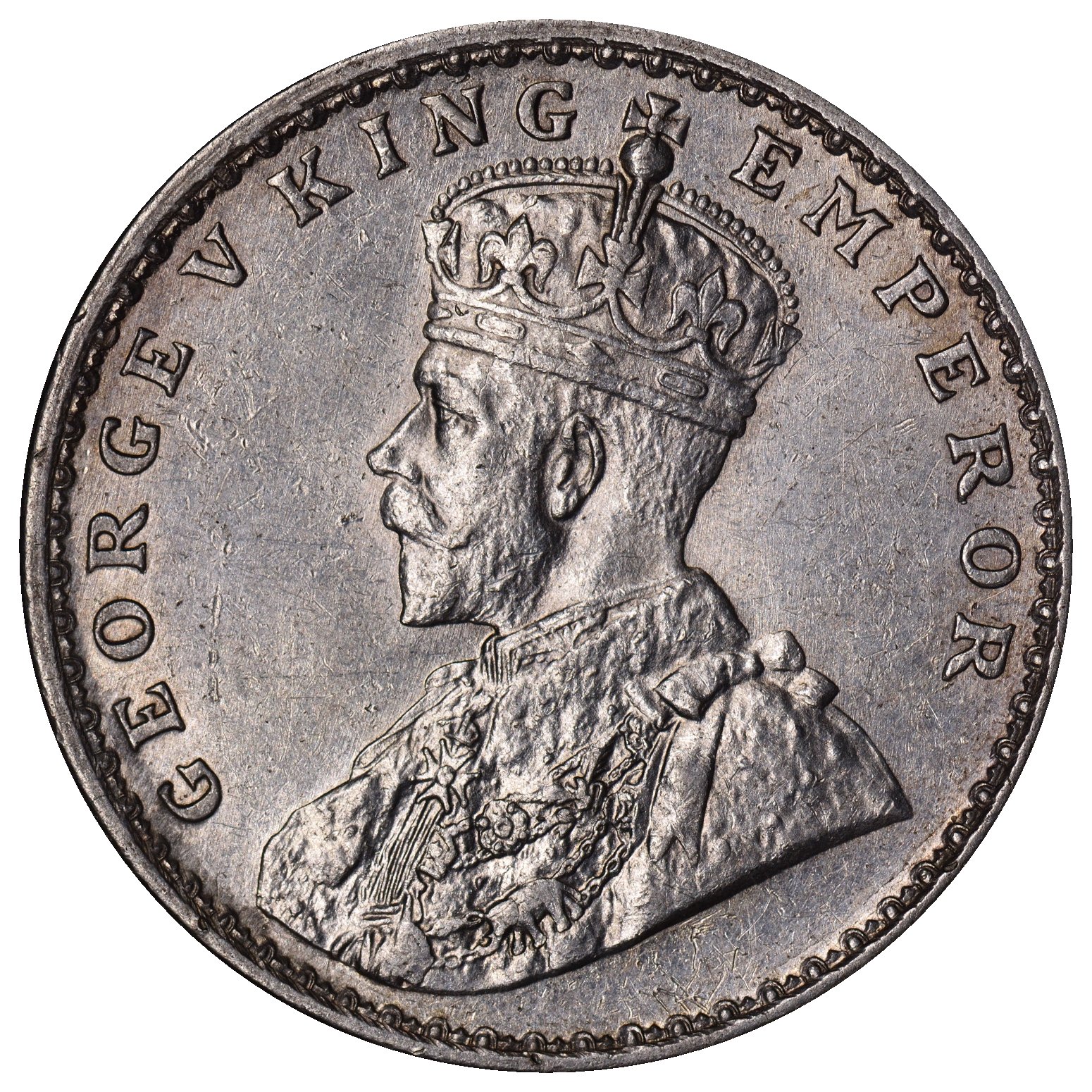
George V — MacKennal
B.M. on truncation
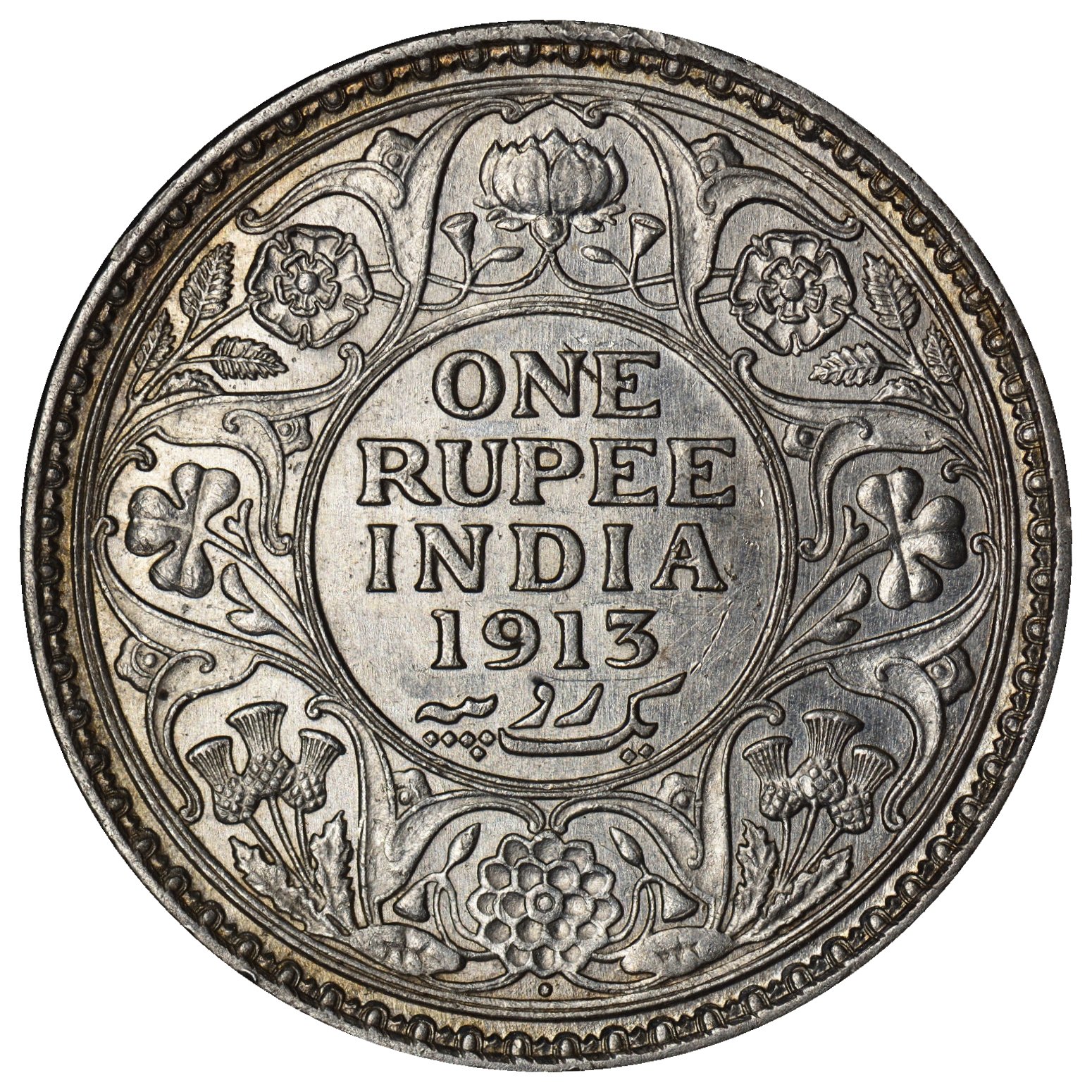
Saracenic scroll — Percy Brown
Dot below lotus = Bombay
| Section | Topic | Notes | |||||||||||||||||||||||||||||||||||||||||||||
|---|---|---|---|---|---|---|---|---|---|---|---|---|---|---|---|---|---|---|---|---|---|---|---|---|---|---|---|---|---|---|---|---|---|---|---|---|---|---|---|---|---|---|---|---|---|---|---|
| History & Context | |||||||||||||||||||||||||||||||||||||||||||||||
| History | The Rupee — Coin of the Raj |
The rupee — worth sixteen annas, sixty-four pice, one hundred and ninety-two pies — was the principal silver denomination of British India and the coin most people across the subcontinent encountered as a unit of significant value. In the 1910s, one rupee equated to approximately one shilling and four pence sterling. For an agricultural labourer, it was roughly two days' pay; for an urban clerk, half a day's. It was the coin that settled rents, paid wages, purchased sacks of grain, and crossed hands at every bazaar from Peshawar to Madras. Its silver content made it trusted in a way no paper currency had yet achieved across the subcontinent. 1 Rupee = 16 Annas = 64 Pice = 192 Pies. This old monetary system persisted until Indian decimalisation in 1957, when 1 new rupee = 100 new paise replaced the traditional structure. The George V rupee was struck throughout the whole of this old system, and the Urdu denomination text on its reverse reflects the multilingual commercial reality of the Raj. | |||||||||||||||||||||||||||||||||||||||||||||
| History | George V — King-Emperor |
George Frederick Ernest Albert (3 June 1865 – 20 January 1936) succeeded his father Edward VII on 6 May 1910 and was crowned at Westminster Abbey on 22 June 1911. As King-Emperor he was sovereign over British India, and coins bearing his portrait were introduced in the same year as his coronation. Circulation rupees were struck from 1911 until 1922, when production ceased. His reign encompassed the First World War, the Amritsar massacre of 1919, Gandhi's Salt March of 1930, and the independence movement's most formative decades. George V was the only reigning British monarch to attend his own Indian Coronation Durbar in person — at Delhi, December 1911. A special commemorative rupee was struck for the occasion showing the busts of both George V and Queen Mary. This Delhi Durbar rupee is an entirely separate coin from the standard 1911 circulation rupee discussed in this guide. | |||||||||||||||||||||||||||||||||||||||||||||
| History | World War I and the Silver Crisis |
The outbreak of war in August 1914 sent silver prices sharply upward as military demand consumed global metal supplies. By 1918–19 the silver in a rupee approached its face value — the classic condition that leads to hoarding and melting. The Government of India responded by attempting to replace the fractional silver denominations (half rupee, quarter rupee, two annas) with cupro-nickel equivalents. These proved deeply unpopular, were quickly counterfeited, and were withdrawn within two years. Silver fractions resumed production. The standard one rupee was never substituted — it continued in full .917 silver throughout the war and beyond, maintaining the trust its metal content conferred. In Britain, the silver coinage standard was permanently halved in 1920 — from .925 to .500. India did not follow. The political calculation was different: the Indian population's trust in heavy fine silver coin was too important to risk the unrest that debasement might produce. All George V Indian rupees are therefore full .917 silver throughout the series. | |||||||||||||||||||||||||||||||||||||||||||||
| The Pig Rupee & The Reverse Design | |||||||||||||||||||||||||||||||||||||||||||||||
| Pig Rupee | The 1911 Controversy — How It Happened |
Work on the George V Indian coinage began in 1910, immediately after his accession, with the Royal Mint in London preparing master dies for despatch to India. MacKennal's obverse depicted the King in his coronation robes, including a small decorative elephant on the Garter collar — a detail taken from the actual ceremonial robes. The elephant, in the original engraving, was rendered with insufficient zoological definition: short legs, a vague rounded head, and a downward-curving trunk. As preliminary distribution began in late 1911, complaints arrived at the Government of India from Muslim leaders and community representatives. The pig — forbidden by Islamic dietary law — was the shape they saw in the collar device. The controversy was not merely aesthetic. British India in 1911 was acutely aware of communal sensitivities following the Partition of Bengal controversy of 1905–1911. Any official symbol perceived as insulting to the Muslim community — roughly a quarter of British India's population — was a serious political matter, not merely a numismatic curiosity. | |||||||||||||||||||||||||||||||||||||||||||||
| Pig Rupee | Type I vs. Type II — The Elephant in Detail |
The dies were revised swiftly. The two types share the same obverse composition, reverse design, and all specifications; they are distinguished solely by the rendering of the elephant on the King's collar.
Type I (KM#523, 1911): Body compact and round. Legs short and barely differentiated from the body mass. Head rounded with no distinct brow. Trunk curves sharply downward, appearing as a snout. Tusks absent or vestigial. Ears not clearly defined. Type II (KM#524, 1912–1922): Body elongated. Legs clearly separate, with defined joints. Head has a distinct brow and angular profile. Trunk extends naturally. Tusks prominent. Ears visible. The animal is unambiguously an elephant. The distinction is visible at VF and above without a loupe on a well-struck example. On Fine or below, a 10× loupe is essential. When buying a 1911 rupee offered as "Type I / Pig Rupee" at a premium, always verify the elephant detail personally before accepting the seller's attribution. A 1911 coin with a Type II elephant is not a "Pig Rupee" and commands no premium beyond the 1911 date itself. |
|||||||||||||||||||||||||||||||||||||||||||||
| Percy Brown | The Saracenic Scroll Reverse |
The reverse — produced not in London but locally, in Calcutta — is one of the most considered original reverse designs in the British colonial coinage. Percy Brown, an art historian and educationist who had studied Islamic architecture across the subcontinent, drew on the Mughal decorative tradition: his arabesque scroll weaves four flora together. The English rose and Scottish thistle represent Britain; the Irish shamrock completes the Union; the Indian lotus at the top and bottom represents the country in whose commerce the coin would circulate. All are rendered in a Saracenic curvilinear vocabulary. The central panel reads ONE RUPEE / INDIA in English with the Urdu transliteration below, and the date at the foot. The design proved so successful that it was retained, with only minor modifications, through the George VI coinage as well — lasting on Indian currency until Independence in 1947 and beyond. Percy Brown's scroll outlasted the King for whom it was created by more than a decade. | |||||||||||||||||||||||||||||||||||||||||||||
| Design — Both Types | |||||||||||||||||||||||||||||||||||||||||||||||
| Design | Obverse | MacKennal's obverse presents a left-facing crowned and robed bust of George V in his coronation crown and imperial mantle. The legend reads GEORGE V KING EMPEROR. His initials B.M. appear in relief on the truncation of the King's shoulder. The portrait is the same effigy used on British domestic silver coinage of the period, adapted for the Indian format. The most important collecting distinction is the elephant on the collar — the sole difference between KM#523 and KM#524, and the cause of the 1911 controversy. On grades above Fine, the collar device is visible to the naked eye; a loupe is required on worn examples. | |||||||||||||||||||||||||||||||||||||||||||||
| Design | The Edge and the Reverse Legend |
The edge of the George V Indian rupee is reeded — a continuous series of fine parallel reeds running around the circumference. Unlike the British crown's celebrated inscribed edge (Decus et Tutamen), the Indian rupee carries no edge legend; the reeding is purely functional and anti-counterfeiting. The reverse legend is bilingual: ONE RUPEE and INDIA appear in English; below the central device, the Urdu/Persian text یک روپیہ (Yek Rupiya, "One Rupee") addresses the non-English-speaking majority of the coin's users. The date appears at the foot of the reverse. The bilingual reverse is a practical acknowledgement that the coin would circulate among populations who read Urdu and Persian script as readily as — or more readily than — Roman letters. The Edward VII rupee carried the same bilingual format; it was a continuous convention of British Indian silver coinage from the nineteenth century onward. | |||||||||||||||||||||||||||||||||||||||||||||
| Design | Currency vs. Proof — How to Tell |
Proof rupees exist for a small number of dates in the George V series — including 1911 and 1918 — struck for presentation and collector purposes. The proof surface differs from the currency strike in the same way as any proof coinage: mirror-polished fields (or, on some examples, a uniformly frosted surface) against frosted devices. The currency strike shows cartwheel lustre in the fields, flowing from the devices outward. Under directional raking light, a genuine proof shows a reflective depth that the currency strike does not. As with all Indian silver proofs, beware cleaned or polished currency strikes offered as proofs; genuine proofs have die-polished fields showing a different quality of surface than a buffed coin. Proof George V rupees are considerably rarer than proof Edward VII rupees, which were more systematically struck and distributed as part of the 1903 Indian coronation sets. George V proofs were struck more informally and are less well-documented in standard references. NGC and PCGS certification provides third-party confirmation when paying a proof premium. | |||||||||||||||||||||||||||||||||||||||||||||
| Mints & Production | |||||||||||||||||||||||||||||||||||||||||||||||
| Mint | The Calcutta Mint — No Mark |
The Calcutta Mint (Strand Road, Calcutta — now Kolkata) was established in its modern form in 1829 and remained the senior Indian mint throughout the British period. No mint mark of any kind identifies Calcutta products — the absence of any mark is itself the identifier. In catalogue notation, Calcutta strikes are shown with a parenthetical "(C)" but no letter, dot, or symbol appears on the actual coin. The Calcutta Mint struck the greater proportion of George V rupees in most years of the series. Beginning collectors should not look for a "C" on Calcutta rupees: none exists. If no dot is visible below the bottom lotus of the reverse, the coin is from Calcutta. Attribution is by exclusion, not by symbol — the absence of the dot is the Calcutta identifier. | |||||||||||||||||||||||||||||||||||||||||||||
| Mint | The Bombay Mint — The Dot |
The Bombay Mint (Mint Road, Bombay — now Mumbai) was established in 1830 and served as the second major production facility throughout the colonial period. Bombay rupees are identified by a small raised dot below the bottom lotus flower on the reverse — a system documented by D. Chakravarty as chosen because it was considered adequate to distinguish Bombay products without a conspicuous letter. The dot is raised (not incuse), which means it wears down on circulated examples. Reliable attribution requires a 10× loupe and directional raking light. On coins below Fine, the dot may be entirely lost to wear and a definitive attribution may not be possible. The Bombay Mint closed in 2006 and is now a heritage museum. The historic Mint Road building — where George V rupees were struck from 1911 to 1922 — remains a listed structure. All modern Indian Mint production has been consolidated at other facilities. | |||||||||||||||||||||||||||||||||||||||||||||
| Mint | Date Survey |
|
|||||||||||||||||||||||||||||||||||||||||||||
| Valuation | |||||||||||||||||||||||||||||||||||||||||||||||
| Value | Type II Standard Issue Price Guide |
|
|||||||||||||||||||||||||||||||||||||||||||||
| Value | Type I "Pig Rupee" Price Guide |
|
|||||||||||||||||||||||||||||||||||||||||||||
| Value | Silver Content vs Numismatic Value |
The George V rupee contains 0.3437 troy oz of pure silver — approximately $25.78 at current silver prices. For a common Type II date in VF, the collector premium over bullion remains modest: a VF common date at $35–$50 sits just above the bullion floor, while XF examples at $40–$65 represent a 1.5–2.5× premium. For the 1911 Type I "Pig Rupee" in UNC, the premium approaches 15–25× bullion — driven entirely by historical controversy and genuine scarcity, not by metal content. The higher silver price also means that even worn examples now carry a meaningful intrinsic floor, and should not be acquired below bullion value regardless of condition. | |||||||||||||||||||||||||||||||||||||||||||||
| Collecting Notes | |||||||||||||||||||||||||||||||||||||||||||||||
| Collect | Type Set or Date Set? |
For most collectors, the choice is between a type set and a date-and-mint set. A two-coin type set — one KM#523 Pig Rupee and one KM#524 common date in VF — tells the complete story of the series in two pieces and costs approximately $100–$180. It is the natural entry point. A complete date set (one coin per calendar year 1911–1922, either mint) requires 12 pieces in VF at approximately $350–$600, with the two 1911 Pig Rupees driving the upper cost. A full date-and-mint set of all 13 combinations is the specialist undertaking: $600–$1,200+ in VF. Proofs, where they exist, form a separate specialty tier beyond any general collection. | |||||||||||||||||||||||||||||||||||||||||||||
| Collect | What to Look For | Key grading points for the Type II standard issue: (1) The King's crown — arches and cross-pattée at the crown's summit; the first obverse point to show wear. (2) The King's cheek and brow — smooth high-relief areas; wear appears as a flat plane across the cheekbone. (3) The scroll border on the reverse — rose petals, thistle barbs, and lotus segments should be individually defined in EF. (4) The inner denomination circle — the raised double line of the panel; should be crisp. (5) The Bombay dot — under raking light with a loupe; present = Bombay, absent = Calcutta. For the Type I "Pig Rupee": all of the above, plus (6) the elephant on the collar — confirm the short-legged pig-snout form under magnification before paying any premium. | |||||||||||||||||||||||||||||||||||||||||||||
| Collect | Problems to Avoid | (1) Cleaning and polishing — extremely common in Indian silver coinage; harsh cleaning removes original lustre and leaves a characterless grey brightness without die-flow lines. (2) False "Pig Rupee" attribution — a 1911 rupee with a Type II elephant is not a "Pig Rupee" and should carry no premium; always verify the collar device under a loupe. (3) Misidentified Bombay dot — a random die chip or surface flaw at the bottom of the reverse is not a mint mark; genuine dots are circular, consistently positioned, and raised. (4) Over-grading — the scroll reverse survives wear well and can show XF detail when the obverse portrait is only VF; grade by the weaker side. (5) Test marks — Indian coins frequently carry small punched or incised banker's marks from bazaar and treasury use; these reduce collector value and should be disclosed by sellers. | |||||||||||||||||||||||||||||||||||||||||||||
| Collect | Collection Contexts | The George V rupee fits naturally into: a British India rupee type set by monarch (Victoria, Edward VII, George V, George VI — four types, four coins); a George V Indian silver set (rupee, half rupee, quarter rupee, with or without their respective 1911 Pig variants); an Indian Imperial rupee set pairing the standard type with the 1911 Delhi Durbar commemorative; a MacKennal portrait set alongside British domestic George V silver coinage (same obverse effigy, radically different reverses); or a Percy Brown reverse study paired with the half rupee and quarter rupee, which share the same Saracenic scroll vocabulary throughout the series. | |||||||||||||||||||||||||||||||||||||||||||||
| Collect | Related Coins | Natural companions: the George V half rupee 1911–1922 (KM#521/522 — same obverse and reverse design in smaller module; 24mm, 5.83g; also carries the 1911 "Pig" variety and Bombay dot); the George V quarter rupee 1911–1920 (KM#517/518 — 19mm, 2.92g; same design family, also has 1911 Type I); the 1911 Delhi Durbar commemorative rupee (dual portrait — George V and Queen Mary — the only Indian rupee showing a Queen consort; struck for the Coronation Durbar at Delhi, December 1911); the Edward VII rupee 1903–1910 (KM#508 — direct predecessor; uncrowned portrait, lotus-flanked reverse without the Saracenic scroll — a natural design-comparison pairing); and the George VI rupee 1938–1947 (KM#557 — same scroll reverse, Humphrey Paget's portrait — the immediate successor, issued to Indian Independence). | |||||||||||||||||||||||||||||||||||||||||||||
Sources: Krause Standard Catalog of World Coins — KM#523 (Type I) and KM#524 (Type II) · Pridmore, F. The Coins of the British Commonwealth of Nations, Part IV: India · Chakravarty, D. — Bombay dot system attribution and mint identification · Campbell, J.F. The Coins of British India: George V (1911–1922) — jfcampbell.us · chiefacoins.com — George V coin specifications and die descriptions · PCGS — "The 1911 Pig Rupee" (pcgs.com/news, March 2023) — Type I/II distinction and melt history · Numista catalogue — KM#523 and KM#524 community valuations · Heritage Auctions — George V Indian rupee realised prices 2020–2026 · Stack's Bowers Galleries — British India silver auction results · theindiancoins.com — George V coinage overview, minting history, WWI silver crisis · Silver spot price reference: ~$75/oz USD