British Sixpence — Edward VII — 1902–1910 Complete Series Guide — All Nine Dates — Sterling Silver — Royal Mint
KM# 779 · S.3983 · ESC 1789–1795 · Silver .925 (Sterling) · 19.3 mm · 2.83 g · Reeded edge · ASW 0.0841 troy oz
George William de Saulles — Designer of the Edward VII Sixpence
The obverse of every Edward VII sixpence from 1902 to 1910 carries the bare-headed right-facing portrait of Edward VII by George William de Saulles (1862–1903), Engraver to the Royal Mint from 1893. De Saulles prepared the complete Edward VII coinage following the King's coronation in 1902, working from a model by Emil Fuchs. His initials DES appear below the portrait truncation. De Saulles died in August 1903 while still preparing the Great Seal of Edward VII — his portrait on the sixpence thus outlasted him by seven years, continuing unchanged until the King's death in 1910. The reverse — the crowned SIX PENCE within a wreath of laurel and oak — was designed by Jean Baptiste Merlen, a Flemish-born engraver who had worked at the Royal Mint from the 1820s; his reverse design was a survival from the Victorian era, adapted for Edward VII.
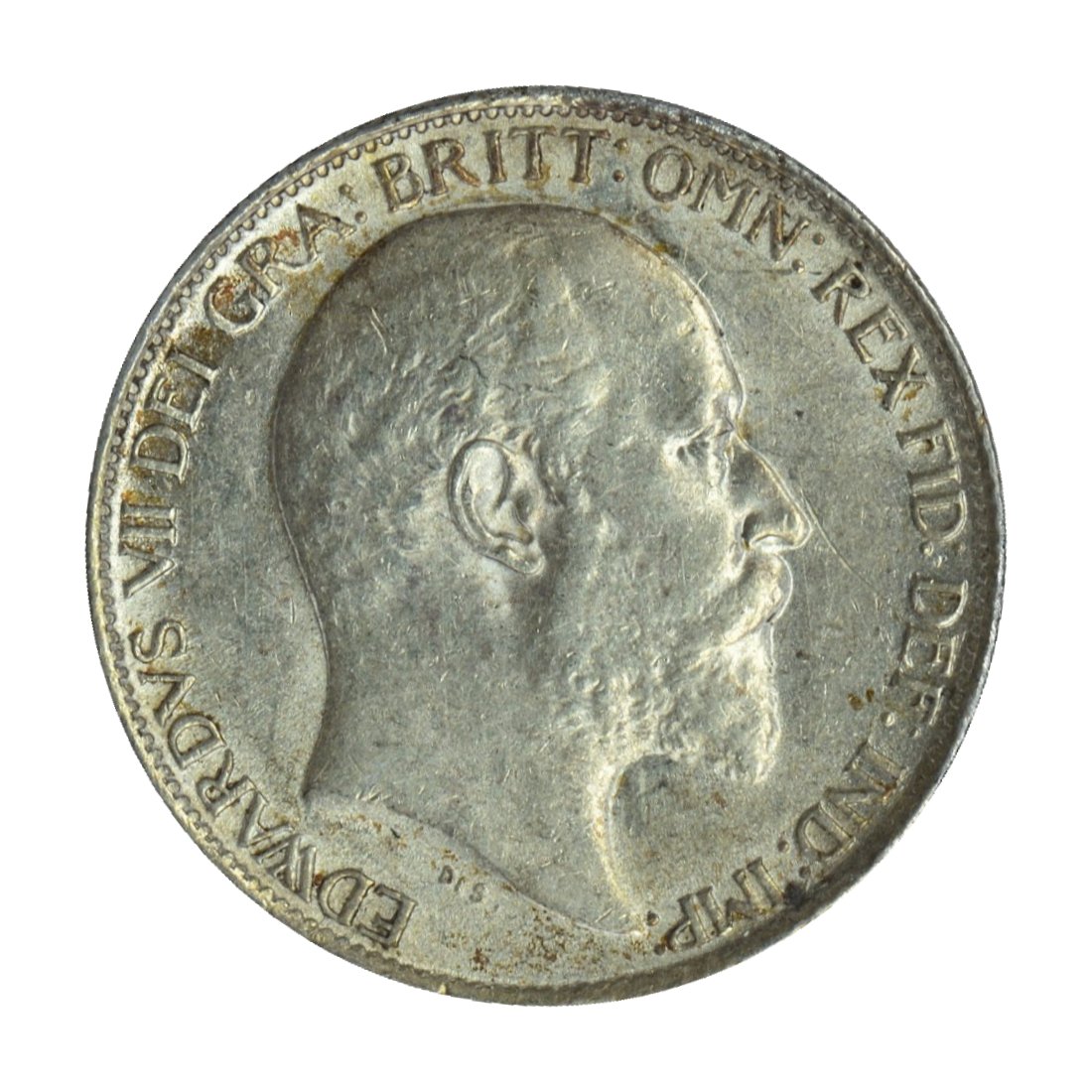
Edward VII — de Saulles
DES below truncation
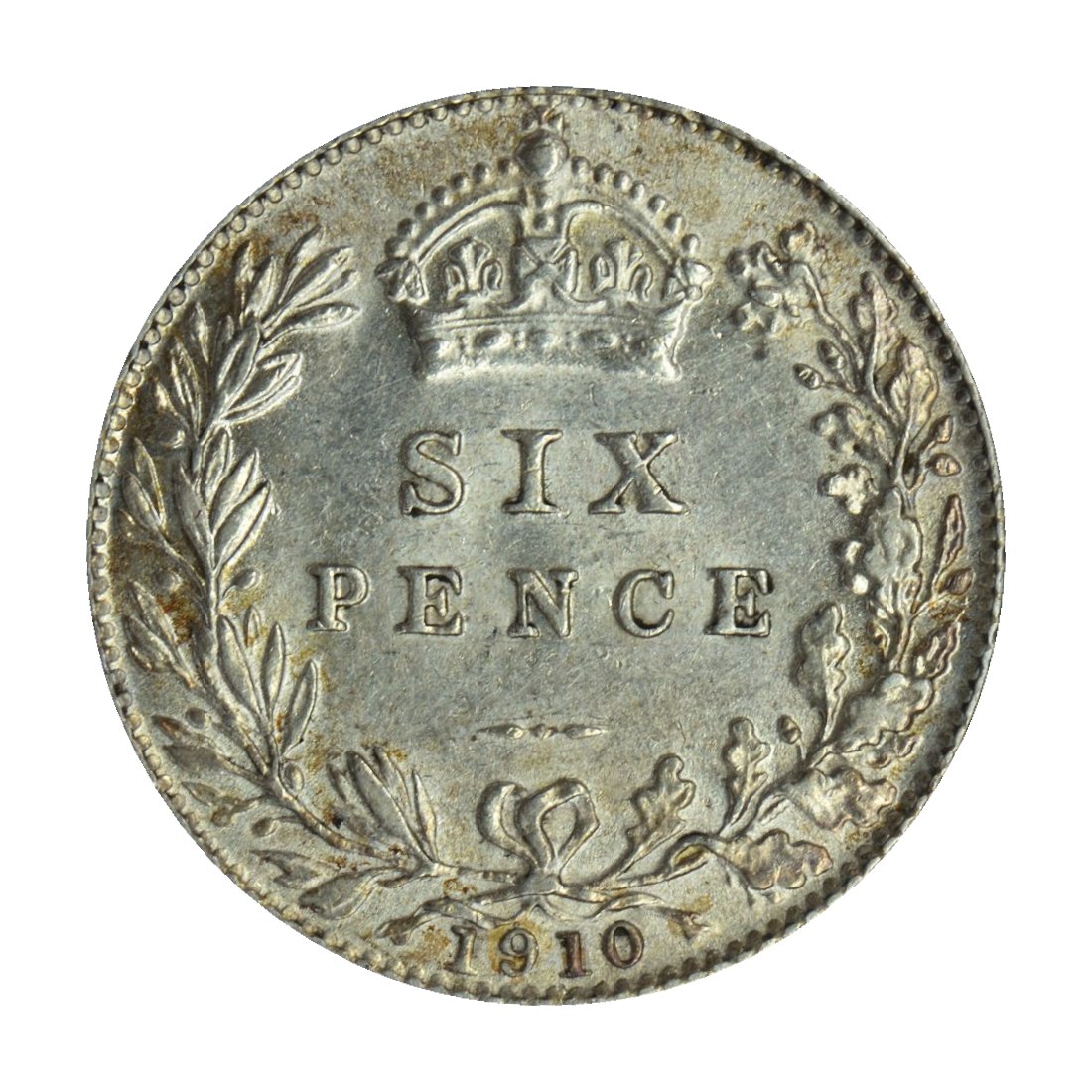
Crown / SIX PENCE / wreath
Merlen design
| Section | Topic | Notes | ||||||||||||||||||||||||||||||||||||||||||||||||||||||||||||||||||||||
|---|---|---|---|---|---|---|---|---|---|---|---|---|---|---|---|---|---|---|---|---|---|---|---|---|---|---|---|---|---|---|---|---|---|---|---|---|---|---|---|---|---|---|---|---|---|---|---|---|---|---|---|---|---|---|---|---|---|---|---|---|---|---|---|---|---|---|---|---|---|---|---|---|
| History & Context | ||||||||||||||||||||||||||||||||||||||||||||||||||||||||||||||||||||||||
| History | The Edwardian Era | Edward VII — Albert Edward, eldest son of Queen Victoria and Prince Albert — came to the throne on 22 January 1901, aged 59, having waited nearly six decades as heir apparent. His reign of nine years (1901–1910) is known as the Edwardian era: a brief golden Indian summer of British imperial confidence, characterised by opulent court life, rapid technological change (automobiles, aeroplanes, cinema), social reform agitation, rising trade union power, and the beginnings of the constitutional crisis that would culminate in the Parliament Act of 1911. Britain was still the world's foremost imperial power, governing roughly a quarter of the Earth's surface. Edward VII died on 6 May 1910 — and the 1910 sixpence, the last of the series, bears the date of the final year of his reign. He was succeeded by his son George V, for whom Bertram Mackennal designed the new coinage portrait. | ||||||||||||||||||||||||||||||||||||||||||||||||||||||||||||||||||||||
| History | The Sixpence — The Tanner |
The sixpence — known colloquially as the tanner (a term of uncertain origin, possibly from tanner as a slang word for a small coin or from the Romany tawno, meaning small) — was one of the most familiar coins in British daily life. Worth six pence, or half a shilling, or 1/40 of a pound, it was large enough to purchase a loaf of bread, a newspaper, or a music-hall gallery ticket in Edwardian England; small enough to be given to children as a significant treat. The sixpence featured in Christmas puddings (said to bring luck to the finder), in songs and sayings, and in street-corner commerce throughout the period. The sixpence was first minted in 1551 under Edward VI and continued virtually without interruption until decimalisation in 1971 — 420 years. The Edwardian series represents just nine of those years. The coin's cultural resonance extended well beyond its monetary value: "not a sixpence to my name" was a common expression of poverty, and "sixpence off" a familiar market trader's cry. | ||||||||||||||||||||||||||||||||||||||||||||||||||||||||||||||||||||||
| History | Sterling Silver & 1920 |
The Edward VII sixpence, like all British silver coinage from mediaeval times to 1920, was struck in .925 sterling silver — an alloy of 92.5% silver and 7.5% copper that has been the British standard since at least the 13th century (the name "sterling" may derive from the Easterlings, German merchants who traded silver in England). In 1920, in the immediate aftermath of WWI, the silver content of British coinage was reduced from .925 to .500 — the most drastic debasement in British monetary history. The Edward VII sixpences are therefore the last generation of full-sterling-silver sixpences from a period of unchallenged British monetary stability. | ||||||||||||||||||||||||||||||||||||||||||||||||||||||||||||||||||||||
| Design | ||||||||||||||||||||||||||||||||||||||||||||||||||||||||||||||||||||||||
| Design | Obverse: De Saulles Portrait |
The obverse shows the bare head of King Edward VII facing right — a more naturalistic and dignified portrait than Victoria's aging veiled effigy that preceded it. The legend reads EDWARDVS VII D:G: BRITT: OMN: REX F:D: IND: IMP: — "Edward the Seventh, by the Grace of God, King of all the Britains, Defender of the Faith, Emperor of India" — a statement of unprecedented imperial reach. Below the truncation of the neck: DES, de Saulles's signature. De Saulles (1862–1903) worked from a model by Emil Fuchs, an Austrian-born sculptor who had been granted several sittings with the King. The portrait was compared favourably at the time with the Austrian Franz Joseph portrait on the Habsburgcoronation coins — a coincidence that is ironic given that Stephan Schwartz at the Vienna Mint was producing the Habsburg portrait at almost exactly the same period. See the companion articles on the 1913 Austria 2 Corona and 1916 Austria 1 Corona for the Schwartz comparison. | ||||||||||||||||||||||||||||||||||||||||||||||||||||||||||||||||||||||
| Design | Reverse: Merlen's Design |
The reverse carries a design by Jean Baptiste Merlen (c.1769–1850), a Flemish-born engraver who had worked at the Royal Mint from the early 19th century. The central device is the word SIX PENCE in two lines, surmounted by a small royal crown; the whole enclosed within an elegant wreath of laurel and oak branches, tied with a bow at the base. Below the wreath: the date. The design was a survival from the Victorian era, used across multiple reigns — its clean classicism suited both the Victorian and Edwardian coin aesthetic without modification. A small scroll appears below the crown, above the denomination text, on close examination. The reverse shows no explicit royal cypher or national symbol — the crown alone signals British royal authority. This restraint gives the reverse a timeless quality that has made it easy to adapt for successive reigns with only the obverse portrait changed. | ||||||||||||||||||||||||||||||||||||||||||||||||||||||||||||||||||||||
| Design | The 1902 Matt Proof |
For the 1902 Coronation, the Royal Mint struck special matt proof sets — coins with a unique satin-like surface finish produced by a different striking method from the usual proof (which has highly polished dies). The 1902 matt proof sixpence (ESC 1789) is a distinct and collectible piece, commanding significantly higher premiums than the regular circulation 1902. It should not be confused with the normal 1902 currency issue. All values on this page refer to circulation strikes unless otherwise stated. | ||||||||||||||||||||||||||||||||||||||||||||||||||||||||||||||||||||||
| Complete Series — All Nine Dates | ||||||||||||||||||||||||||||||||||||||||||||||||||||||||||||||||||||||||
| Series | Mintage & Values by Year |
|
||||||||||||||||||||||||||||||||||||||||||||||||||||||||||||||||||||||
| Mint & Production | ||||||||||||||||||||||||||||||||||||||||||||||||||||||||||||||||||||||||
| Mint | Royal Mint, London |
All Edward VII sixpences were struck at the Royal Mint, then located at Tower Hill in the City of London (the Mint moved to Llantrisant in Wales in 1968). No branch mint struck sixpences — unlike some colonial denominations, the home coinage silver was produced exclusively in London. No mint mark appears on the coins. The Royal Mint in the Edwardian era was producing coins for a large part of the British Empire: Australia, Canada, India, South Africa, and dozens of smaller territories all received coinage from London or from branch mints operating under Royal Mint authority. | ||||||||||||||||||||||||||||||||||||||||||||||||||||||||||||||||||||||
| Mint | Sterling Silver and Fineness |
At .925 fine, the Edward VII sixpence contains 2.617 g pure silver (= 0.0841 troy oz). The .925 sterling standard had been used for British silver coins since the late 14th century and was one of the most consistent standards in world monetary history. The Coinage Act 1870 codified the standard: all silver coins to be "of silver eleven twelfths fine" (= 916.7 milliemes) — close to but not exactly .925, reflecting the slight variation in the historical standard. By the Edwardian era, the actual fineness was being held at .925 (sterling) for all silver coinage. | ||||||||||||||||||||||||||||||||||||||||||||||||||||||||||||||||||||||
| Mint | The 1904 Key Date |
The 1904 sixpence has the lowest circulation mintage of the series at 4,487,098. It is consistently described as the key date — the scarcest date for high-grade examples. In circulated grades (G–VF) it is only moderately harder to find than other dates, but in EF and above it is significantly rarer. The combination of lower original mintage, heavy Edwardian-era circulation, and the coin's small size (more easily lost than larger denominations) means that fewer gem examples survived. Values in EF–UNC are approximately 3–4× those of the common 1906/1907 dates. The 1905 has an even lower absolute mintage (3,806,969) but is less expensive in practice — possibly because more were preserved in the period's silver hoarding, or because the die quality of the 1905 strikes produced coins that wore more slowly. The interaction of mintage, wear rate, and hoarding behaviour creates a market hierarchy that does not always follow the raw mintage figures. | ||||||||||||||||||||||||||||||||||||||||||||||||||||||||||||||||||||||
| Valuation — Grade Guide for Common Dates | ||||||||||||||||||||||||||||||||||||||||||||||||||||||||||||||||||||||||
| Value | Grade Guide (Common Dates: 1906, 1907, 1908) |
|
||||||||||||||||||||||||||||||||||||||||||||||||||||||||||||||||||||||
| Collecting Notes | ||||||||||||||||||||||||||||||||||||||||||||||||||||||||||||||||||||||||
| Collect | Building the Complete Set |
A complete set of nine dates (1902–1910) in circulated grades is very achievable — the common dates (1906, 1907, 1908, 1909, 1910) can be purchased for £2–30 each depending on grade, and the first year (1902) is similarly accessible. The difficulty dates are 1903, 1904, and 1905 — particularly the 1904. A complete set in VF would cost approximately £120–300 total for the eight common-to-moderate dates, plus £30–80 for the 1904. A complete set in EF runs to perhaps £600–900 total depending on quality, with the 1904 alone accounting for £120–200 of that. | ||||||||||||||||||||||||||||||||||||||||||||||||||||||||||||||||||||||
| Collect | What to Look For | Key grading points: (1) Edward VII's portrait — the ear, the cheek below the cheekbone, and the collar edge are the highest points of the obverse and wear first. (2) DES signature — the engraver's initials below the portrait truncation are a useful grade cross-check; they should be clear in VF and above. (3) The crown on the reverse — the arched band and cross at the summit of the crown wear quickly; sharp crown detail indicates EF or better. (4) The wreath — individual leaf outlines should be distinct at EF; they merge in VF. (5) Original lustre — sterling silver develops a beautiful toning over time; original untouched examples show a flowing brilliance that differs from cleaned coins. | ||||||||||||||||||||||||||||||||||||||||||||||||||||||||||||||||||||||
| Collect | Problems to Avoid | Common issues: (1) Cleaning — extremely widespread; harsh dipping removes original toning and lustre. Genuine EF examples have a warm tone; cleaned pieces are bright and harsh. (2) Tooling — some worn examples have been artificially enhanced by engraving work to sharpen worn features, particularly on the 1904; check under magnification for inconsistent metal flow. (3) Wrong date — all nine dates look similar; confirm the date clearly before paying key-date premiums for a supposed 1904. (4) Matt proof vs currency — the 1902 matt proof has a distinctive satin surface; do not pay proof prices for a currency strike or vice versa. (5) Over-grading — sixpences are small and the detail is fine; handle under a loupe in good light. | ||||||||||||||||||||||||||||||||||||||||||||||||||||||||||||||||||||||
| Collect | Collection Contexts | The Edward VII sixpence fits into: a complete reign set (all nine dates, 1902–1910); a British sixpence by monarch type set (one coin per reign from Elizabeth I to Elizabeth II — nine monarchs over 420 years); a de Saulles portrait collection (all Edward VII denominations sharing his portrait — halfcrown, shilling, sixpence, threepence, penny, halfpenny, and the decimal forerunner coins); an Edwardian silver set (halfcrown, florin, shilling, sixpence, threepence — all in sterling); or simply as a standalone piece of Edwardian history in the hand. | ||||||||||||||||||||||||||||||||||||||||||||||||||||||||||||||||||||||
| Collect | Related Coins | The natural companions within the Edwardian silver series: the Edward VII threepence (2.83g, 16mm — same weight as the sixpence, same obverse); Edward VII shilling (5.65g, 23.6mm); Edward VII florin (11.31g, 28.3mm); and the Edward VII halfcrown (14.14g, 32mm). All use de Saulles's portrait with the same Latin legend. The preceding Victoria Old Head sixpence (S.3938, Veiled Head, 1893–1901) and succeeding George V sixpence (S.4013, Mackennal portrait, 1911–1927) complete the contextual run. For the de Saulles portrait specifically, see also the companion article on the Jersey 1/12 and 1/24 shilling 1909 — the only non-UK coinage to carry his Edward VII portrait. | ||||||||||||||||||||||||||||||||||||||||||||||||||||||||||||||||||||||
Sources: Spink Standard Catalogue of British Coins (S.3983) · Maurice Bull & Alan Rayner, English Silver Coinage Since 1649, 7th ed. (2020) — ESC 1789–1795 · Coinparade.co.uk — mintages (1908: 6,738,400; 1909: 6,584,000) and design attribution (Merlen reverse) · allcoinvalues.com — date-by-date value ranges (1902 £1.50–£60; 1903 £2–£110; 1904 £3–£300; 1905 £3–£160; 1906 £2–£100) · The London Coin Company — PCGS MS-63 1902 description · Golding Eagle Coins — 1908 KM#779 XF description; de Saulles attribution · sovr.co.uk — 1910 Edward VII sixpence, ESC 1795, weight 2.86g, Bull 3606 · coin-identifier.com — Edward VII coinage overview · Numista catalogue entry #4211 — 6 Pence Edward VII