British Shilling — Edward VII — 1902–1910 Complete Series Guide — All Nine Dates — De Saulles Obverse & Reverse — Royal Mint
KM# 800 · S.3982 · ESC 1411–1419 · Bull 3586–3594 · Silver .925 (Sterling) · 23.5 mm · 5.66 g · Reeded edge · ASW 0.1682 troy oz
George William de Saulles — Both Sides of the Shilling
The Edward VII shilling is unusual in that George William de Saulles (1862–1903) designed and engraved both sides — obverse and reverse alike. The obverse carries his bare-headed portrait of Edward VII with DES below the truncation. The reverse — his design — shows a lion passant guardant standing left on a royal crown, with the date divided to either side of the crown; around, FID: DEF: IND: IMP: in the upper half, and ONE SHILLING below. This was a new reverse design, not a Victorian survival — de Saulles created it specifically for the Edwardian coinage. It proved so successful that George V retained it, essentially unchanged, for the shilling of 1911–1936. The design endured for 35 years. De Saulles died in August 1903 while still preparing the King's Great Seal — his shilling design outlasted him by a generation.
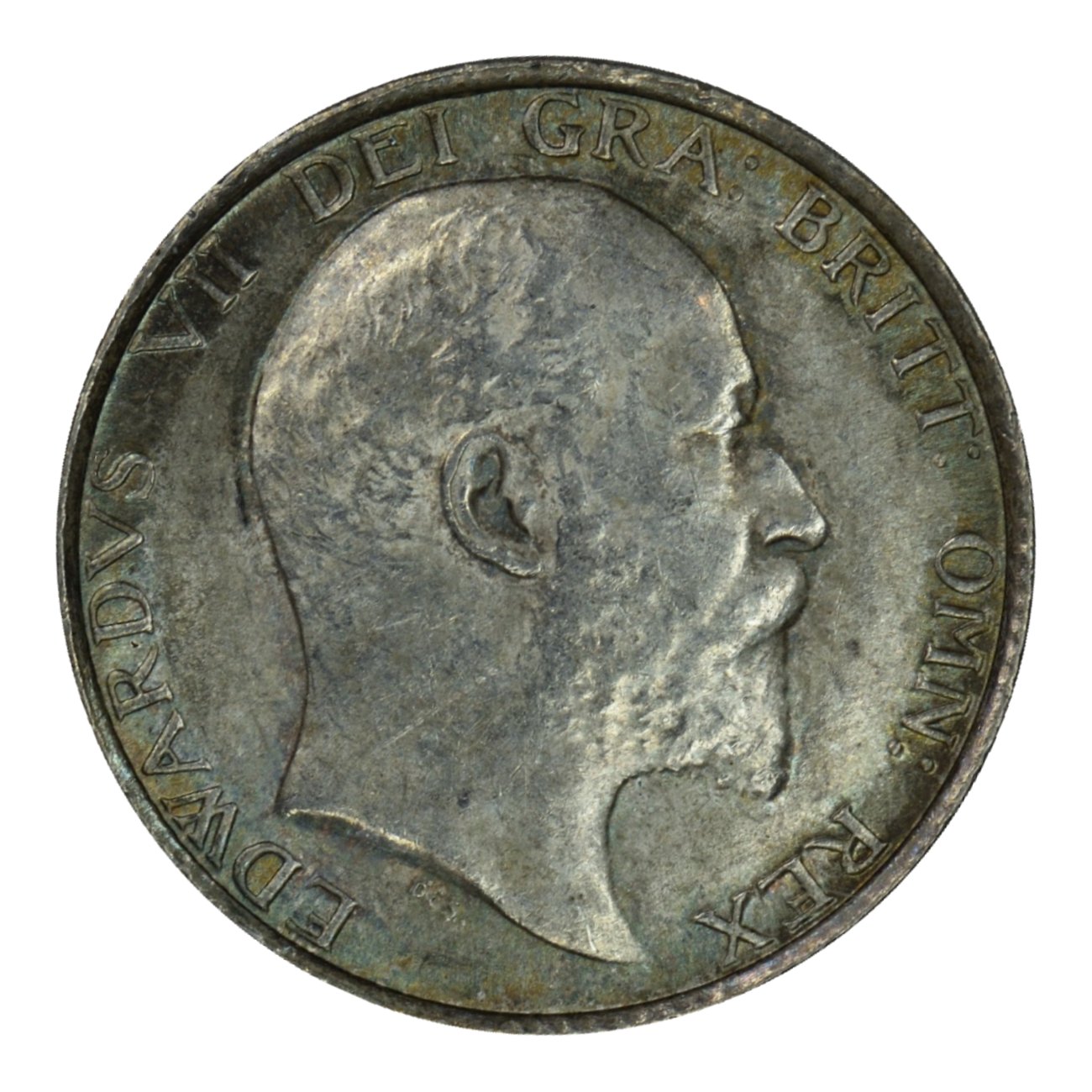
Edward VII — de Saulles
DES below truncation
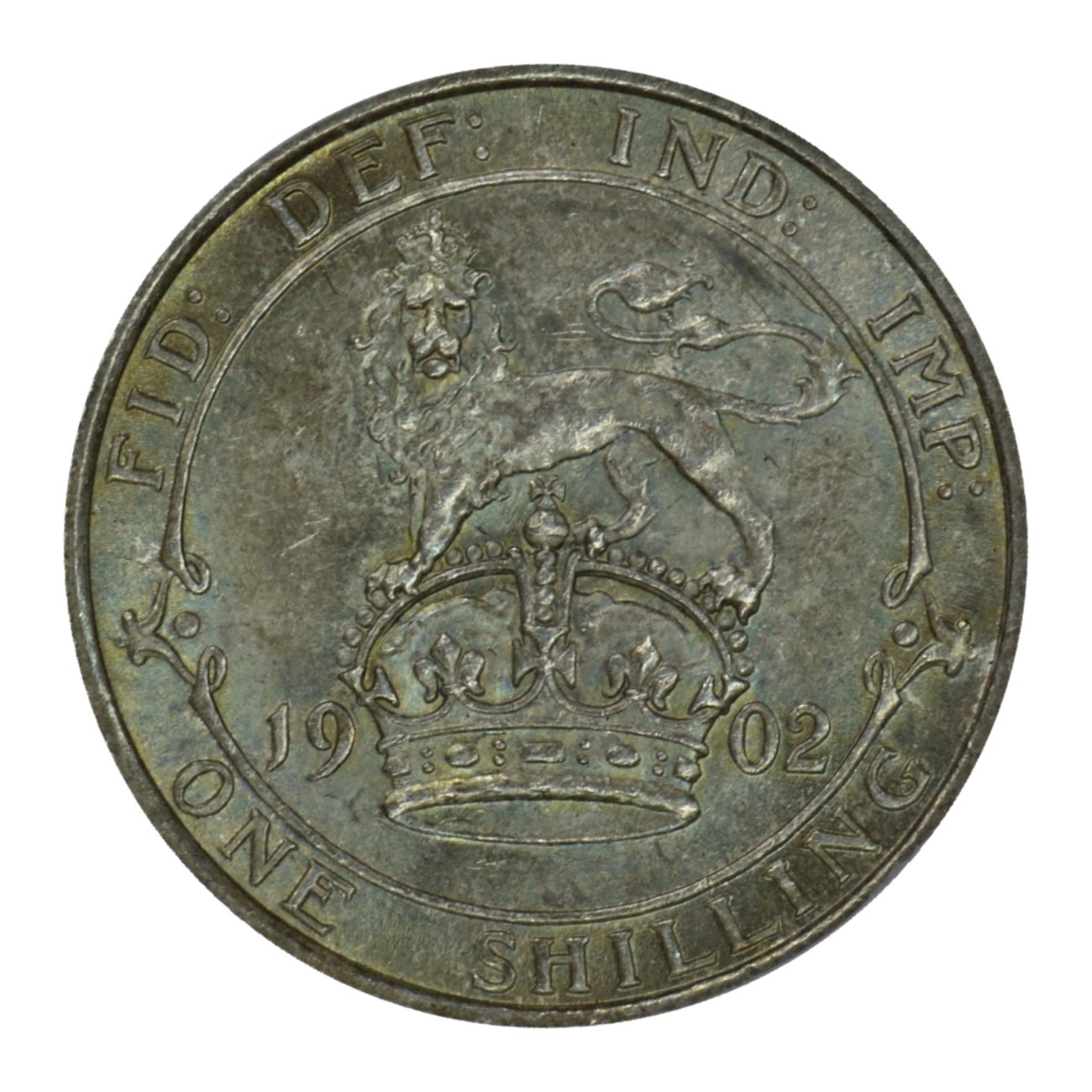
Lion on crown — de Saulles
Date divided by crown
| Section | Topic | Notes | ||||||||||||||||||||||||||||||||||||||||||||||||||||||||||||||||||||||
|---|---|---|---|---|---|---|---|---|---|---|---|---|---|---|---|---|---|---|---|---|---|---|---|---|---|---|---|---|---|---|---|---|---|---|---|---|---|---|---|---|---|---|---|---|---|---|---|---|---|---|---|---|---|---|---|---|---|---|---|---|---|---|---|---|---|---|---|---|---|---|---|---|
| History & Context | ||||||||||||||||||||||||||||||||||||||||||||||||||||||||||||||||||||||||
| History | The Shilling — The Bob |
The shilling — 12 pence, one twentieth of a pound, colloquially known as the bob (a term of uncertain origin in use at least since the 18th century) — was one of the most important coins in British daily commerce. In Edwardian England, a shilling was a meaningful sum: a daily wage for an agricultural labourer, the price of a pound of beef, or a gallery ticket for a West End theatre. It was used constantly and worn accordingly. The shilling was first minted in 1503 (then called the "testoon") and struck continuously until decimalisation on 15 February 1971 — a run of 468 years. 12 pennies = 1 shilling = 1/20 of a pound. The shilling was also the model for the denomination subsequently adopted for the Commonwealth of Australia's coinage from 1910 — the Australian shilling was identical in size, weight, and alloy to the British shilling and directly interchangeable. | ||||||||||||||||||||||||||||||||||||||||||||||||||||||||||||||||||||||
| History | Edward VII & the Edwardian Era |
Albert Edward came to the throne on 22 January 1901, aged 59, having waited 59 years as heir apparent — the longest such wait in British history. As Prince of Wales he had been a prominent figure in society, arts, and diplomacy; as King he brought a more relaxed, cosmopolitan style to the monarchy. His nine-year reign (1901–1910) was a period of imperial confidence and social ferment — the peak of the British Empire, the rise of the Suffragette movement, the Entente Cordiale with France (1904), the Anglo-Russian Convention (1907), and the beginning of the constitutional crisis over the House of Lords. Edward VII died on 6 May 1910. His 1910 shilling — with a mintage of 26,547,236, the highest of the series — was being struck in great quantities right through the final months of his reign and circulated in both Britain and the Australian Commonwealth for decades afterward. | ||||||||||||||||||||||||||||||||||||||||||||||||||||||||||||||||||||||
| History | The Shilling & Australia |
The Edward VII shilling has a particular significance for Australian numismatics. When the Commonwealth of Australia issued its first coinage in 1910, the shilling was struck at the Royal Mint in London and at the Melbourne and Sydney branch mints to identical specifications — 5.66g, 23.5mm, .925 sterling silver — as the British coin. The Australian shilling and the British shilling were legally interchangeable. Collectors of Australian coins often acquire Edward VII British shillings as context pieces for the early Commonwealth series. Museums Victoria notes: "This coin was current in Australia and was the model (in terms of size and alloy) for this denomination among those chosen for the coinage of the Commonwealth of Australia." The Australian Edward VII shilling (1910 only, Melbourne and Sydney mints) is a separate type, but its British counterpart circulated alongside it freely. | ||||||||||||||||||||||||||||||||||||||||||||||||||||||||||||||||||||||
| Design | ||||||||||||||||||||||||||||||||||||||||||||||||||||||||||||||||||||||||
| Design | Obverse | The bare head of King Edward VII facing right, with the legend EDWARDVS VII DEI GRA: BRITT: OMN: REX — "Edward the Seventh, by the Grace of God, King of all the Britains" — around the rim. Below the truncation: De S. or DES — de Saulles's signature, visible on EF and better examples. The portrait was prepared by de Saulles working from a model by sculptor Emil Fuchs, who had been granted sittings with the King. The obverse legend on the shilling differs slightly from the sixpence: DEI GRA: BRITT: OMN: REX vs the sixpence's D:G: BRITT: OMN: REX F:D: IND: IMP: — the full titles appear split between obverse and reverse on the shilling. FID: DEF: IND: IMP: (Defender of the Faith, Emperor of India) appear on the reverse instead. | ||||||||||||||||||||||||||||||||||||||||||||||||||||||||||||||||||||||
| Design | Reverse — The Lion on Crown |
De Saulles's own reverse design shows a lion passant guardant — the royal beast of England — standing left on a royal crown, facing right. The date is divided either side of the crown (e.g. 19 — 05 for 1905). In the upper half of the coin: FID: DEF: IND: IMP: (Defender of the Faith, Emperor of India). Below: ONE SHILLING. The design is bold, heraldically correct, and strikes superbly — the lion's mane and the jewelled crown render with exceptional clarity on well-struck examples. This reverse was so successful that George V used it, with the new monarch's portrait, for the shilling of 1911–1936. De Saulles's lion-on-crown reverse is generally considered one of the best British coin reverse designs of the 20th century. Its combination of powerful central motif, clean field, and bold heraldry gives it a visual authority that the sixpence's simpler wreath-and-SIX-PENCE reverse lacks. Collectors who build Edwardian type sets consistently rate the shilling as the finest piece of the series. | ||||||||||||||||||||||||||||||||||||||||||||||||||||||||||||||||||||||
| Design | The 1902 Matt Proof |
A special matt proof issue was prepared in 1902 for the Coronation: 15,123 pieces struck with a distinctive satin (not brilliant mirror) surface finish (ESC 1411; S.3982). The 1902 matt proof shilling is a significant collectible in its own right — worth substantially more than the currency issue. The Britannia Coin Company describes their NGC PF-61 example: "A collectable silver matte proof Shilling of King Edward VII… from a limited mintage of 15,123 pieces." All values on this page refer to the currency (circulation) strikes unless explicitly stated. | ||||||||||||||||||||||||||||||||||||||||||||||||||||||||||||||||||||||
| Complete Series — All Nine Dates | ||||||||||||||||||||||||||||||||||||||||||||||||||||||||||||||||||||||||
| Series | Mintages & Values by Year |
|
||||||||||||||||||||||||||||||||||||||||||||||||||||||||||||||||||||||
| Mint & Production | ||||||||||||||||||||||||||||||||||||||||||||||||||||||||||||||||||||||||
| Mint | Royal Mint, London |
All Edward VII shillings were struck exclusively at the Royal Mint, Tower Hill, London. No branch mint struck British shillings. No mint mark appears — the absence of a mark is the normal condition for Royal Mint London issues throughout this period. The Royal Mint in the Edwardian era was simultaneously supplying coinage for a large part of the Empire as well as the home coinage, operating under significant production pressure from the demands of a rapidly growing industrial economy. | ||||||||||||||||||||||||||||||||||||||||||||||||||||||||||||||||||||||
| Mint | The 1907 Mintage Discrepancy |
The 1907 shilling mintage is one of the most debated figures in British numismatics. Three different published sources give different numbers. Numista made a direct enquiry to the Royal Mint Museum and received the reply: "In the 1907 annual report the specific mintage figure for the shilling is not provided, but it does say that £180,000 worth of shillings were produced." At 20 shillings to the pound, this implies 3,600,000 pieces — much closer to the Collectors' Coins GB figure of 4,083,418 than to Krause's 14,083,418. The correct figure is most likely in the 3–4 million range. The Krause figure of 14,083,000 appears to be an error (possibly 4,083,418 misread or mistransferred with an extra digit). Dealers and cataloguers increasingly favour the lower figure. If the true mintage is c.4 million, the 1907 is a somewhat scarcer date than commonly assumed — possibly comparable to 1908 rather than 1906. | ||||||||||||||||||||||||||||||||||||||||||||||||||||||||||||||||||||||
| Mint | The 1905 Key Date: Why So Rare? |
The 1905 mintage of 488,390 is the lowest in the Edwardian shilling series by a factor of approximately four. No single confirmed explanation has been established for why the Mint struck so few shillings in 1905. Likely factors include: (1) large carryover stocks of 1903 and 1904 shillings still in the system; (2) normal fluctuation in Royal Mint production scheduling based on Treasury demand forecasts; (3) the economic cycle of Edwardian Britain, which saw slightly lower commercial activity in 1905 than in the preceding or following years. Whatever the cause, the result is that the 1905 shilling is one of the most celebrated low-mintage dates in 20th-century British coinage — on a par with the 1854 Victoria shilling and the 1926 George V modified effigy sixpence as a defining set-building challenge. A dealer (cointrust.co.uk) specifically offers Edward VII shillings "not 1903–4–5" — demonstrating that the trade recognises these three low-mintage years as a group that commands premium stock-management attention, with 1905 the most challenging of the three to source. | ||||||||||||||||||||||||||||||||||||||||||||||||||||||||||||||||||||||
| Valuation — Grade Guide | ||||||||||||||||||||||||||||||||||||||||||||||||||||||||||||||||||||||||
| Value | Grade Guide: Common Dates vs 1905 Key Date |
|
||||||||||||||||||||||||||||||||||||||||||||||||||||||||||||||||||||||
| Value | The 1903 and 1904 — Hidden Scarcity |
Collectors sometimes overlook the 1903 and 1904 dates because the 1905 so dramatically dominates discussion of scarcity. But with mintages of 2,061,823 and 2,040,161 respectively — roughly one-quarter to one-fifth the common dates — the 1903 and 1904 are genuinely difficult in EF and above. A 1903 in true EF will cost £280–380, and a 1904 £240–325 — representing perhaps 3–4× the common date premium. These are collector-grade premiums, not the dramatic 10–25× premium of the 1905, but they matter when building a complete EF set. | ||||||||||||||||||||||||||||||||||||||||||||||||||||||||||||||||||||||
| Collecting Notes | ||||||||||||||||||||||||||||||||||||||||||||||||||||||||||||||||||||||||
| Collect | Building the Complete Set |
A complete nine-date set in circulated grades (G–VF) is achievable for under £150 total for the eight common-to-moderate dates — but the 1905 will add £30–200+ depending on the grade acquired, making it the determining cost factor of any complete set. An EF complete set costs approximately £1,500–2,500 total, with the 1905 alone accounting for roughly £600–1,200 of that. A UNC complete set is a serious numismatic undertaking, given the rarity of the 1905 in that condition, and could realistically cost £5,000+. | ||||||||||||||||||||||||||||||||||||||||||||||||||||||||||||||||||||||
| Collect | What to Look For | Key grading points for the shilling: (1) Edward VII's portrait — the ear and cheek are the highest points of the obverse; their wear defines EF from VF. (2) DES signature — below the portrait truncation; should be clear in VF and above; confirms attribution. (3) The lion's back and mane — the highest point of the reverse; the individual hairs of the mane distinguish EF (distinct) from VF (present but soft) from F (merged). (4) The crown jewels — the arched bands and central orb of the crown; sharp at EF. (5) The date — divided either side of the crown; should be fully legible in all grades above F; on the 1905 specifically, confirm the date clearly and check for signs of alteration on lesser dates. | ||||||||||||||||||||||||||||||||||||||||||||||||||||||||||||||||||||||
| Collect | The 1905: Beware of Fakes |
The 1905 shilling's value premium makes it a target for alteration and forgery. Common methods of faking a 1905: (1) Date alteration — tooling a 5 from a 3, 4, 6, or 8 on a lower-value year; check the date figures for consistent depth and metal flow — genuine die-struck numerals have sharp, consistent edges; altered numerals often show filing marks, uneven surfaces, or inconsistent depth. (2) Genuine forgeries — contemporary copies exist; check weight (genuine: 5.66g), diameter (23.5mm), and edge (reeded, 172 reeds). (3) Over-grade presentation — a VF 1905 presented as EF to capture the premium; inspect under good raking light with a loupe. For any 1905 commanding a significant price, certification (NGC/PCGS) is strongly recommended. | ||||||||||||||||||||||||||||||||||||||||||||||||||||||||||||||||||||||
| Collect | Problems to Avoid | Beyond 1905-specific issues: (1) Cleaning — extremely common in shillings; genuine original lustre flows in cartwheel patterns under raking light; cleaned pieces are flat and bright. (2) Tooling — worn examples sharpened with an engraving tool to raise apparent grade. (3) 1907 mintage confusion — if a dealer prices a 1907 as a scarce date based on a 4-million-piece mintage (rather than Krause's disputed 14 million), they may be correct; treat 1907 with moderate caution. (4) Matt proof vs currency — the 1902 matt proof has a distinctive satin surface that differs clearly from the currency strike; do not overpay for a currency 1902 or underpay for a genuine matt proof. | ||||||||||||||||||||||||||||||||||||||||||||||||||||||||||||||||||||||
| Collect | Collection Contexts | The Edward VII shilling fits into: a complete nine-date set 1902–1910; a British shilling by monarch type set (one per reign, Henry VII to Elizabeth II, covering 500 years); a de Saulles complete works collection — all denominations using his portrait and, in the case of the shilling, his reverse; an Edwardian silver set (halfcrown, florin, shilling, sixpence, threepence); a famous key dates collection (1905 alongside such pieces as the 1854 Victoria shilling, 1952 halfcrown, etc.); or as a companion to the Jersey 1/12 shilling 1909, also designed by de Saulles and the only non-UK coinage bearing his Edward VII portrait. | ||||||||||||||||||||||||||||||||||||||||||||||||||||||||||||||||||||||
| Collect | Related Coins | The natural companions within the Edwardian series: the Edward VII sixpence 1902–1910 (KM#779, 2.83g, 19.3mm — covered in the companion article); the Edward VII florin 1902–1910 (KM#801, 11.31g, 28.3mm — double the shilling weight; lion reverse replaced by Britannia standing); the Edward VII halfcrown 1902–1910 (KM#802, 14.14g, 32mm). The George V shilling 1911–1936 (KM#816, same lion-on-crown reverse retained from de Saulles) is the immediate successor. For Australian collectors, the Australian Edward VII shilling 1910 (struck at Melbourne and Sydney Mints to identical specifications) is the complementary piece. | ||||||||||||||||||||||||||||||||||||||||||||||||||||||||||||||||||||||
Sources: Spink Standard Catalogue of British Coins (S.3982) · Maurice Bull & Alan Rayner, English Silver Coinage Since 1649, 7th ed. (2020) — ESC 1411–1419 · Dorset Coin Company — 1905 mintage 488,390 ("hardest of the Edwardian shillings to find") · sovr.co.uk — 1905 "rarest date of this reign and for denomination"; weight 2.86g, ESC 1415 · allcoinvalues.com — date-by-date value ranges (1902–1910) · mycoinage.co.uk — 1905 key date context; £100–500 in collectable grade · vcoins — 1905 GVF++ Key Date listing · Numista catalogue entry #13225 — 1907 mintage discrepancy and Royal Mint Museum enquiry · Baldwin's — 1906 EF description (ESC 1415, S.3982, Bull 3592) · Britannia Coin Company — 1902 matt proof NGC PF-61 (15,123 mintage) · Museums Victoria — 1902 shilling entry (colonial context, model for Australian coinage) · cointrust.co.uk — "Our choice of dates (not 1903–4–5–)" (stock availability note) · tezbid.com — specifications 5.66g, 23.5mm, .925 silver