British Penny — Edward VII — 1902–1910 The Bun Penny's Successor — Bronze — Britannia Seated — Low Tide & High Tide — Complete Series Guide
KM# 794.1 (1902 Low Tide) & KM# 794.2 (1902–1910 High Tide) · S.3990 / S.3990A · Freeman 156–168 · Bronze · 30.82 mm · 9.4 g · Plain edge
The Last Bun Penny — De Saulles and the Seated Britannia
The Edwardian penny is the final chapter in the story of the Victorian "Bun Penny" — the bronze penny first struck in 1860, designed by Leonard Charles Wyon with a seated Britannia reverse that continued virtually unchanged for 50 years. The obverse portrait is new — George William de Saulles's bare-headed Edward VII, facing right, with DES below the truncation. But the reverse Britannia — seated right, helmeted, holding a trident, her other hand resting on a shield bearing the Cross of St George, waves behind, ONE PENNY above and the date in the exergue below — is Wyon's 1860 design, carried forward unmodified. Wyon's Britannia thus appeared on British bronze pennies from 1860 to 1901 under Victoria, and then again from 1902 to 1910 under Edward VII: 50 years of the same reverse design, with only the obverse portrait changing at the monarch's accession.
The Low Tide and High Tide — 1902 Die Varieties
To identify the Low Tide: look at the sea level relative to Britannia's robe hemline, and check whether the 2 in "1902" has a straight or wavy baseline. The same Low Tide / High Tide distinction exists for the 1902 halfpenny. The Gouby reference (BP1902A/B) and Freeman reference (F156/F157) provide detailed die pair attributions. Additional reverse varieties are documented for 1903, 1905, 1908 (obverse and reverse), and 1909.
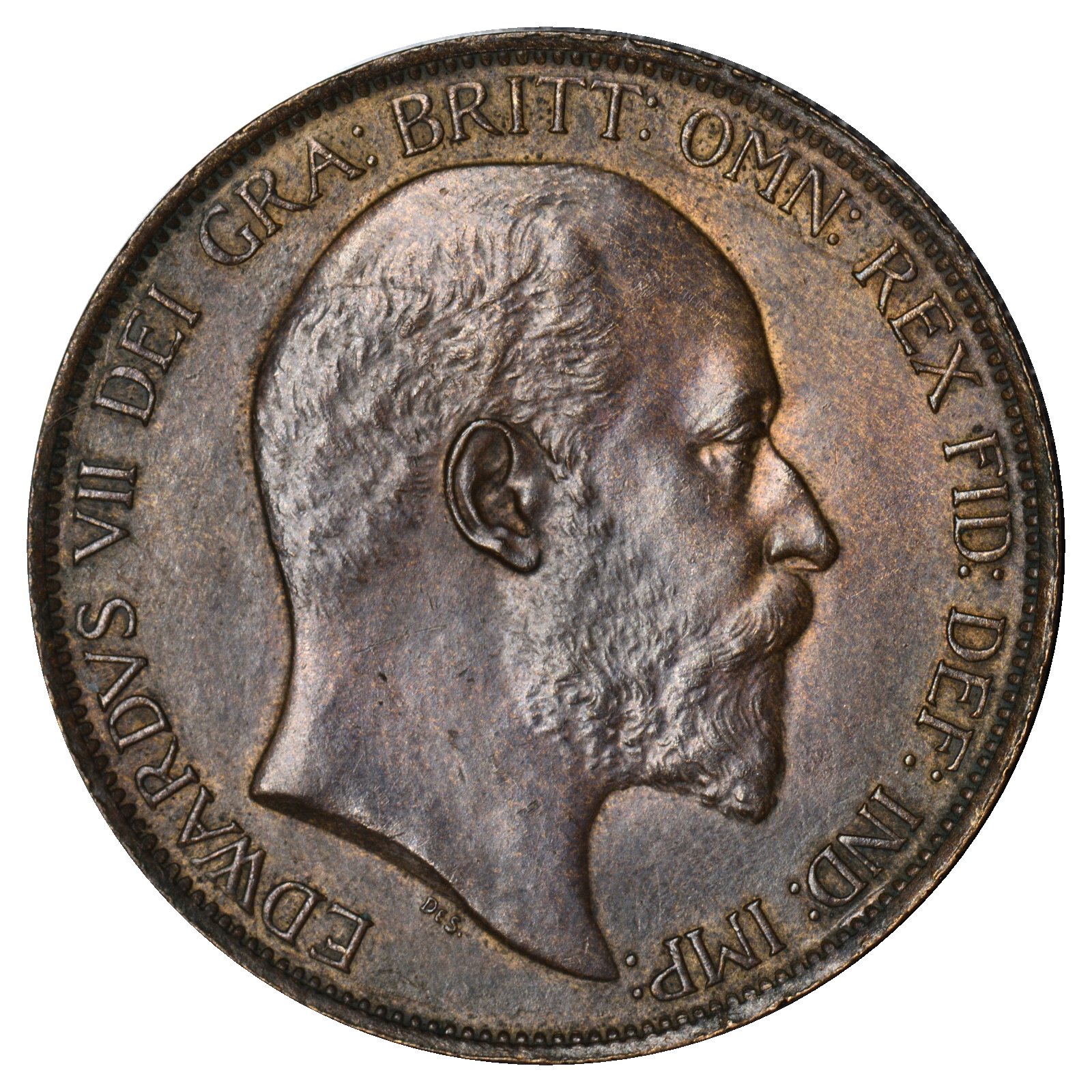
Edward VII — de Saulles
DES below truncation
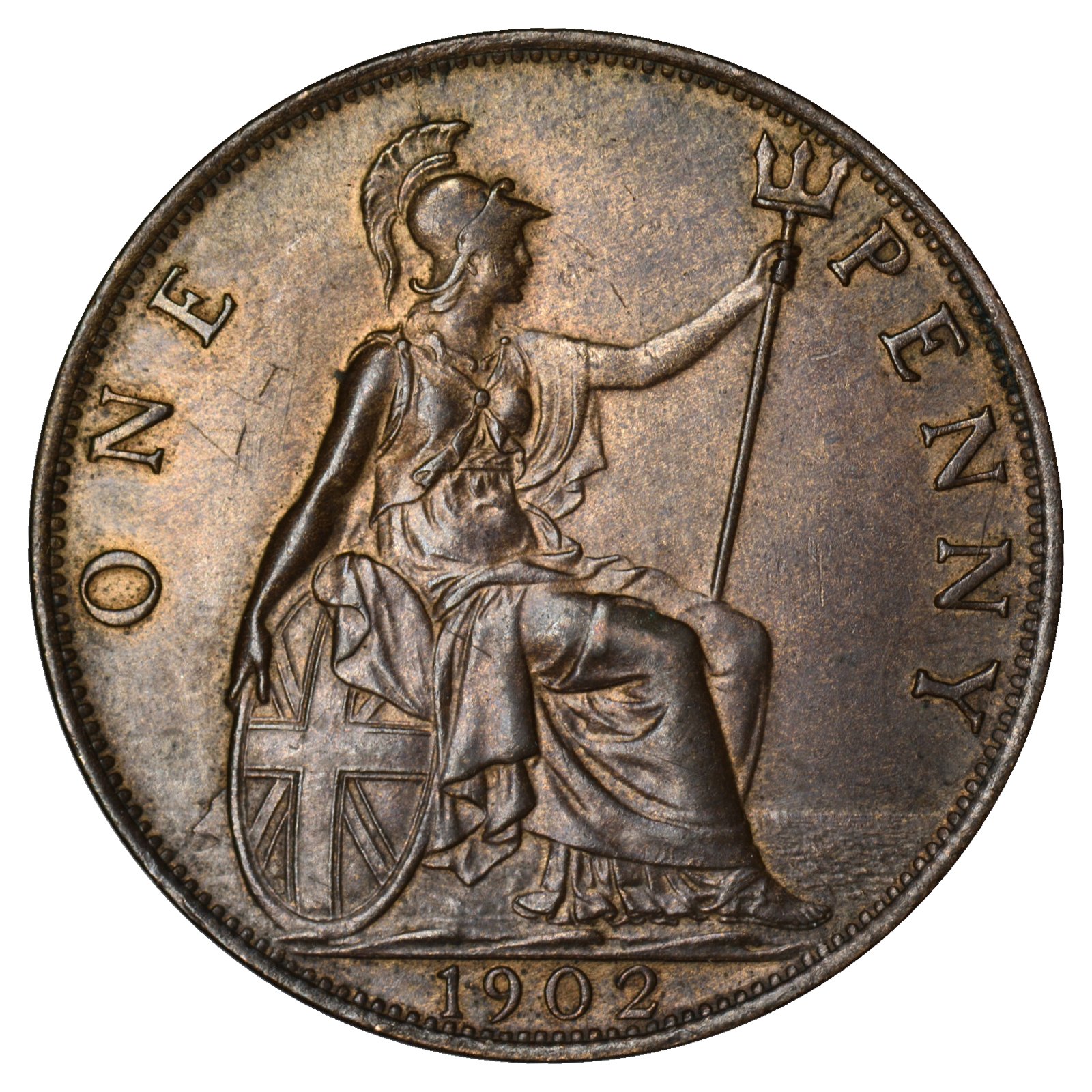
Britannia seated — Wyon design
ONE PENNY / date in exergue
| Section | Topic | Notes | |||||||||||||||||||||||||||||||||||||||||||||||||||||||||||||||||||||||||||||
|---|---|---|---|---|---|---|---|---|---|---|---|---|---|---|---|---|---|---|---|---|---|---|---|---|---|---|---|---|---|---|---|---|---|---|---|---|---|---|---|---|---|---|---|---|---|---|---|---|---|---|---|---|---|---|---|---|---|---|---|---|---|---|---|---|---|---|---|---|---|---|---|---|---|---|---|---|---|---|---|
| History & Context | |||||||||||||||||||||||||||||||||||||||||||||||||||||||||||||||||||||||||||||||
| History | The Penny — One Two-Hundred- and-Fortieth of a Pound |
The penny — worth one twelfth of a shilling or one two-hundred-and-fortieth of a pound — was the foundation unit of British currency: every denomination from the halfpenny to the pound was defined in multiples or fractions of pennies. In Edwardian England a penny bought a daily newspaper, a small loaf of bread (in some shops), or a portion of chips from a street vendor. Children received pennies as pocket money. Street musicians played for pennies. The church collection plate expected pennies. No denomination was more constantly present in Edwardian life. 1 penny = 1/12 shilling = 1/20 florin = 1/240 pound. The decimal equivalent of the old penny is 5/12 of a new penny (approximately 0.417p). At decimalisation in 1971, pre-decimal pennies were demonetised and exchanged at the rate of 240 old pennies to £1 (= 100 new pence). | |||||||||||||||||||||||||||||||||||||||||||||||||||||||||||||||||||||||||||||
| History | The Bun Penny Legacy (1860–1901) |
The Edwardian penny is the immediate successor to the Victorian "Bun Penny" — so called for Victoria's distinctive hair style on the Leonard Charles Wyon obverse portrait. The Bun Penny ran from 1860 to 1901 under Victoria, using the same seated Britannia reverse throughout. Its longevity (41 years) made it the most familiar bronze coin in Victorian England. When Edward VII came to the throne, the reverse was so well-established that it required no change — only the obverse portrait was updated. The Edwardian penny is therefore not a new design but a reissue of a proven type with a new face. The continuity of the Britannia reverse from 1860 to 1910 — 50 years without change — is one of the longest uninterrupted design runs in British coinage history for a circulation denomination. It was broken only when the George V penny of 1911 used a slightly updated Britannia design by Bertram Mackennal (for the obverse) and continued Wyon's reverse, modified slightly in relief. | |||||||||||||||||||||||||||||||||||||||||||||||||||||||||||||||||||||||||||||
| History | Bronze: Not Silver | Unlike all other denominations covered in this series, the penny is a base-metal coin — bronze (approximately 95% copper, 4% tin, 1% zinc). This composition had been used for the British penny since 1860, replacing the older pure copper penny (which was too heavy and large for convenient use). Bronze gave a harder, more wear-resistant alloy than copper and a slightly more golden colour. The penny has no intrinsic bullion value; its entire numismatic value is derived from condition, colour, date, and die variety. | |||||||||||||||||||||||||||||||||||||||||||||||||||||||||||||||||||||||||||||
| Design | |||||||||||||||||||||||||||||||||||||||||||||||||||||||||||||||||||||||||||||||
| Design | Obverse | De Saulles's bare-headed portrait of Edward VII facing right, scaled to the penny's 30.82mm diameter. At this size the portrait has good detail — the King's collar, whiskers, and brow are all distinct on well-struck examples. The legend reads EDWARDVS VII D: G: BRITT: OMN: REX F: D: IND: IMP: Below the truncation: DES. The portrait's quality varies slightly between die states and between Royal Mint and Birmingham Mint strikes — Birmingham Mint examples (1902–1906) tend to have slightly softer detail than Royal Mint pieces. | |||||||||||||||||||||||||||||||||||||||||||||||||||||||||||||||||||||||||||||
| Design | Reverse — Wyon's Seated Britannia |
Britannia seated facing right — helmeted, draped in classical robes, holding a trident in her right hand, with a large shield bearing the Cross of St George on her left. Behind her: the sea, with the horizon barely visible. In the fields left and right: ONE / PENNY. Below in the exergue: the date. The High Tide type (KM#794.2, standard for 1902–1910) has the sea level at approximately the point where Britannia's crossed legs are visible beneath her robe — providing the nickname. This level is slightly higher than the Low Tide 1902 type where the sea aligns with the hemline. The Wyon Britannia reverse is arguably the most recognised numismatic design in British history — appearing on the penny from 1860 to 1970 (110 years, counting the decimal penny that used an updated Britannia design from 1971). The seated Britannia is an older symbol still: she first appeared on British copper coinage under Charles II in 1672. | |||||||||||||||||||||||||||||||||||||||||||||||||||||||||||||||||||||||||||||
| Design | The 1908 Matte Proof |
A remarkable numismatic curiosity: only 3 matte proof pennies were struck dated 1908 (Freeman F167a). These are among the rarest of all Edwardian coins — not just pennies, but any denomination. The matte proof surface is the same distinctive satin finish used on the 1902 Coronation proof sets. The reason only 3 exist is unknown — they were presumably struck as presentation pieces or die trials. Their existence is documented but examples are essentially museum pieces. Compare the 1902 matt proof sets (produced in substantial numbers for the Coronation) with the 1908 matte proof penny (3 pieces). The contrast is dramatic and unexplained. If one were to appear at auction, it would attract very significant bidding. | |||||||||||||||||||||||||||||||||||||||||||||||||||||||||||||||||||||||||||||
| Varieties & Die Pairs | |||||||||||||||||||||||||||||||||||||||||||||||||||||||||||||||||||||||||||||||
| Variety | The Low Tide in Detail |
The 1902 Low Tide (KM#794.1, Freeman F156, Gouby BP1902A) is the most important and most valuable variety in the Edwardian penny series. Key identification points: (1) the sea level on the reverse aligns with Britannia's hemline rather than where her legs cross; (2) the numeral 2 in the date has a wavy, curved baseline rather than straight; (3) the die pair is 1+A rather than 1+B. These three features together confirm identification. The rarity rating N3 means it is considerably scarcer than the common High Tide 1902, and values in EF and UNC are accordingly much higher. The Low Tide is called "Low Tide" because the sea level is lower on the coin — closer to Britannia's feet. The High (Normal) Tide has the sea higher, obscuring more of the lower figure. This is a minor die re-engraving, not a different design — the change was made specifically to update the reverse from the Victorian to the Edwardian standard. | |||||||||||||||||||||||||||||||||||||||||||||||||||||||||||||||||||||||||||||
| Variety | Further Varieties | The Edwardian penny series is exceptionally rich in die varieties beyond the 1902 Low/High Tide distinction. The following years have documented additional varieties in the Gouby and Freeman references: • 1903: Open 3 variety (Freeman 158A) — very rare, rarity R6 (one of the highest rarity ratings in the series). The loop of the 3 in the date is more open than standard. • 1905: Reverse die variety documented (BP1905A and variants). • 1908: Multiple obverse AND reverse die varieties — the most complex die-variety year of the series; see BP1908A/B/C etc. and Freeman F162/163/164. • 1909: Reverse D vs E varieties documented by Numista and Gouby. These are specialist-level varieties and require detailed reference comparison; they command significant premiums over the standard type in equivalent grade. | |||||||||||||||||||||||||||||||||||||||||||||||||||||||||||||||||||||||||||||
| Complete Series — All Dates & Key Varieties | |||||||||||||||||||||||||||||||||||||||||||||||||||||||||||||||||||||||||||||||
| Series | Mintages & Values by Year |
|
|||||||||||||||||||||||||||||||||||||||||||||||||||||||||||||||||||||||||||||
| Series | The Heaton Birmingham Issues (H mintmark) |
From 1902 to 1906, some Edwardian pennies were struck at the Heaton and Sons Mint, Birmingham under contract to the Royal Mint. These Heaton-struck pieces carry a small H mintmark below the date in the exergue — the only British pennies to carry a mintmark during this period. Heaton issues exist for 1902, 1903, 1904, 1905, and 1906. They are generally considered slightly scarcer than the Royal Mint equivalent years and command a modest premium in EF and above. The H mintmark is the clearest way to distinguish a Heaton strike from a Royal Mint strike of the same year. Look in the exergue beneath the date: the letter H should be visible under magnification at F and above. From 1907 onward, all Edwardian pennies were struck at the Royal Mint only. | |||||||||||||||||||||||||||||||||||||||||||||||||||||||||||||||||||||||||||||
| Mint & Production | |||||||||||||||||||||||||||||||||||||||||||||||||||||||||||||||||||||||||||||||
| Mint | Royal Mint & Heaton Birmingham |
The Edwardian penny was struck at the Royal Mint, Tower Hill, London for all nine years, and additionally at Heaton and Sons, Birmingham for 1902–1906. The Royal Mint dies were used for both, but the Heaton strikes carry the H mintmark. The quality difference between the two mints is generally slight — both produced competent coins to the same specification. Collectors seeking Heaton examples specifically look for the H below the date; collectors building date sets usually treat Royal Mint and Heaton as separate collectibles for completeness. | |||||||||||||||||||||||||||||||||||||||||||||||||||||||||||||||||||||||||||||
| Mint | The 1904 Key Date |
The 1904 penny had a mintage of 12,910,000 — the lowest of any standard date in the series. The reason follows the same pattern as the other low-mintage Edwardian dates (1904 sixpence, 1905 shilling, 1905 florin): normal Royal Mint demand forecasting, with a carry-over stock from the previous large mintage reducing the new requirement. In the penny series, the 1904 scarcity is less dramatic than the 1905 shilling (because the 1904 penny is still a multi-million mintage), but in EF and above it is consistently harder to find and commands meaningful premiums. | |||||||||||||||||||||||||||||||||||||||||||||||||||||||||||||||||||||||||||||
| Valuation — Grade & Colour Guide | |||||||||||||||||||||||||||||||||||||||||||||||||||||||||||||||||||||||||||||||
| Value | Grade Guide: Common Dates vs 1904 Key Date |
|
|||||||||||||||||||||||||||||||||||||||||||||||||||||||||||||||||||||||||||||
| Value | Colour & Surface Premium |
For bronze coins, surface colour is the most important single value determinant in uncirculated grade — far more so than for silver coins. A common-date 1907 penny in BN-UNC might retail at £20–40; the same coin in RB-UNC would be £35–65; in RD-UNC (with full original copper-red surfaces), £50–100+. For the 1902 Low Tide, a BN-EF might be £40–60 while an RD-EF would be £120+. The reason full-red examples are so rare is that copper oxidises relatively quickly — a century-old copper coin that has remained un-toned requires essentially perfect airtight storage since the day it was struck. | |||||||||||||||||||||||||||||||||||||||||||||||||||||||||||||||||||||||||||||
| Collecting Notes | |||||||||||||||||||||||||||||||||||||||||||||||||||||||||||||||||||||||||||||||
| Collect | Building the Complete Set |
A complete set in VF (all standard types — 1902 High Tide and Low Tide, 1903–1910) costs approximately £60–150 total — the 1902 Low Tide (£25–60 in VF) being the determining cost item. Adding Heaton H examples for 1902–1906 doubles the set to 15 pieces. A complete date and mint set in EF runs to approximately £400–600 total. Adding the main die varieties (1903 Open 3, 1908 multiple varieties, 1909 Rev D/E) extends the set considerably in both pieces required and cost. | |||||||||||||||||||||||||||||||||||||||||||||||||||||||||||||||||||||||||||||
| Collect | What to Look For | Key grading points: (1) Britannia's trident — the prongs should be individually distinct in EF; in VF they are present but softer; in F they merge. (2) The shield's cross detail — the raised cross and its field texture indicate die quality. (3) Britannia's helmet plume — individual feather outlines at EF; general plume shape at VF. (4) Edward VII's portrait — the collar, whiskers, and brow. (5) The exergue date — sharp numerals confirm the grade claimed. (6) Surface colour under raking light — cartwheel lustre in warm copper-red for genuine UNC; absence of this indicates either wear or cleaning. | |||||||||||||||||||||||||||||||||||||||||||||||||||||||||||||||||||||||||||||
| Collect | Problems to Avoid | (1) Cleaning — widespread in copper/bronze; harsh cleaning removes original surface and leaves a bright, unnatural copper tone without lustre flow. (2) Artificial re-toning — sometimes applied to cleaned coins to simulate natural brown; genuine toning deepens from the high points inward; artificial is often too uniform. (3) Unattributed Low Tide — a 1902 coin without variety attribution may be priced as the common High Tide; always check the sea level and the 2-baseline before paying. (4) Missing H mintmark — Heaton examples should have an H in the exergue below the date; if you're paying a Heaton premium, verify the mark is there and not worn off. (5) Colour misrepresentation — a coin described as RB that is really BN, or described as RD that is really RB; always examine in hand or from high-quality images under proper lighting. | |||||||||||||||||||||||||||||||||||||||||||||||||||||||||||||||||||||||||||||
| Collect | Collection Contexts | The Edwardian penny fits into: a complete nine-date set 1902–1910; a British penny by monarch type set (Bronze penny 1860–1967: George IV → William IV → Victoria → Edward VII → George V → George VI → Elizabeth II); a Low Tide / High Tide specialist set with all attributed varieties; a die variety specialist collection (using Gouby and Freeman references — the Edwardian penny has more documented varieties than any other denomination of the reign); an Edwardian bronze set (penny, halfpenny, farthing, third farthing); or a Heaton Birmingham contract coinage collection across multiple denominations and territories. | |||||||||||||||||||||||||||||||||||||||||||||||||||||||||||||||||||||||||||||
| Collect | Related Coins | Natural companions: the Edward VII halfpenny 1902–1910 (KM#793.1/793.2 — same Low/High Tide distinction for 1902; same Britannia reverse, smaller scale; same Heaton H mintmark 1902–1906); the Edward VII farthing 1902–1910 (KM#792 — same portrait, Britannia reverse, bronze); the Victorian "Bun Penny" 1860–1901 (Leonard Charles Wyon obverse; same reverse — the direct predecessor); and the George V penny 1911–1936 (Bertram Mackennal obverse; modified Britannia reverse — the immediate successor). The Jersey 1/12 shilling 1909 (see the companion de Saulles article on this site) uses the same de Saulles portrait on a bronze coin of comparable size. | |||||||||||||||||||||||||||||||||||||||||||||||||||||||||||||||||||||||||||||
Sources: Spink Standard Catalogue of British Coins (S.3990, S.3990A) · Freeman, M. The Bronze Coinage of Great Britain, 2nd ed. — F156–168 · Gouby, M. British Bronze Pennies — BP1902A, B etc. (variety reference) · Numista catalogue entry #857 — Low Tide / High Tide description; 1908/1909 variety notes · coinscatalog.net — complete mintage series (1903–1910) and USD values · allcoinvalues.com — GBP date-by-date value ranges · CoinBrothers catalog — KM#794, Bronze, 9.4g, 30.82mm · Baldwin's — 1902 Low Tide description (S.3990A, dies 1+A, Gouby 1902A) · sovr.co.uk — 1902 High Tide description (Fr.156, S.3990; weight 9.52g) · headsntails14.wordpress.com — Edward VII Varieties table (Gouby/Freeman die pair listing) · coinscatalog.net — 1908 Matte Proof penny mintage 3 (confirmed)