British Halfpenny — Edward VII — 1902–1910 The Ha'penny — Bronze — Seated Britannia — Low Tide & High Tide — Complete Series Guide
KM# 793.1 (1902 Low Tide) & KM# 793.2 (1902–1910 High Tide) · S.3991 / S.3991A · Freeman 370–382 · Bronze · 25.5 mm · 5.6 g · Plain edge
The Halfpenny — De Saulles Portrait, Wyon's Britannia
The Edwardian halfpenny mirrors the penny in its design composition. The obverse carries George William de Saulles's bare-headed portrait of Edward VII facing right, with DES below the truncation. The reverse uses Leonard Charles Wyon's seated Britannia design from 1860 — identical in composition to the penny reverse, simply scaled down to the halfpenny's 25.5mm diameter. The legend reads HALF PENNY with the date below in the exergue. De Saulles died in August 1903; Wyon in 1891 — yet both their designs circulated together on this coin until 1910 and beyond. The halfpenny and penny form a natural pair for display, sharing obverse and reverse compositions at different scales.
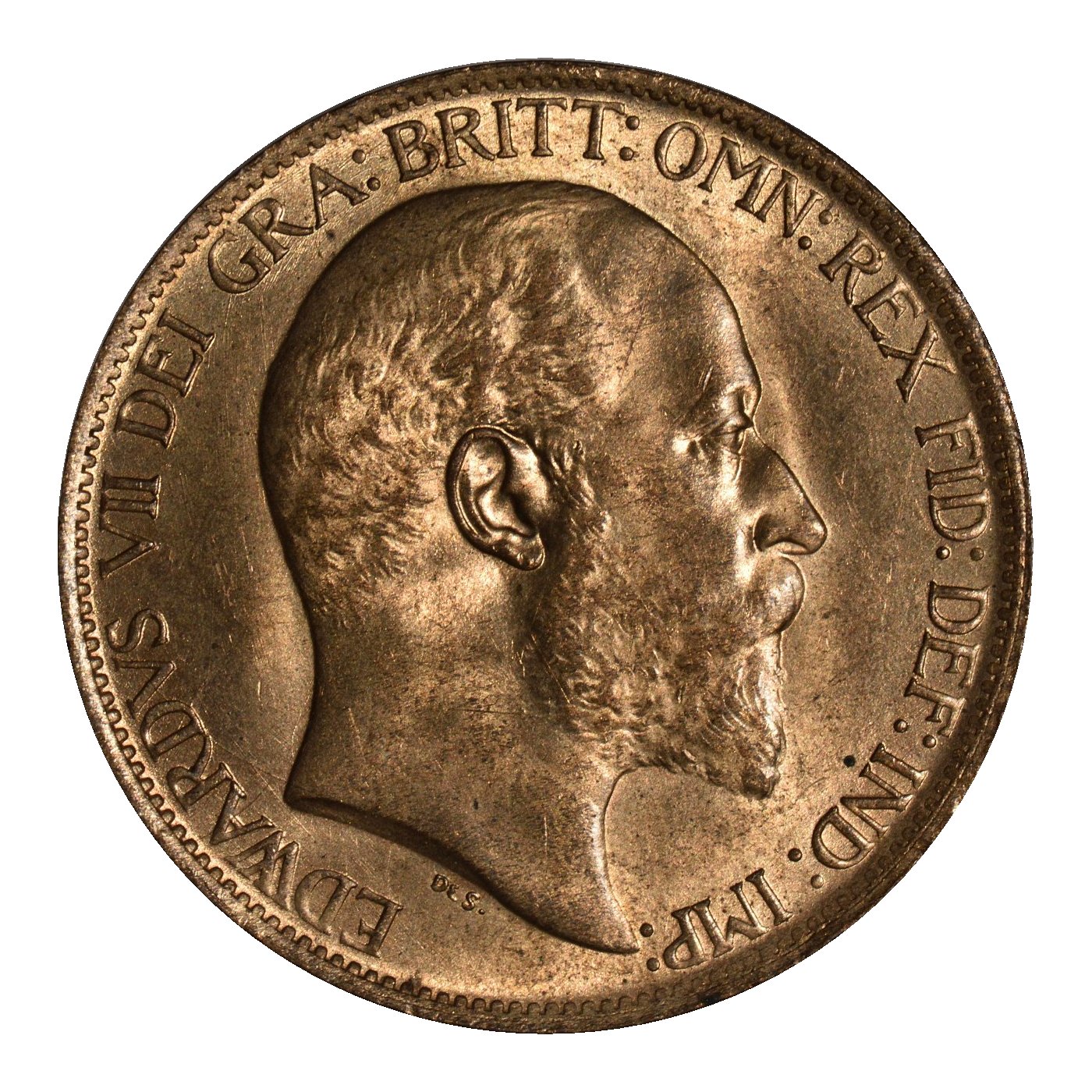
Edward VII — de Saulles
DES below truncation
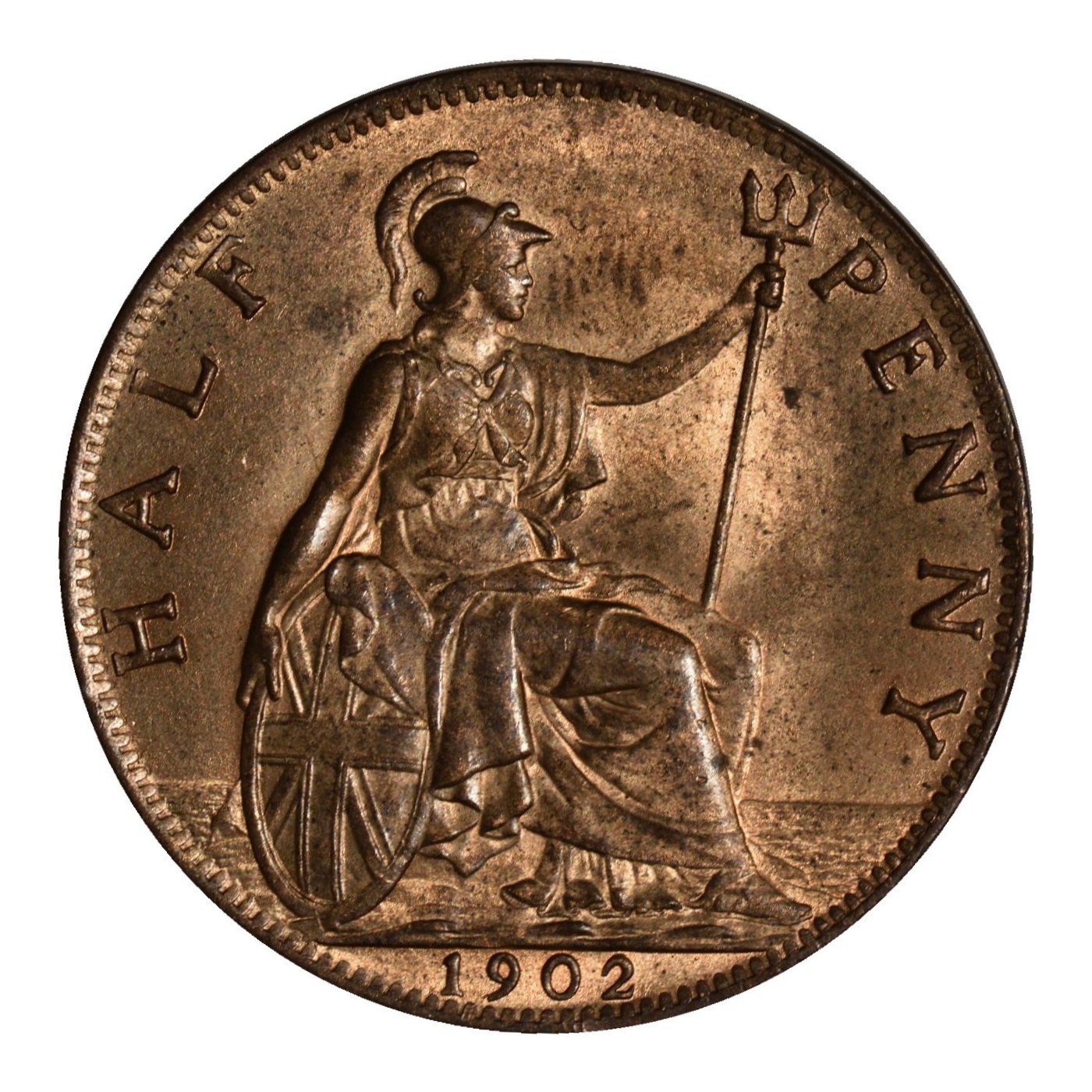
Britannia seated — Wyon design
HALF PENNY / date in exergue
| Section | Topic | Notes | |||||||||||||||||||||||||||||||||||||||||||||||||||||||||||||||||||||||||||||
|---|---|---|---|---|---|---|---|---|---|---|---|---|---|---|---|---|---|---|---|---|---|---|---|---|---|---|---|---|---|---|---|---|---|---|---|---|---|---|---|---|---|---|---|---|---|---|---|---|---|---|---|---|---|---|---|---|---|---|---|---|---|---|---|---|---|---|---|---|---|---|---|---|---|---|---|---|---|---|---|
| History & Context | |||||||||||||||||||||||||||||||||||||||||||||||||||||||||||||||||||||||||||||||
| History | The Ha'penny — Half a Penny |
The halfpenny — the ha'penny — was worth half a penny, one twenty-fourth of a shilling, one four-hundred-and-eightieth of a pound. In Edwardian England it bought a small bag of sweets, a single sheet of notepaper, or served as the customary tip for a minor service. It was the coin that ended up in charity boxes, in the pockets of errand boys, and thrown as scattered donations. Children collected halfpennies; adults tried to avoid having too many of them. The halfpenny was also the coin associated with the ha'penny paper — the cheap popular press that proliferated in the Edwardian period. ½d = 1/2 penny = 1/24 shilling = 1/480 pound. The halfpenny was abolished at decimalisation in 1971 — it was worth too little in the new decimal currency to justify continued production. The decimal halfpenny (½p) issued 1971–1984 was its nominal successor. | |||||||||||||||||||||||||||||||||||||||||||||||||||||||||||||||||||||||||||||
| History | No Heaton Issues |
Unlike the penny, which was struck at both the Royal Mint and Heaton and Sons Birmingham (1902–1906, H mintmark), the Edwardian halfpenny was struck at the Royal Mint only. No H mintmark issues exist for the halfpenny. This simplifies attribution considerably — there is no need to check for a mint mark, and every Edwardian halfpenny in existence was made at Tower Hill, London. This is one of the key collecting differences between the penny and halfpenny series. The penny collector must track two mint sources and an H mintmark; the halfpenny collector has a single mint and no mintmark complications. The series is correspondingly simpler to build. | |||||||||||||||||||||||||||||||||||||||||||||||||||||||||||||||||||||||||||||
| History | The Halfpenny & the Ha'penny Paper |
The late Victorian and Edwardian period saw the rise of the halfpenny newspaper — a revolutionary development in popular publishing. Papers like the Daily Mail (founded 1896, price ½d) transformed British reading culture, reaching audiences who could not afford the penny papers. The halfpenny became inseparable from the idea of mass-market information at the lowest possible price. A coin worth half a penny was also, in this period, the cost of a seat on a horse-drawn omnibus for a short journey in London, or the price of a cup of tea at a street stall. | |||||||||||||||||||||||||||||||||||||||||||||||||||||||||||||||||||||||||||||
| Design | |||||||||||||||||||||||||||||||||||||||||||||||||||||||||||||||||||||||||||||||
| Design | Obverse | De Saulles's bare-headed portrait of Edward VII, right-facing, scaled to 25.5mm. The legend reads EDWARDVS VII DEI GRA: BRITT: OMN: REX FID: DEF: IND: IMP: Around the rim; below the truncation: DES. The detail is slightly compressed compared to the penny version at 30.82mm — the portrait is recognisable but the finest elements (collar detail, side-whisker modelling) are less elaborate at this scale. The DES signature is correspondingly smaller and requires magnification to read clearly. | |||||||||||||||||||||||||||||||||||||||||||||||||||||||||||||||||||||||||||||
| Design | Reverse — Wyon's Seated Britannia |
Identical in composition to the penny reverse: Britannia seated right, helmeted, trident in right hand, shield on left arm, the sea behind. In the fields: HALF / PENNY. Date in the exergue below. The High Tide reverse (KM#793.2, standard 1902–1910) has the sea level at Britannia's leg crossing point. The Low Tide reverse (KM#793.1, 1902 only) has the sea lower, meeting the folds of Britannia's robe. The halfpenny's Britannia reverse was first struck in 1860 — alongside the penny — and continued through Victoria's entire reign. The Edwardian halfpenny is the penultimate generation; the George V halfpenny used a modified Britannia from 1911. The design's run from 1860 to 1967 is arguably the longest uninterrupted reverse design for any British bronze denomination. | |||||||||||||||||||||||||||||||||||||||||||||||||||||||||||||||||||||||||||||
| Design | Halfpenny vs Penny — Scaling |
Penny (KM#794)
Halfpenny (KM#793)
|
|||||||||||||||||||||||||||||||||||||||||||||||||||||||||||||||||||||||||||||
| Varieties | |||||||||||||||||||||||||||||||||||||||||||||||||||||||||||||||||||||||||||||||
| Variety | The 1902 Low Tide in Detail |
The 1902 Low Tide halfpenny (KM#793.1, S.3991A) is the standout variety of the series. The early 1902 dies used the same reverse as the Victoria Veiled Head halfpenny, with the sea level further from the letter Y in HALF PENNY — meaning the sea is lower, and the folds of Britannia's robes below the leg crossing are more visible. Key identification features: (1) the sea level meets the folds of the robe rather than the leg crossing; (2) the lower part of Britannia's draped figure is more visible, including robe detail near the feet. The Low Tide is considerably scarcer than the High Tide for 1902 and commands a significant premium. A 1902 Low Tide halfpenny in UNC was listed at $137.09 on allnumis.com — confirming its premium status even in online casual trading. For comparison, a High Tide 1902 halfpenny in equivalent condition sells for perhaps $20–40. The difference is attributable entirely to the die variety. | |||||||||||||||||||||||||||||||||||||||||||||||||||||||||||||||||||||||||||||
| Variety | Other Known Varieties |
Beyond the 1902 Low/High Tide distinction, the Edwardian halfpenny series has fewer documented die varieties than the penny, reflecting the smaller collector base and less intensive specialist study. The Freeman reference documents die pairs for all years; some years show minor reverse die differences in the exergue numeral spacing or in Britannia's device details. Collectors seeking varieties beyond the Low Tide should consult the Freeman The Bronze Coinage of Great Britain and the Gouby supplement for specific die pair attributions. | |||||||||||||||||||||||||||||||||||||||||||||||||||||||||||||||||||||||||||||
| Complete Series — All Dates | |||||||||||||||||||||||||||||||||||||||||||||||||||||||||||||||||||||||||||||||
| Series | Mintages & Values by Year |
|
|||||||||||||||||||||||||||||||||||||||||||||||||||||||||||||||||||||||||||||
| Mint & Production | |||||||||||||||||||||||||||||||||||||||||||||||||||||||||||||||||||||||||||||||
| Mint | Royal Mint Only | All Edwardian halfpennies were struck exclusively at the Royal Mint, Tower Hill, London. The halfpenny was not contracted to Heaton Birmingham (unlike the penny, 1902–1906). No mint mark appears on any halfpenny. This simplicity — one mint, no varieties by source — makes the series easier to collect systematically than the penny. The Royal Mint's quality for the halfpenny was consistent; well-struck examples with sharp Britannia detail and crisp obverse portrait are the norm rather than the exception in high grades. | |||||||||||||||||||||||||||||||||||||||||||||||||||||||||||||||||||||||||||||
| Mint | The 1904 Key Date |
The 1904 halfpenny had a mintage of 8,131,000 — the lowest standard-date mintage of the series (excluding the Low Tide sub-variety of 1902). The same pattern of low production as the 1904 sixpence and 1905 shilling applied here: reduced Royal Mint demand scheduling, carry-over stock from the higher-mintage preceding years. The 1904 is consistently the hardest standard date to find in EF and above, and commands the highest premiums within the regular series. The 1909 is the second-lowest at 8,279,000 — almost identical to the 1904. In practice, the 1909 is often as hard or slightly harder than the 1904 in gem UNC condition, reflecting normal variation in die quality and preservation rates, though the 1904 is usually cited as the key date of the series. | |||||||||||||||||||||||||||||||||||||||||||||||||||||||||||||||||||||||||||||
| Valuation — Grade & Colour Guide | |||||||||||||||||||||||||||||||||||||||||||||||||||||||||||||||||||||||||||||||
| Value | Grade Guide: Common Dates vs 1904 Key Date |
|
|||||||||||||||||||||||||||||||||||||||||||||||||||||||||||||||||||||||||||||
| Value | 1902 Low Tide Value Guide |
|
|||||||||||||||||||||||||||||||||||||||||||||||||||||||||||||||||||||||||||||
| Collecting Notes | |||||||||||||||||||||||||||||||||||||||||||||||||||||||||||||||||||||||||||||||
| Collect | Building the Complete Set |
A complete set of the standard dates in VF (1902 High Tide, 1903–1910) costs approximately £40–90 total — with 1904 (£8–28) and 1909 (£5–18) as the moderate-cost pieces, and the remaining dates at £3–14 each. Adding the 1902 Low Tide to make a truly complete set adds £30–90 in VF. An EF complete set (standard dates) runs to approximately £250–400 total. The halfpenny is the most affordable complete date set among the Edwardian bronze denominations — easier to complete than the penny (no Heaton variant complications, no 1908 die variety complexity) and considerably cheaper than the silver series. | |||||||||||||||||||||||||||||||||||||||||||||||||||||||||||||||||||||||||||||
| Collect | What to Look For | Key grading points: (1) Britannia's trident — individual prongs distinct in EF; present but softer in VF. (2) The helmet plume — feather outlines at EF. (3) The shield Cross of St George — raised cross and field texture. (4) De Saulles's portrait on the obverse — the collar, brow, and whiskers. (5) Surface colour — in good raking light, genuine UNC examples show a warm copper-red lustre flowing from the devices; cleaned examples show flat brightness without lustre flow. (6) For the 1902 Low Tide — the sea level on the reverse: does it meet the folds of the robe (Low Tide) or the leg crossing (High Tide)? | |||||||||||||||||||||||||||||||||||||||||||||||||||||||||||||||||||||||||||||
| Collect | Problems to Avoid | (1) Cleaning — widespread in bronze; look for cartwheel lustre rather than flat brightness. (2) Artificial re-toning — applied to simulate natural toning; genuine toning deepens toward recesses. (3) Low Tide misattribution — a 1902 halfpenny priced without variety attribution may be either Low or High Tide; check the sea level and robe detail before paying any premium. (4) Colour misrepresentation — a BN coin listed as RB or RD; examine under proper raking light or request detailed photographs of the surface. (5) Carbon spots — small dark spots on the bronze surface are common and reduce value; the sovr.co.uk description of their 1902 High Tide example specifically mentions "one small carbon spot on obverse and one on reverse" as a quality note. | |||||||||||||||||||||||||||||||||||||||||||||||||||||||||||||||||||||||||||||
| Collect | Collection Contexts | The Edwardian halfpenny fits into: a complete nine-date set 1902–1910 (standard dates) or an eleven-piece set including both 1902 varieties; a British halfpenny by monarch type set (bronze halfpenny 1860–1967 across six monarchs); an Edwardian bronze set (penny, halfpenny, farthing); a Low Tide pair collection (the 1902 penny Low Tide and the 1902 halfpenny Low Tide displayed side-by-side — they share the same die change story); or a smallest-coins display alongside the threepence and farthing. | |||||||||||||||||||||||||||||||||||||||||||||||||||||||||||||||||||||||||||||
| Collect | Related Coins | Natural companions: the Edward VII penny 1902–1910 (KM#794 — same obverse and reverse compositions at larger scale; companion article in this series); the Edward VII farthing 1902–1910 (KM#792 — same portrait, smaller Britannia reverse, 20mm); the Victorian halfpenny 1860–1901 (Wyon Bun Head obverse, same reverse — the direct predecessor); the George V halfpenny 1911–1936 (Mackennal obverse, modified Britannia — immediate successor); and the decimal halfpenny 1971–1984 (notional successor denomination, but an entirely different coin). | |||||||||||||||||||||||||||||||||||||||||||||||||||||||||||||||||||||||||||||
Sources: Spink Standard Catalogue of British Coins (S.3991, S.3991A) · Freeman, M. The Bronze Coinage of Great Britain, 2nd ed. — F370–382 · Numista catalogue entry #1867 — Low/High Tide description by Declan Magee & Sjoelund · sovr.co.uk — 1902 High Tide halfpenny (F381; S.3991; combined mintage 13,672,960; weight 5.83g; carbon spot note) · coinscatalog.net — KM#793.1 value $20–$425; KM#793.2 value $1–$120; farthing mintages cross-reference · CoinBrothers catalog — KM#793, Bronze, 5.6g, 25.5mm · allcoinvalues.com — per-year value pages 1902–1910 · allnumis.com — 1902 Low Tide UNC listed $137.09 (online confirmation of premium) · eBay Germany — sold halfpenny examples 2023–2026 for grade calibration