British Florin — Edward VII — 1902–1910 Two Shillings · Britannia on Prow · De Saulles Obverse & Reverse · Complete Series Guide
KM# 801 · S.3981 · ESC 918–926 · Silver .925 (Sterling) · 28.3–28.5 mm · 11.31 g · Reeded edge · ASW 0.3364 troy oz
De Saulles on Both Sides — A New Britannia for a New Reign
Like the shilling, the Edwardian florin was designed by George William de Saulles on both obverse and reverse — a complete departure from the Victorian florin's Gothic quartered shields design. His reverse for the florin is one of the most dramatic in British numismatic history: Britannia standing helmeted at the prow of a warship, trident in her right hand, shield on her left arm, with waves below and the sea horizon behind. This was a triumphant image of naval supremacy for the world's foremost maritime power — quite different from the seated Britannia of the copper coinage, and a far more assertive composition than anything that had appeared on the florin since the "Godless Florin" controversy of 1849. De Saulles died in August 1903, so he only saw two years of his florin design in circulation; it was used unchanged through the full nine years of the reign.
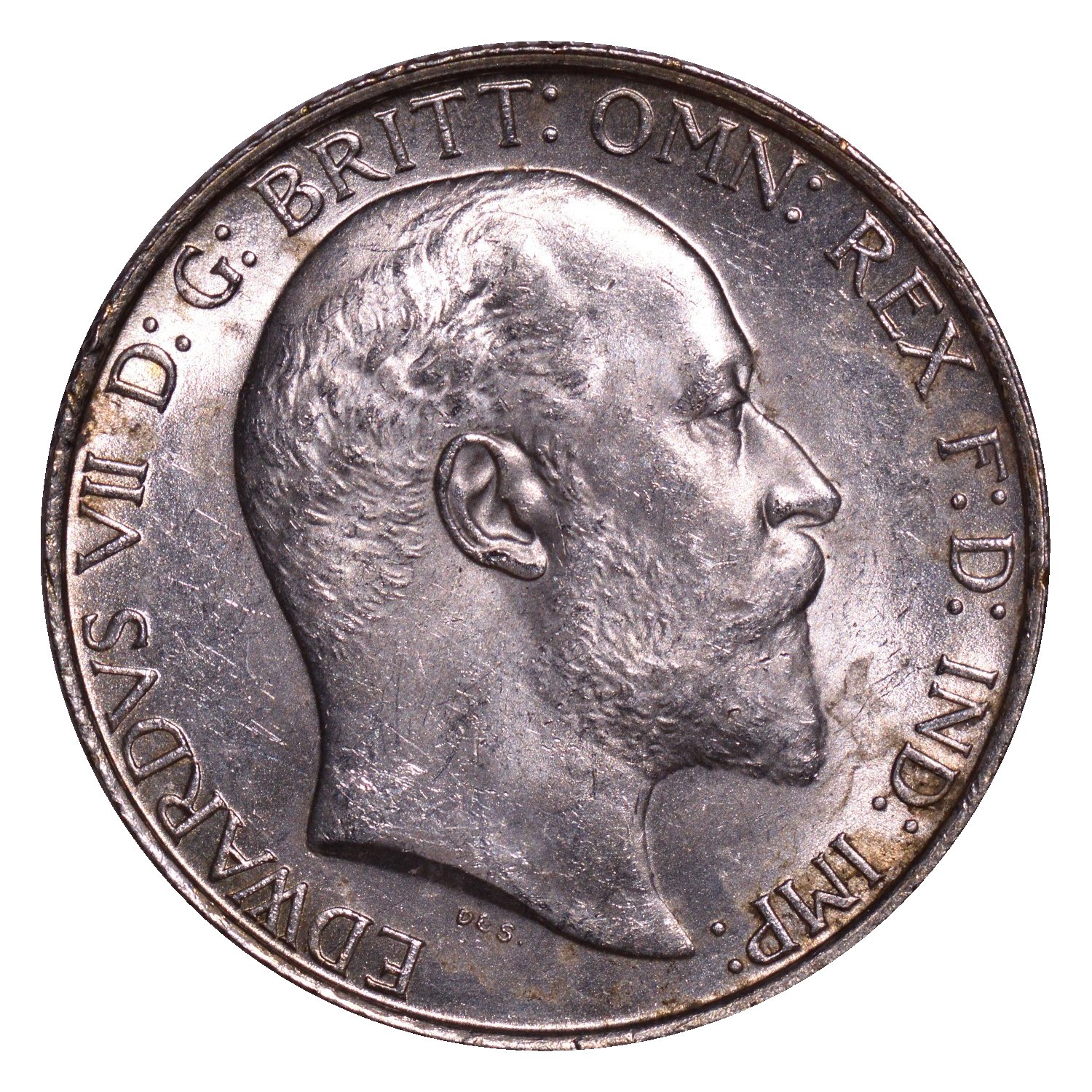
Edward VII — de Saulles
DES below truncation
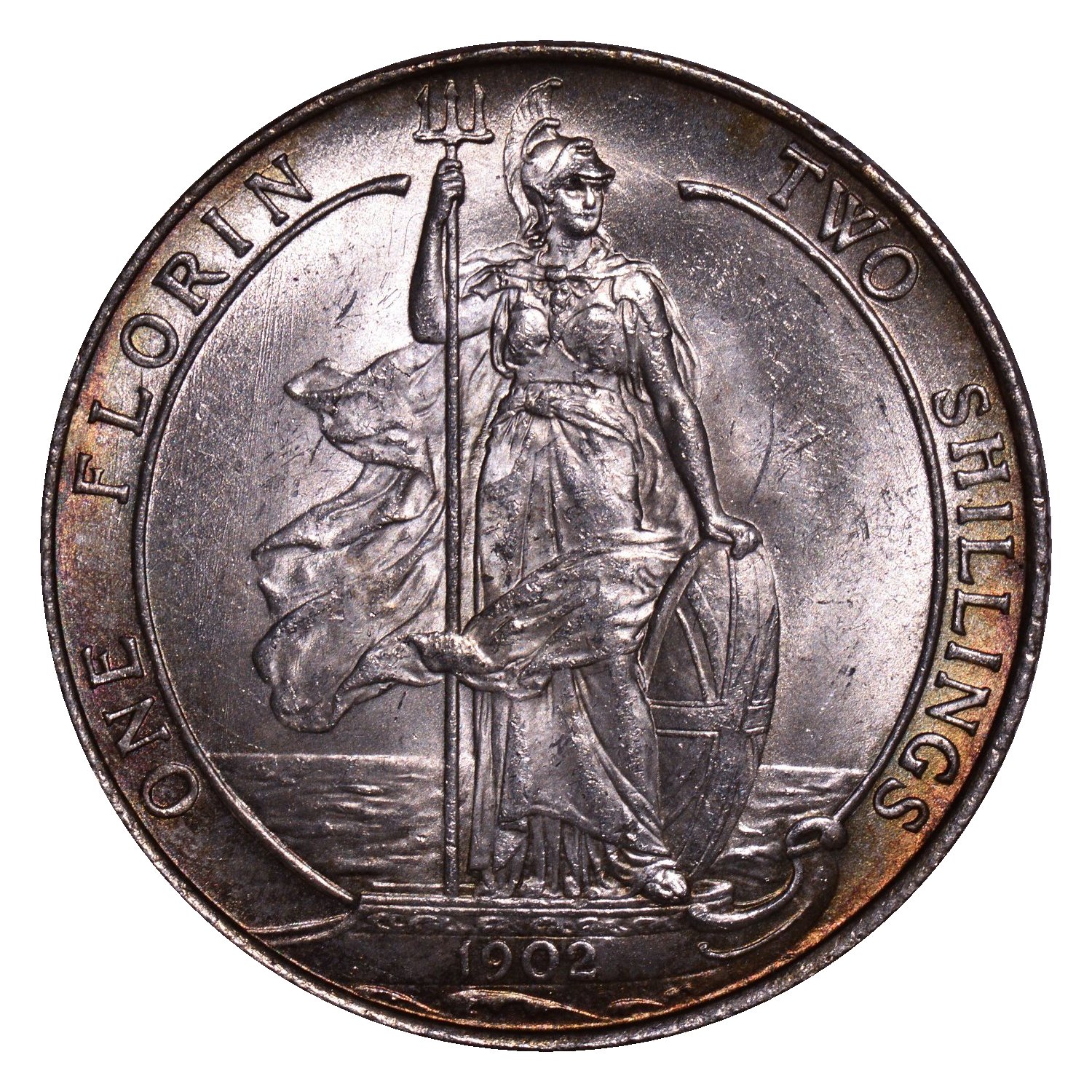
Britannia on prow — de Saulles
ONE FLORIN TWO SHILLINGS
| Section | Topic | Notes | ||||||||||||||||||||||||||||||||||||||||||||||||||||||||||||||||||||||
|---|---|---|---|---|---|---|---|---|---|---|---|---|---|---|---|---|---|---|---|---|---|---|---|---|---|---|---|---|---|---|---|---|---|---|---|---|---|---|---|---|---|---|---|---|---|---|---|---|---|---|---|---|---|---|---|---|---|---|---|---|---|---|---|---|---|---|---|---|---|---|---|---|
| History & Context | ||||||||||||||||||||||||||||||||||||||||||||||||||||||||||||||||||||||||
| History | The Florin — Two Shillings |
The florin — worth two shillings, one tenth of a pound — had a peculiar history among British denominations. Introduced in 1849 as Britain's first tentative step toward decimal coinage (see the dual legend ONE FLORIN TWO SHILLINGS), it had been controversial from the start: the original 1849 "Godless Florin" omitted Dei Gratia from the royal titles and caused a public scandal; the 1850–1887 "Gothic Florin" with its elaborate mediaeval design was admired but considered difficult to read in commerce. The Edwardian florin was therefore something of a fresh start — a modern, martial design after decades of Victorian Gothic. 24 pence = 2 shillings = 1 florin = 1/10 of a pound. The florin was the largest of the four smaller silver denominations (threepence, sixpence, shilling, florin) and the second largest silver coin in regular circulation, behind the halfcrown. Its decimal equivalence to one-tenth of a pound made it the natural denomination for any future decimalisation — and indeed, the pre-decimal florin became the decimal 10 new pence piece on 15 February 1971, circulating unchanged until 1992. | ||||||||||||||||||||||||||||||||||||||||||||||||||||||||||||||||||||||
| History | Britannia & British Sea Power |
De Saulles's Britannia standing at the ship's prow is a conscious statement of British naval supremacy at its late-Victorian and Edwardian peak. In 1902–1910, the Royal Navy was engaged in the naval arms race with Germany (the Dreadnought programme began 1906); Britain's command of the seas was the cornerstone of Imperial defence policy; and "Britannia rules the waves" was as much a contemporary political reality as a piece of nationalistic verse. Placing a helmeted, trident-bearing Britannia on the prow of a warship on the most widely circulated large silver denomination was a precise political statement as well as an aesthetic one. The florin's Britannia is quite different from the copper coinage Britannia (seated, helmeted, holding trident and shield on a rock by the sea — a passive, classical image). De Saulles's florin Britannia is active and forward-moving — standing, not seated, at the prow of a ship in motion. The difference reflects the more assertive mood of Edwardian imperialism. | ||||||||||||||||||||||||||||||||||||||||||||||||||||||||||||||||||||||
| History | The Florin as Pre-Decimal Pioneer |
The florin was the only pre-decimal coin to survive decimalisation physically unchanged. When Britain switched to decimal currency on 15 February 1971, the florin (worth 2 shillings = 24 pence) simply became the 10 new pence piece (worth 10p), and the existing florin coins remained legal tender at the new value. Pre-decimal florins continued to circulate alongside the new decimal 10p until the smaller 10p was introduced in 1992, at which point the old florins were finally withdrawn. This means that some Edwardian florins were still circulating in British pockets as late as 1992 — nearly 90 years after striking. | ||||||||||||||||||||||||||||||||||||||||||||||||||||||||||||||||||||||
| Design | ||||||||||||||||||||||||||||||||||||||||||||||||||||||||||||||||||||||||
| Design | Obverse | The same de Saulles bare-headed portrait of Edward VII as appears on the shilling, sixpence, and threepence — but scaled up to the florin's 28.3mm diameter. At this size, the portrait has noticeably more detail: the collar, ear, and side-whiskers are all distinctly rendered. The legend reads EDWARDVS VII D: G: BRITT: OMN: REX F: D: IND: IMP: in full. Below the truncation: DES. The larger diameter also means the portrait is more vulnerable to the light wear typical of coin-to-coin contact in circulation — the florin circulated heavily and unworn examples are meaningfully scarce. | ||||||||||||||||||||||||||||||||||||||||||||||||||||||||||||||||||||||
| Design | Reverse — Britannia on Prow |
De Saulles's reverse is exceptional: a full-length Britannia in classical armour and plumed helmet, standing erect at the bow (prow) of a warship. In her right hand: a trident, symbol of naval mastery. On her left arm: a shield. Waves crash below the prow. The horizon is barely visible behind her. Encircling: ONE FLORIN TWO SHILLINGS and below: the date. This was an entirely new design — replacing the Victorian Gothic quartered arms that had appeared on the florin for 40 years — and it was immediately recognised as a dramatic improvement. On a well-struck example in EF or better, the waves, the helmet plume, and the individual rivets of Britannia's armour can be seen clearly. The Britannia reverse on the florin was specifically designed by de Saulles rather than adapted from an existing Victorian design. The figure is related to his seated Britannia on the bronze penny but given a far more dynamic, martial character. This reverse was not continued on the George V florin — a new design (the quartered shields and cross, by Bertram Mackennal's reverse engraver) replaced it from 1911. | ||||||||||||||||||||||||||||||||||||||||||||||||||||||||||||||||||||||
| Design | The Date Problem: High Relief |
The most important practical note about the Edwardian florin reverse: the date is positioned at the highest point of the reverse, which is also the area of maximum wear in circulation. Coincraft, specialists in British coins for over 60 years, note explicitly: "The trouble with the King Edward VII florins is that the date is in too high a relief. It is on the highest part of the coin, so it is also the first thing to wear off." A large proportion of surviving Edwardian florins have partially or fully illegible dates. This design flaw makes the entire series harder to collect in any grade requiring a readable date — and makes well-preserved examples disproportionately scarce. | ||||||||||||||||||||||||||||||||||||||||||||||||||||||||||||||||||||||
| Complete Series — All Nine Dates | ||||||||||||||||||||||||||||||||||||||||||||||||||||||||||||||||||||||||
| Series | Mintages & Values by Year |
|
||||||||||||||||||||||||||||||||||||||||||||||||||||||||||||||||||||||
| Mint & Production | ||||||||||||||||||||||||||||||||||||||||||||||||||||||||||||||||||||||||
| Mint | Royal Mint, London |
All Edward VII florins were struck at the Royal Mint, Tower Hill, London. No branch mint struck the florin; no mint mark appears. The florin's larger diameter (28.3–28.5mm) and heavier weight (11.31g) compared to the shilling (23.5mm, 5.66g) meant that the dies wore somewhat faster and that planchet quality was more critical to the final appearance of the coin. Dies for the florin were prepared with the Britannia reverse in reasonably high relief for Britannia herself, but the unfortunate decision to place the date in the highest zone of the reverse contributed directly to the wear problem noted by Coincraft. | ||||||||||||||||||||||||||||||||||||||||||||||||||||||||||||||||||||||
| Mint | The 1905 Key Date: Mintage 1,187,596 |
The 1905 florin had a mintage of 1,187,596 — by far the lowest of the series, roughly half the 1902 mintage and dramatically below the higher years. The reason for the low production follows the same pattern as the 1905 shilling and 1904 sixpence and threepence — a combination of Treasury demand forecasts, carry-over stock from previous years, and normal production scheduling variation. Whatever the cause, the result is that the 1905 florin is the key date of the series: starting at £20 even in heavily worn condition, and reaching £1,500+ in uncirculated grade. Compare the 1905 shilling (488,390 — lowest of its series) and the 1905 florin (1,187,596 — also lowest of its series): 1905 was consistently the low-mintage year across the silver denominations. This pattern has led some numismatists to suggest that 1905 saw deliberately reduced coinage production across the silver denominations — possibly reflecting an unexpected surplus of silver coins in the commercial banking system that year. | ||||||||||||||||||||||||||||||||||||||||||||||||||||||||||||||||||||||
| Mint | Scarcity Across the Series |
The florin is distinctive among the Edwardian silver denominations in that every date in the series is genuinely scarce in EF and above — not just the 1905 key date. Even the "common" dates (1906, 1907, 1910) retail at £200–410+ in EF, compared to the shilling's common dates at £80–140 in EF. This overall scarcity reflects both the coin's heavy commercial circulation (it was used constantly and worn hard) and the date-wear problem. The Edwardian florin is therefore the most challenging of the five silver denominations to complete in high grade — even collecting a single attractive EF example of any date requires care and premium. | ||||||||||||||||||||||||||||||||||||||||||||||||||||||||||||||||||||||
| Valuation — Grade Guide | ||||||||||||||||||||||||||||||||||||||||||||||||||||||||||||||||||||||||
| Value | Grade Guide: Common Dates vs 1905 |
|
||||||||||||||||||||||||||||||||||||||||||||||||||||||||||||||||||||||
| Value | The Florin vs the Shilling — Relative Values |
The Edwardian florin commands higher premiums at EF and above than the shilling at every date. A common-date florin in EF (£120–200) costs more than a common-date shilling in EF (£55–100), and the scarce dates (1903, 1904 florin vs 1903, 1904 shilling) follow the same pattern. This reflects: (1) the date-wear problem making EF florins genuinely harder to find; (2) the florin's more dramatic and sought-after reverse design; (3) the coin's dual role as a large circulated piece (heavy wear) and a showpiece denomination (when preserved, very desirable). The 1905 florin (£200 in VF) costs less than the 1905 shilling (£200–600 in VF) despite being rarer in mintage, because the shilling is considered a more famous key date and attracts wider collector interest. | ||||||||||||||||||||||||||||||||||||||||||||||||||||||||||||||||||||||
| Collecting Notes | ||||||||||||||||||||||||||||||||||||||||||||||||||||||||||||||||||||||||
| Collect | The Date Rule | Never buy an Edwardian florin without a fully legible date. Coincraft's warning is the single most important piece of collecting advice for this series. Before assessing grade or value, confirm the date. The date figures should be sharp, complete, and fully readable without a loupe in any coin offered as VF or better. A coin with a doubtful date — even in otherwise fine condition — is worth a fraction of its potential value. This rule applies equally to all nine dates; the 1905 with a worn date is as unsatisfying as the same condition in 1910. | ||||||||||||||||||||||||||||||||||||||||||||||||||||||||||||||||||||||
| Collect | What to Look For | After confirming the date: (1) Britannia's helmet plume — the individual feathers of the plume should be distinct at EF; soft but present at VF; merged in F. (2) Britannia's armour — the individual scale or rivet details on the breastplate and shield are the finest elements of the reverse; visible in EF and gem UNC; soft but present in VF. (3) The waves below the prow — individually shaped wave crests should be distinct in EF. (4) Edward VII's portrait on the obverse — the collar and side-whiskers wear first; DES below the truncation should be clear in EF. (5) Original lustre — full sterling lustre with the characteristic "cartwheel" appearance in raking light; cleaned coins show flat or hairlined fields. | ||||||||||||||||||||||||||||||||||||||||||||||||||||||||||||||||||||||
| Collect | Building the Complete Set |
A complete nine-date set in circulated grades with readable dates costs approximately £200–350 total for the six more available dates (1902, 1906, 1907, 1908, 1909, 1910) at F–VF, plus £50–120 for the 1903 and 1904, plus £50–120 for the 1905 in G–F. A VF complete set runs to approximately £600–900 total, with 1903, 1904, and 1905 each accounting for £60–200 of that. An EF complete set is a serious and expensive undertaking — budget £2,000–3,000 minimum — and the date problem makes the search as much about patience as about money. | ||||||||||||||||||||||||||||||||||||||||||||||||||||||||||||||||||||||
| Collect | Problems to Avoid | (1) Undated or weakly dated specimens — the cardinal rule; see above. (2) Cleaning — extremely common in florins; the large fields show hairlines and artificial brightness very easily. (3) Tooling on the date — the natural tendency to try to sharpen a worn date by engraving creates tell-tale inconsistencies in the metal flow around the numerals; check under magnification. (4) Altered dates — the 1905 key date premium tempts alteration; a 1906, 1907, 1908, or 1909 with a tampered date figure could easily be changed to resemble a 1905; verify with magnification and compare against reference images. (5) Matt proof confusion — the 1902 matt proof has a distinctive satin surface; do not price a currency 1902 as a proof or accept a proof priced as currency. | ||||||||||||||||||||||||||||||||||||||||||||||||||||||||||||||||||||||
| Collect | Collection Contexts | The Edward VII florin fits into: a complete nine-date Edwardian florin set; a British florin by monarch type set (the Victorian Gothic florin 1851–1887 → the "regular" Victorian florin 1887–1901 → the Edwardian Britannia florin 1902–1910 → the George V florin 1911–1936 — a fascinating design evolution over 85 years); an Edwardian silver set (halfcrown, florin, shilling, sixpence, threepence — all five silver denominations, all de Saulles portrait); a Britannia across denominations collection; or a decimal origins collection (florin as the original decimal coin from 1849). As the most visually dramatic of the five Edwardian silver denominations, the florin is often the centrepiece of an Edwardian silver type display. | ||||||||||||||||||||||||||||||||||||||||||||||||||||||||||||||||||||||
| Collect | Related Coins | Natural companions: the Edward VII shilling 1902–1910 (KM#800, same obverse portrait, lion-on-crown reverse, 23.5mm — companion article in this series); the Edward VII halfcrown 1902–1910 (KM#802, 32mm, 14.14g — the denomination above the florin; the 1905 halfcrown with mintage c.166,000 is an even rarer key date); the George V florin 1911–1936 (KM#817, same dual-legend format, Mackennal portrait, new quartered-arms reverse); and the decimal 10 new pence (successor denomination, 1968–present). For a comparison of Britannia reverse designs, the Victorian copper penny (seated Britannia by Leonard Charles Wyon) and the Victorian halfcrown (allegorical St George variants) provide the iconographic context. | ||||||||||||||||||||||||||||||||||||||||||||||||||||||||||||||||||||||
Sources: Spink Standard Catalogue of British Coins (S.3981) · Maurice Bull & Alan Rayner, English Silver Coinage Since 1649, 7th ed. — ESC 918–926 · Coincraft — Edward VII Florin full date set (specific warning re: date in high relief, "first thing to wear off") · allcoinvalues.com — per-year value ranges (1902 £5–£90 through 1910 £5–£260; 1905 £20–£1,500) · CoinBrothers catalog — KM#801, 11.31g, 28.3mm · CPMcoins.com — specifications .925, 11.3g, 28.5mm; obverse & reverse both by de Saulles · eBay Germany item #205653355241 — 1905 mintage 1,187,596 confirmed · eBay Germany item #335901026522 — 1904 KM-801, ASW 0.3364 confirmed · Baldwin's — 1906 GEF florin description (ESC 1415, S.3982, Bull 3592) · Numista catalogue entry #4716 — 1 Florin Edward VII