British Farthing — Edward VII — 1902–1910 The Smallest Bronze — Artificially Darkened — De Saulles Portrait — Complete Series Guide
KM# 792 · S.3992 · Freeman 554–565 · Bronze · 20 mm · 2.8 g · Plain edge · Medal alignment ↑↑ · Artificially darkened finish 1897–1917
The Smallest Edwardian Bronze — De Saulles and Wyon at 20mm
The farthing completes the Edwardian bronze denominations: the same combination of George William de Saulles's Edward VII portrait on the obverse and Leonard Charles Wyon's 1860 seated Britannia reverse as on the penny and halfpenny, but compressed into a 20mm, 2.8g coin — the smallest and lightest bronze piece in the Edwardian series. De Saulles died in August 1903; Wyon in 1891. Both their designs continued in use after their deaths, the Britannia reverse unaltered since 1860. The farthing legend reads FARTHING with the year on the reverse; the obverse legend is the full imperial title as on all the larger denominations. At 20mm the portrait detail is inevitably limited, but the coin's role as the Edwardian series' smallest denomination gives it its own distinct collecting appeal.
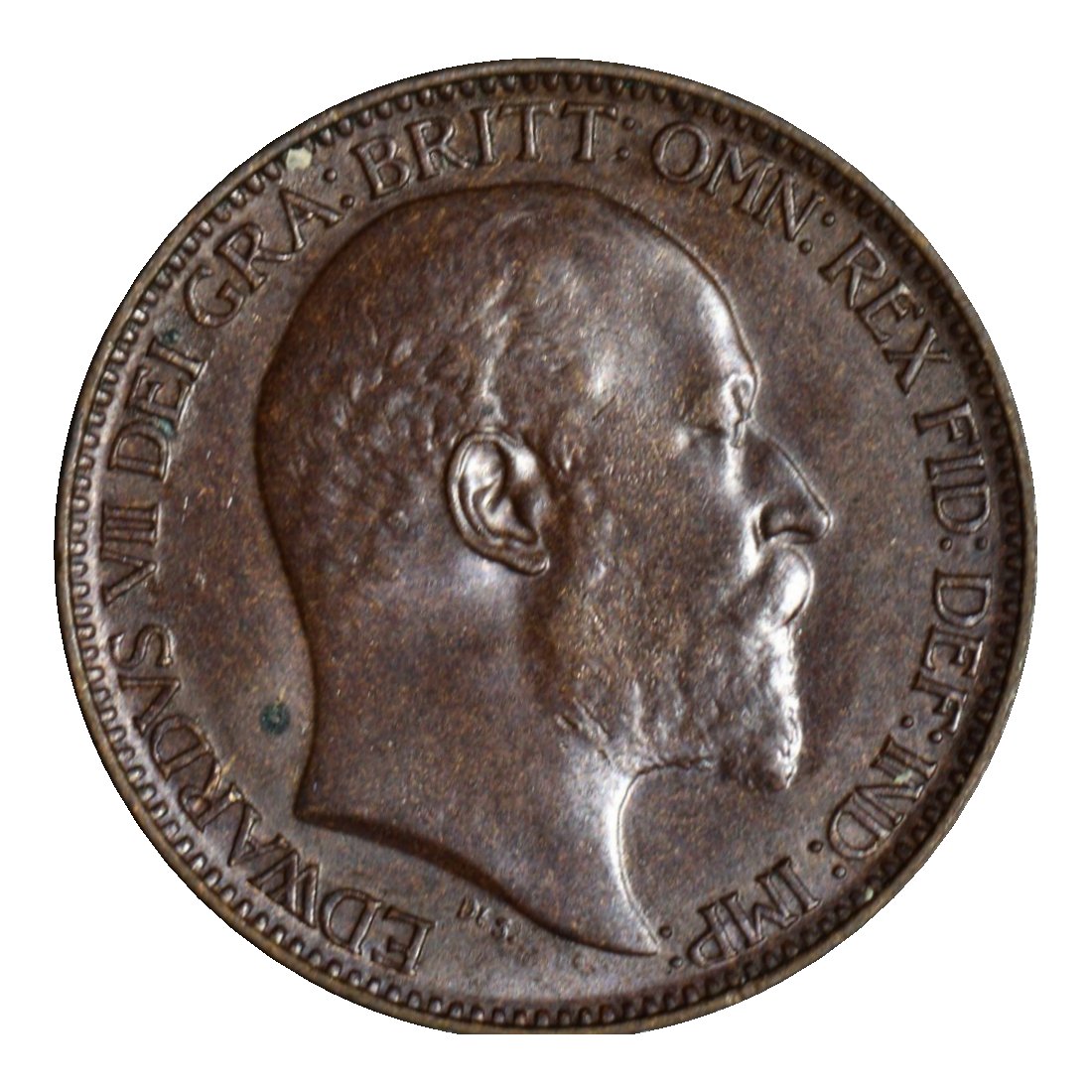
Edward VII — de Saulles
DES below truncation
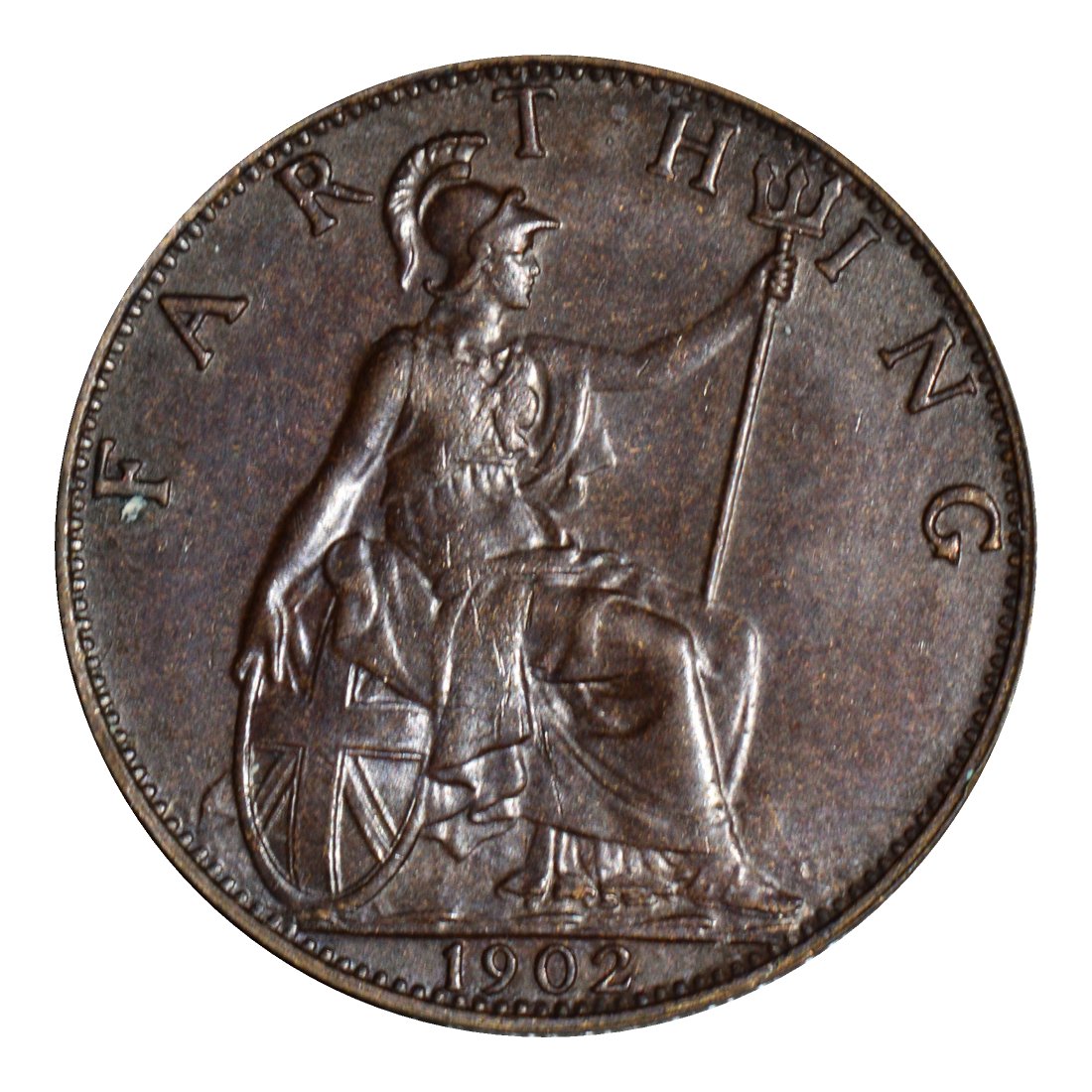
Britannia seated — Wyon
FARTHING / year
| Section | Topic | Notes | ||||||||||||||||||||||||||||||||||||||||||||||||||||||||||||||||||||||
|---|---|---|---|---|---|---|---|---|---|---|---|---|---|---|---|---|---|---|---|---|---|---|---|---|---|---|---|---|---|---|---|---|---|---|---|---|---|---|---|---|---|---|---|---|---|---|---|---|---|---|---|---|---|---|---|---|---|---|---|---|---|---|---|---|---|---|---|---|---|---|---|---|
| History & Context | ||||||||||||||||||||||||||||||||||||||||||||||||||||||||||||||||||||||||
| History | The Farthing — A Quarter Penny |
The farthing — worth one quarter of a penny, one forty-eighth of a shilling, one nine-hundred-and-sixtieth of a pound — was the smallest denomination in regular British circulation. In Edwardian England, a farthing was not negligible: it appeared in pricing (goods priced at 1¾d required farthing change), in charitable collections (farthing bundles of firewood, farthing newspapers), and in the tipping economy (a farthing left on a tray was better than nothing). Children received farthings and spent them on single sweets from the glass jars in corner shops. The farthing occupied the bottom of the British monetary hierarchy with a quiet but persistent utility. ¼d = 1/4 penny = 1/48 shilling = 1/960 pound. The farthing was abolished in 1960 — earlier than decimalisation — because its purchasing power had fallen so low that it was essentially worthless in commerce. The last bronze farthing was struck in 1956. | ||||||||||||||||||||||||||||||||||||||||||||||||||||||||||||||||||||||
| History | The Farthing in Commerce |
The farthing's role in Edwardian daily commerce was shaped by the widespread use of fractional pricing. British retail prices of the period commonly included farthing components: 1¾d, 2¾d, 3¾d — always one less than a round penny, creating the need for farthing change. Advertisers exploited this: "from 1s 11¾d" was a common price point, requiring the customer to receive a farthing in change from a shilling and a penny. The farthing thus circulated through ordinary commerce constantly, which is why so many surviving examples show significant wear — it was genuinely used, not merely curiosity-hoarded like the crown. | ||||||||||||||||||||||||||||||||||||||||||||||||||||||||||||||||||||||
| History | Medal Alignment ↑↑ | Unlike the penny, halfpenny, and all the silver denominations (which use coin alignment ↑↓, where the reverse is inverted relative to the obverse), the Edwardian farthing was struck in medal alignment ↑↑ — rotating the coin around its vertical axis, both obverse and reverse read the same way up. This is confirmed by coinscatalog.net and is a persistent feature of the farthing series. The reason is historical convention rather than any practical necessity; the distinction matters only to variety collectors attributing die pairs. Medal alignment (↑↑): hold obverse upright, flip coin around vertical axis — reverse is also upright. Coin alignment (↑↓): same flip — reverse is upside-down. All silver denominations in this series use coin alignment. The farthing uses medal alignment. | ||||||||||||||||||||||||||||||||||||||||||||||||||||||||||||||||||||||
| The Artificially Darkened Finish — 1897–1917 | ||||||||||||||||||||||||||||||||||||||||||||||||||||||||||||||||||||||||
| Darkening | Why the Farthing Was Darkened |
The artificially darkened finish is the single most distinctive and most important collecting characteristic of the Edwardian farthing series — unique among British coinage. The reason is disarmingly simple: a freshly struck Victorian or Edwardian bronze farthing, bright copper-gold in colour, was approximately the same diameter as a half-sovereign (the gold 10 shilling coin). Unscrupulous individuals were gilding or otherwise treating bright farthings and passing them as half-sovereigns to the unwary — a fraud that cost victims 120 times the coin's face value. The Royal Mint's solution, adopted from 1897 onward, was to darken every farthing before issue using acid fumes, making them immediately distinguishable from the golden half-sovereign. The specific method was to expose newly struck farthings to sulphurous acid fumes, which rapidly blackened the surface. The result is a dark brown-to-black patina on the high relief areas, grading to a warmer brown in the recesses. This treatment was applied consistently through the entire 1897–1917 period (covering the final Victorian Veiled Head farthings and all Edwardian farthings). | ||||||||||||||||||||||||||||||||||||||||||||||||||||||||||||||||||||||
| Darkening | What Original Finish Looks Like |
A correctly preserved Edwardian farthing in UNC condition should appear dark — essentially a very dark brown to near-black on the highest relief areas, warming to brown in protected areas. On some examples the treatment was lighter and results in shades down to medium brown. The key point: a bright copper-red or golden Edwardian farthing described as "uncirculated" has almost certainly had the original darkening removed by cleaning, polishing, or treatment. Bright red is a warning sign, not a premium feature. This inverts the normal bronze colour grading convention: for the penny and halfpenny, RD (full red) is the most desirable surface for UNC examples. For the farthing, the original UNC surface is dark — the equivalent of a "correct" BN on the penny. A genuinely uncirculated darkened farthing is significantly rarer than a cleaned bright example, because the darkening is easily removed and many dealers and collectors have done so, inadvertently destroying the original surface. | ||||||||||||||||||||||||||||||||||||||||||||||||||||||||||||||||||||||
| Darkening | The End of Darkening: 1917 |
After 1917 the practice of artificially darkening farthings was discontinued. The reason was that the half-sovereign had been withdrawn from circulation at the outbreak of WWI in 1914 — once there was no golden coin of similar size to be confused with, the darkening rationale disappeared. George V farthings struck from 1917 onward are therefore bright-finish pieces; the artificially darkened farthing is an exclusively late-Victorian and Edwardian collecting phenomenon. | ||||||||||||||||||||||||||||||||||||||||||||||||||||||||||||||||||||||
| Design | ||||||||||||||||||||||||||||||||||||||||||||||||||||||||||||||||||||||||
| Design | Obverse | De Saulles's Edward VII portrait compressed to 20mm. The legend reads EDWARDVS VII D: G: BRITT: OMN: REX F. D. IND: IMP: At this scale the portrait is necessarily less detailed than on the larger denominations — the facial features are present but the fine collar and whisker work visible on the crown or halfcrown is substantially reduced. Below the truncation: DES, though at 20mm this signature is very small and requires magnification to read. The dark original finish on UNC examples gives the portrait a dignified, medallic quality quite different from the bright-copper penny. | ||||||||||||||||||||||||||||||||||||||||||||||||||||||||||||||||||||||
| Design | Reverse | Wyon's 1860 seated Britannia at 20mm — the same composition as the penny and halfpenny reverse, further reduced. Britannia sits right, helmeted, trident in hand, shield on arm, sea behind. The legend reads FARTHING with the date below in the exergue. At this scale the reverse detail is inevitably limited: Britannia's general form is clear, but the fine detail of the trident prongs, shield cross, and helmet plume requires EF or better condition to read individually. The farthing reverse differs from the penny and halfpenny in one key respect: the legend is simply FARTHING rather than ONE PENNY or HALF PENNY. The denomination label convention varies across the three bronze series: penny = "ONE PENNY", halfpenny = "HALF PENNY", farthing = "FARTHING" (without a numeral). This reflects the farthing's status as an indivisible minimum unit. | ||||||||||||||||||||||||||||||||||||||||||||||||||||||||||||||||||||||
| Design | The 1903 Coloured Shield Variety |
The 1903 farthing has a documented die variety — the Shield heraldically coloured variety — noted by coinscatalog.net. This variety shows colour fill applied to the heraldic devices on Britannia's shield, presumably a die trial or a small special production batch. It is listed as a separate entry with no published mintage. This is a specialist-level variety requiring specific reference attribution; most collectors treat it as a curiosity rather than a set requirement, but it represents the kind of die experiment that the Royal Mint occasionally produced without formal announcement. | ||||||||||||||||||||||||||||||||||||||||||||||||||||||||||||||||||||||
| Complete Series — All Dates | ||||||||||||||||||||||||||||||||||||||||||||||||||||||||||||||||||||||||
| Series | Mintages & Values by Year |
|
||||||||||||||||||||||||||||||||||||||||||||||||||||||||||||||||||||||
| Mint & Production | ||||||||||||||||||||||||||||||||||||||||||||||||||||||||||||||||||||||||
| Mint | Royal Mint Only — No Heaton Issues |
All Edwardian farthings were struck exclusively at the Royal Mint, Tower Hill, London. Unlike the penny (which had Heaton Birmingham contract issues 1902–1906 with an H mintmark), the farthing was never contracted to Heaton. No H mintmark issues exist. This is the simplest attribution situation among all the Edwardian bronze denominations — one mint, no mintmark complications. The same applies to the halfpenny (Royal Mint only). Only the penny needed the Heaton supplement. | ||||||||||||||||||||||||||||||||||||||||||||||||||||||||||||||||||||||
| Mint | The 1904 Key Date |
The 1904 farthing had the lowest standard mintage of the series at 3,629,000 — the same low-production year pattern seen across all Edwardian bronze denominations (1904 penny: 12,910,000 key date; 1904 halfpenny: 8,131,000 key date). The 1904 is consistently the hardest date in EF and above, commanding a modest but real premium over common dates. The 1910 (2,299,000) is lower still in mintage, but its last-year premium and the lower absolute numbers are partially offset by better preservation rates — fewer 1910 farthings were subject to heavy commercial circulation. The 1909 (8,852,000) is paradoxically the highest mintage of the series — the same year that saw relatively low mintages for the halfpenny (8,279,000) and penny (19,620,000). The farthing's production schedule appears to have been on an independent cycle from the larger denominations. | ||||||||||||||||||||||||||||||||||||||||||||||||||||||||||||||||||||||
| Valuation — Grade Guide | ||||||||||||||||||||||||||||||||||||||||||||||||||||||||||||||||||||||||
| Value | Grade Guide: Common Dates vs 1904 Key Date |
|
||||||||||||||||||||||||||||||||||||||||||||||||||||||||||||||||||||||
| Completing the Edwardian Bronze Set | ||||||||||||||||||||||||||||||||||||||||||||||||||||||||||||||||||||||||
| Collect | The Three Bronze Denominations |
Edwardian Bronze Denominations at a Glance
|
||||||||||||||||||||||||||||||||||||||||||||||||||||||||||||||||||||||
| Collecting Notes | ||||||||||||||||||||||||||||||||||||||||||||||||||||||||||||||||||||||||
| Collect | What to Look For | Key grading and attribution points: (1) Original darkened surface — the most important assessment for any EF or UNC farthing; the surface should show dark brown-to-black artificial toning with warm brown in recesses; any bright red surface on an allegedly high-grade piece is a warning. (2) Britannia's trident — individual prongs at EF; present but merged at VF. (3) The helmet plume — feather outlines at EF. (4) De Saulles's portrait — the brow and collar, though at 20mm detail is inevitably compressed. (5) Date legibility — the date in the reverse exergue should be sharp and fully legible in all grades above F. | ||||||||||||||||||||||||||||||||||||||||||||||||||||||||||||||||||||||
| Collect | Problems to Avoid | (1) Cleaned examples presented as UNC — the most common problem specific to the farthing series; a bright copper-red farthing described as uncirculated has had the original darkening removed. (2) Artificial re-darkening — occasionally sellers re-apply sulphurous treatment to a cleaned farthing to simulate the original surface; compare depth and evenness of toning to reference examples. (3) Carbon spots — small dark spots from moisture or atmospheric contamination; common in bronze; reduce value. (4) Medal vs coin alignment confusion — for variety attribution, confirm the medal alignment (↑↑) by the rotation test; unusual if reversed. | ||||||||||||||||||||||||||||||||||||||||||||||||||||||||||||||||||||||
| Collect | Collection Contexts | The Edwardian farthing fits into: a complete nine-date set 1902–1910 — the most affordable complete date run of any Edwardian denomination; an Edwardian bronze set (penny, halfpenny, farthing — all three at once, different scales of the same design); a British farthing by monarch type set (1860 to 1956, bronze farthing); a darkened-finish specialist collection (1897–1917, focused specifically on original surfaces); or as the anchor piece of a smallest British coins display alongside the Maundy penny and contemporary miniature types. | ||||||||||||||||||||||||||||||||||||||||||||||||||||||||||||||||||||||
| Collect | Related Coins | Natural companions: the Edward VII halfpenny 1902–1910 (KM#793 — same obverse and reverse, 25.5mm, 5.6g; companion article in this series); the Edward VII penny 1902–1910 (KM#794 — same design, 30.82mm, 9.4g; companion article); the Victorian "Bun Penny" farthing 1860–1901 (Wyon portrait, same Britannia reverse — the direct predecessor); the George V farthing 1911–1936 (Mackennal portrait, Wyon reverse modified — immediate successor, no longer darkened from 1917 onward); and for the darkening context, the late-Victorian farthings (1897–1901) which began the darkening practice. The 1902 third-farthing (KM#791 — struck for Malta, different denomination at 15mm) is a related but distinct type. | ||||||||||||||||||||||||||||||||||||||||||||||||||||||||||||||||||||||
Sources: Spink Standard Catalogue of British Coins (S.3992) · Freeman, M. The Bronze Coinage of Great Britain, 2nd ed. — F554–565 · Numista catalogue entry #5746 — artificially darkened finish explanation (1897–1917); medal alignment ↑↑ · coinscatalog.net — complete mintage series (1902–1910); KM#792; 2.8g; 20mm; 1.8mm thick; per-grade USD values · allcoinvalues.com — per-year GBP value pages (1902 first year; 1910 last year; all dates) · ColleConline — 1/3 farthing colonial issue (KM#791 context; de Saulles attribution confirmed) · eBay sold prices 2023–2026 — circulated grade calibration