British Crown, 1902 Five Shillings — Coronation Year — Currency Issue & Matt Proof — De Saulles & Pistrucci
Currency: S.3978 · ESC 361 · Bull 3560 · Matt Proof: S.3979 · ESC 362 · Bull 3562 · Silver .925 · 38–38.61 mm · 28.28–28.31 g · ASW 0.8409 troy oz
Currency Issue — S.3978 · ESC 361 · Bull 3560
- Mintage: c. 256,000
- Surface: Normal business strike
- Finish: Standard circulation quality
- Toning: Natural silver grey over time
- Value range: £30 – £500+
- Primary market: Specialist coin dealers, auction houses, eBay
Matt Proof — S.3979 · ESC 362 · Bull 3562 · KM#803
- Mintage: c. 15,000 (part of Coronation sets)
- Surface: Distinctive satin / matte finish
- Finish: Not brilliant — frosted devices on flat field
- Toning: Often wispy dark tone lines on toned examples
- Value range: £400 – £2,500+
- Primary market: Specialist auction houses; certified examples preferred
Two Masters — De Saulles Meets Pistrucci
The 1902 crown is numismatically extraordinary because it unites the work of two designers separated by nearly a century. George William de Saulles (1862–1903) engraved the obverse — his definitive Edward VII portrait, which appears on every denomination of the reign. Benedetto Pistrucci (1783–1855) designed the reverse — his iconic St George and the Dragon, first used on the gold sovereign of 1817 under George III. By 1902 the Pistrucci design was 85 years old, yet it remained the standard crown reverse and continues on the sovereign to this day. The 1902 crown thus marries an early-20th-century portrait with an early-19th-century reverse — a pairing across the full span of the Victorian era.
Benedetto Pistrucci (1783–1855) and the St George Reverse
Pistrucci was an Italian gem-engraver, born in Rome, who came to England c.1815 and was appointed Chief Medallist at the Royal Mint. His St George and the Dragon — first cut for the 1817 gold sovereign — is arguably the most influential coin reverse design in British numismatic history. St George, armoured and helmeted, rides his rearing horse above a fallen dragon; his sword is raised; to the lower left, the broken lance. The composition combines classical action with heraldic stillness. Pistrucci's initials B.P. appear in the exergue to the right of the date 1902 — a respectful posthumous attribution to a designer who died 47 years before this coin was struck. The design remains in continuous use on the British sovereign to this day, more than 200 years after it was first created.
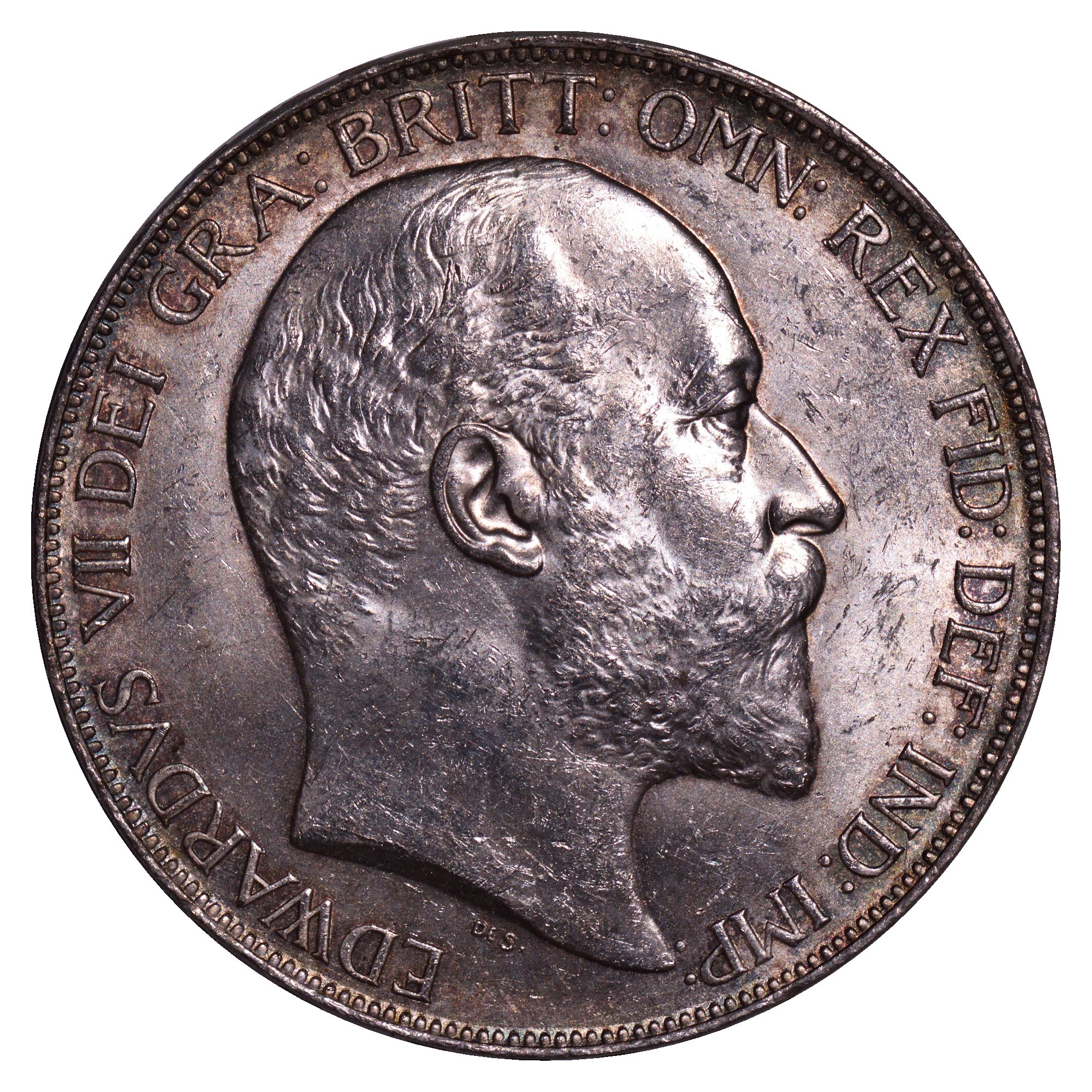
Edward VII — de Saulles
DES below truncation
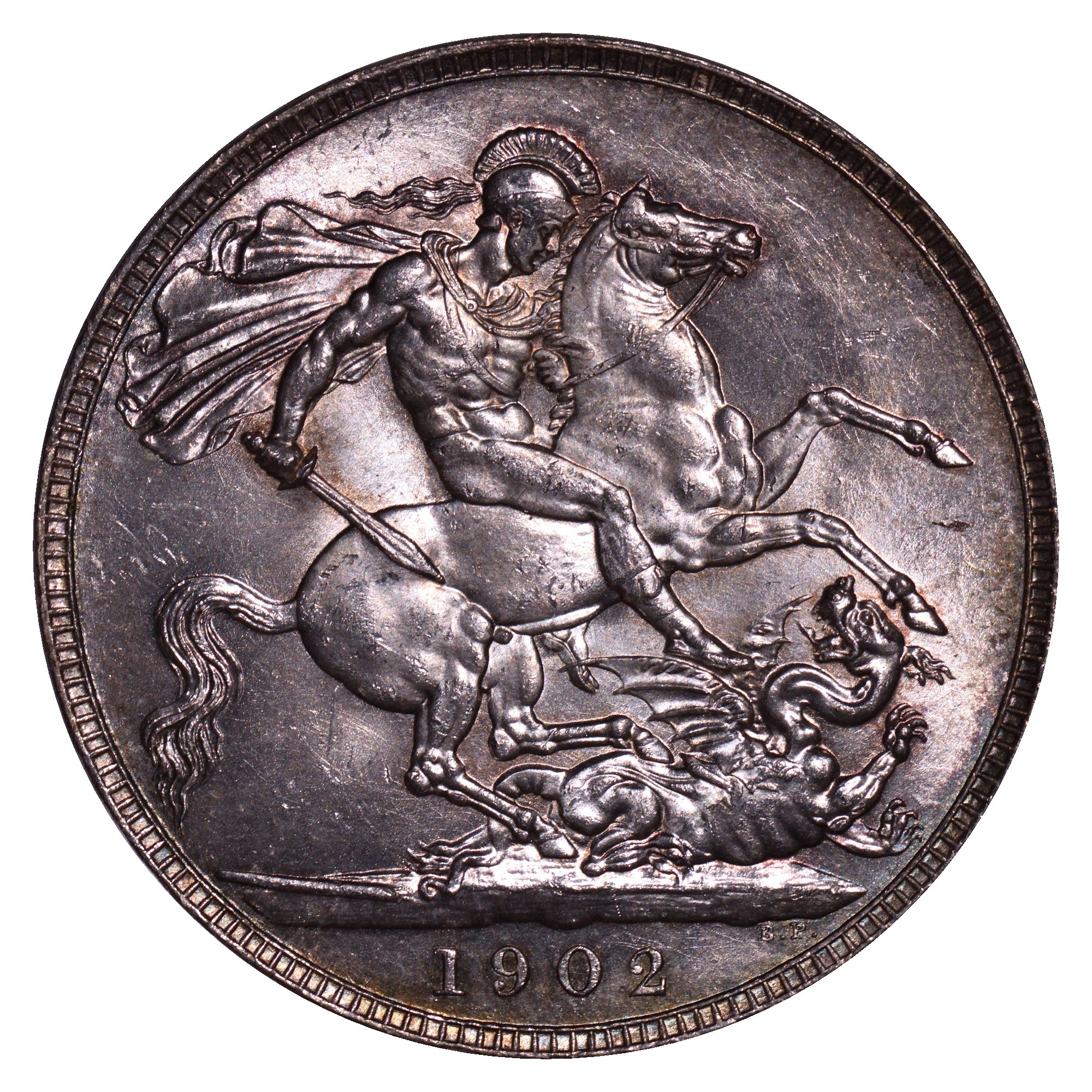
St George and Dragon — Pistrucci
B.P. in exergue, date 1902
| Section | Topic | Notes | ||||||||||||||||||||||||||||
|---|---|---|---|---|---|---|---|---|---|---|---|---|---|---|---|---|---|---|---|---|---|---|---|---|---|---|---|---|---|---|
| History & Context | ||||||||||||||||||||||||||||||
| History | The Crown — Five Shillings |
The crown — worth five shillings, one quarter of a pound, 60 pence — was the largest standard silver denomination in British circulation and the most prestigious. In Edwardian England, five shillings was a meaningful sum: a skilled tradesman's daily wage, several days' food for a working family, a good seat at a major theatre. The crown was too large and valuable to circulate freely — it was more often hoarded, saved as a gift, or put away in a drawer as a keepsake than spent as change. This saved-rather-than-spent tendency is why more Edwardian crowns survive in reasonable condition than their mintage might suggest. 60d = 5s = 1/4 pound. The crown was first struck under Henry VIII in 1526 and circulated with varying frequency through subsequent reigns. In the 20th century it became essentially a commemorative denomination; the 1902 Coronation crown was the last British crown struck primarily for circulation rather than as a collector piece. Subsequent 20th-century crowns (1927, 1935, 1937, etc.) were collector issues. | ||||||||||||||||||||||||||||
| History | The Last Circulation Crown |
The 1902 crown holds a unique place in British numismatic history as the last silver crown struck primarily for general circulation. All subsequent 20th-century British crowns — 1927, 1935 (Silver Jubilee), 1937 (Coronation), 1951 (Festival of Britain), 1953 (Coronation), and the long series from 1965 onward — were collector issues, struck for commemorative purposes rather than ordinary commerce. The 1902 Coronation crown thus marks the end of the crown as a circulating denomination and the beginning of the crown's modern role as a collector piece. The coin was not included in the decimalisation legislation of 1971 and was therefore not demonetised along with the other pre-decimal silver. The Royal Mint has subsequently confirmed that the 1902 crown remains legal tender in the United Kingdom, remonetised at a face value of 25 new pence. This is purely a technicality — its numismatic value as a collector's coin is many times greater. | ||||||||||||||||||||||||||||
| History | The Coronation of Edward VII |
Edward VII's coronation was originally planned for 26 June 1902, but had to be postponed when the King was operated on for appendicitis (perityphlitis) on 24 June. He was crowned on 9 August 1902. The Coronation coin programme — including both the currency crown and the matt proof set — had already been prepared; the coins bore the date 1902 regardless of the revised ceremony date. The regnal year inscription on the edge (ANNO REGNI II — Second Year of the Reign) confirms the year 1902, as Edward VII's reign began on 22 January 1901. The near-disaster of the postponed coronation is mentioned in contemporary accounts as causing considerable logistical problems — hundreds of thousands of guests, decorations, and street parties had been organised for June 26th. The King's recovery and the August coronation were national events of relief and celebration. | ||||||||||||||||||||||||||||
| Pistrucci's St George — The Reverse Design | ||||||||||||||||||||||||||||||
| Pistrucci | Benedetto Pistrucci (1783–1855) |
Pistrucci was born in Rome and trained as a gem-engraver — a specialist in cutting intaglios and cameos in hardstone, the most technically demanding form of miniature relief sculpture. He came to London c.1815 and was engaged by William Wellesley-Pole, Master of the Mint. Pistrucci and the Wyon family were the great rivals of Regency and Victorian numismatic art — his Italian Neoclassical boldness directly contrasted with the Wyons' English academic restraint. He was appointed Chief Medallist (but never Chief Engraver, as the position was reserved for British subjects) and held the post until his death in 1855. The rivalry between Pistrucci and William Wyon was conducted through the press and through the work itself. Both designed competing portraits of Victoria for the 1838 coronation; Wyon's won and entered circulation. Pistrucci's St George reverse, however, proved untouchable — it was so admired that no subsequent designer was ever asked to replace it, and it has appeared on every British gold sovereign from 1817 to the present day, more than 200 years without interruption. | ||||||||||||||||||||||||||||
| Pistrucci | The St George Design in Detail |
Pistrucci's reverse shows St George — patron saint of England — mounted on a rearing horse, wearing a plumed helmet and a billowing cloak. His sword is raised to strike. Below the horse: a fallen dragon, its body writhing in defeat. To the lower left: the broken shaft of St George's lance, which has been snapped in the initial encounter. In the exergue: the date 1902, and to the right: B.P. — Pistrucci's initials. There is no legend on the reverse of the crown; the image speaks entirely for itself. The broken lance is one of the design's most narratively rich details: it tells us that the battle has been going on, that the lance has already been spent in the fight, and that the sword is the weapon of the climactic blow. The drama is in the moment of decision rather than the moment of triumph. Pistrucci derived his composition from the antique — specifically, the Dioscuri on the Quirinal Hill in Rome, and classical equestrian bronzes — but elevated it with Romantic movement and energy. | ||||||||||||||||||||||||||||
| Pistrucci | 85 Years Between Design and Coin |
Pistrucci created the St George design in 1817. By 1902 he had been dead for 47 years. Yet his initials appear on the 1902 crown as a permanent attribution mark — a posthumous recognition that the design was so distinctively his that no other attribution was needed or appropriate. The 1902 crown is one of the very few circulation coins in British numismatic history on which the reverse designer died before the obverse designer was even born: Pistrucci died in 1855, de Saulles was born in 1862. | ||||||||||||||||||||||||||||
| Design — Both Issues | ||||||||||||||||||||||||||||||
| Design | Obverse | De Saulles's finest-scale presentation of the Edward VII portrait — at 38mm the full detail of the King's collar, side-whiskers, ear, and brow is superbly rendered. The legend reads EDWARDVS VII DEI GRA: BRITT: OMN: REX FID: DEF: IND: IMP: Below the truncation: DES or De S ·. On the large crown planchet, de Saulles had room to achieve the portrait's full potential — the result is considered by many numismatists to be the finest realisation of his Edward VII design. | ||||||||||||||||||||||||||||
| Design | The Edge Inscription | The crown's edge carries a raised letter inscription: DECUS ET TUTAMEN · ANNO REGNI II · — Latin for "An Ornament and a Safeguard · In the Second Year of the Reign." The first phrase, Decus et tutamen, was coined by Virgil in the Aeneid to describe a breastplate, and has been used on the edge of British crowns since Charles II introduced the milled edge coinage in 1662. It refers to the milled edge itself — an ornament, and a safeguard against clipping. Anno Regni II — Second Year of the Reign — dates the coin to 1902 (Edward VII's reign began 22 January 1901; his second regnal year commenced 22 January 1902). The raised lettering is a mark of quality and anti-counterfeiting. The use of Decus et tutamen persists on modern British £1 coins, linking the current circulating coinage directly to the 1662 milled coinage tradition. The 1902 crown, with this edge, is thus a direct link in a chain of British numismatic tradition stretching back 350 years. | ||||||||||||||||||||||||||||
| Design | Currency vs Matt Proof: How to Tell |
The currency issue and the matt proof share the same design; they differ in surface quality. The currency issue (ESC 361) has a normal business-strike finish — fields may show some luster flow in high grade; the metal surface shows the typical cartwheel lustre of a freshly struck silver coin. The matt proof (ESC 362) has a distinctive satin or matte finish: the devices appear slightly frosted against flat, non-reflective fields. Under a strong light, the currency issue shows flowing, cartwheel lustre; the matt proof shows a velvety, directional satin quality that does not "cartwheel." The sovr.co.uk description captures the matt proof surface precisely: "wispy dark tone lines, well defined, practically as struck." These toning characteristics are typical of the satin-finished surface and help identify the issue. The matt finish was a deliberate artistic choice for the 1902 Coronation sets — in 1902 this finish was fashionable for medallions and was considered more dignified and artistic than the brilliant mirror proof. It is the only year a British crown was issued in matt proof format alongside a currency issue. | ||||||||||||||||||||||||||||
| Mint & Production | ||||||||||||||||||||||||||||||
| Mint | Royal Mint & Coronation Sets |
Both the currency crown and the matt proof crown were struck at the Royal Mint, Tower Hill, London. The matt proof was struck as part of the 1902 Coronation proof set — available as either the "Short Set" (silver denominations only, from crown to Maundy penny) or the "Long Set" (including gold denominations: £5, £2, sovereign, and half-sovereign). The Royal Mint confirmed mintage of approximately 8,066 complete Long Sets. The currency crown was struck separately for general circulation. The total mintage of approximately 256,000 currency crowns and 15,000 matt proofs makes this a relatively scarce coin — considerably rarer in absolute terms than any of the smaller Edwardian silver denominations. The 1902 Coronation Long Set in gold and silver is one of the great collector sets of British numismatics. Complete sets in fine condition fetch £3,000–5,000+; sets with the gold pieces in exceptional grade significantly more. The Royal Mint offers a modern reissue (2025) of the Long Set; the original 1902 pieces are worth far more individually than the modern restrikes. | ||||||||||||||||||||||||||||
| Mint | A One-Year Issue | No further crowns were struck under Edward VII. The 1902 crown was the only Edwardian crown, and the last British silver crown struck for general circulation. The next circulation-intended crown would not appear until 1927 (George V), and even that was more collector than circulation issue. The practical reason: the crown's face value (5 shillings) made it inconvenient in commerce — too large for small transactions, too small for significant ones — and it increasingly found its way into savings boxes rather than tills. The 1902 Coronation purpose was ideal for a one-off crown issue; there was no annual commercial demand to sustain continued production. | ||||||||||||||||||||||||||||
| Valuation | ||||||||||||||||||||||||||||||
| Value | Currency Issue Price Guide |
|
||||||||||||||||||||||||||||
| Value | Matt Proof Price Guide |
|
||||||||||||||||||||||||||||
| Value | Silver Content vs Numismatic Value |
The 1902 crown contains 0.8409 troy oz of pure silver — approximately £22 / $28 at May 2026 silver prices. Even a heavily worn currency example (£20–40) barely touches the bullion floor; at VF and above, collector premiums run to 5–15× silver value; for the matt proof in gem condition, the premium approaches 100× bullion. The coin's numismatic value is therefore almost entirely collector-driven, not metal-driven — it is the history, the rarity, the design, and the commemorative significance that determine price, not the intrinsic metal. | ||||||||||||||||||||||||||||
| Collecting Notes | ||||||||||||||||||||||||||||||
| Collect | Currency or Matt Proof? |
For most collectors, the choice is straightforward: the currency issue offers an accessible and historically significant coin at a manageable price (£50–250 for a VF–EF example), while the matt proof requires a significantly larger investment (£800–2,500 for a collector-grade piece) but offers a more refined and rarer numismatic object. The currency issue is the more appropriate choice for a type set or a historical collection of Edwardian coinage; the matt proof belongs in a specialist proof coin collection or as part of an original Coronation set assembly. Both issues can also be displayed together as a pair — the contrast between the business-strike lustre of the currency piece and the satin surface of the proof is itself numismatically instructive. | ||||||||||||||||||||||||||||
| Collect | What to Look For | Key grading points for the currency issue: (1) St George's raised arm and sword — the highest point of the reverse; the first area to show wear. (2) The horse's rump and hindquarters — also high relief; define EF from VF. (3) The dragon's body and scales — intricate detail; readable at EF, softened at VF, merged at F. (4) Edward VII's portrait — collar and brow. (5) The edge inscription — readable at all grades; partial illegibility indicates significant wear or damage. For the matt proof: check the satin surface quality under raking light; the characteristic velvety, non-reflective finish must be intact to justify proof premiums. | ||||||||||||||||||||||||||||
| Collect | Problems to Avoid | (1) Cleaning — very common in crowns; harsh cleaning removes the original lustre on the currency issue or the satin surface on the proof. Check for directional hairlines or unnaturally bright surfaces. (2) Currency issue passed off as matt proof — the distinction requires examination under good directional light; if a coin is described as "matt proof" or "specimen," verify the surface quality. A currency issue is never worth matt proof money. (3) Tooling on St George — the complex reverse is a target for sharpening worn details; check under magnification for inconsistent metal flow around the horse's musculature and the dragon's scales. (4) Edge damage — the raised letter edge inscription is vulnerable to nicking; significant damage to the edge letters reduces the coin's desirability substantially. | ||||||||||||||||||||||||||||
| Collect | Collection Contexts | The 1902 crown fits into: an Edwardian silver complete denomination set (halfcrown, florin, shilling, sixpence, threepence, crown — the full hierarchy); a British crown type set (one crown per major issue from Charles II to the present — the 1902 as the last circulation crown); a Pistrucci St George collection (gold sovereign + silver crown — the same design across different metals); a Coronation coinage collection; or a 1902 complete short set (crown, halfcrown, florin, shilling, sixpence, threepence, Maundy set — all in the same matt proof finish). | ||||||||||||||||||||||||||||
| Collect | Related Coins | Natural companions: the 1902 Coronation matt proof set (Short Set or Long Set — the crown is the centrepiece silver piece); the 1902 Edward VII gold sovereign (same Pistrucci St George reverse, same de Saulles obverse, in gold — a natural pair); the 1927 George V proof crown (next British collector crown; different reverse design); the Victorian Gothic Crown 1847 (immediate predecessor in the crown type sequence); and the Edward VII halfcrown 1902–1910 (shares the de Saulles portrait, but carries his Garter shield reverse rather than Pistrucci's St George — a useful design comparison). For the Pistrucci design context, the modern gold sovereign (any year from 1817 to present) carries the same reverse. | ||||||||||||||||||||||||||||
Sources: Spink Standard Catalogue of British Coins (S.3978 currency; S.3979 proof) · Maurice Bull & Alan Rayner, English Silver Coinage Since 1649, 7th ed. — ESC 361/362; Bull 3560/3562 · sovr.co.uk — 1902 matt proof crown description (weight 28.30g; Bull 3562; ESC 362; L&S 2; Davies 1530; S.3979; "practically as struck") · colonialcollectables.com — 1902 matt proof (KM#803; S.3979; 28.28g; 38.61mm; ASW 0.8409 oz; mintage 15,000) · colonialcoins.com.au — currency crown full description (S.3978; Bull 3560; ESC 361; 28.31g; 38mm; edge DECUS ET TUTAMEN ANNO REGNI II) · thecoinexpert.co.uk — currency mintage c.256,000; proof mintage c.15,000; approximate value £260 for good grade · Numista entry #2343 — "one year issue only; last British crown struck for circulation"; legal tender at 25p · Royal Mint — 1902 Long Matt Proof Set description (8,066 sets; de Saulles + Pistrucci) · The London Coin Company — PCGS PR63 matt proof offering · Chards.co.uk — St George first used on sovereigns of George III in 1817 · Britannia Coin Company — currency crown AVF description (weight 28.28g)