France 2 Francs, 1915 — La Semeuse Louis-Oscar Roty — Third Republic — Monnaie de Paris — Struck in Wartime
KM# 845.1 · Silver .835 · 27 mm · 10 g · Reeded edge · ASW 0.2684 troy oz · Series: 1898–1920 · Catalogue: F.266, Gad.532
La Semeuse — The Sower of the French Republic
The Semeuse (Sower) is one of the most celebrated coin designs of the modern era — a woman in a Phrygian cap walking left and sowing seeds against the wind, with the rising sun behind her. Designed by Louis-Oscar Roty (Paris, 11 June 1846 – 23 March 1911), a medallist who won the Grand Prix de Rome in 1875, the design was created in 1887 for a medal for the Ministry of Agriculture — ten years before it appeared on coins. Roty's model was a 15-year-old Italian girl, Rosalina Pesme, encountered by chance in the street. The figure went on to become one of the defining symbols of France, appearing on coins from 1897 to 1920, then again on the new franc from 1959, and inspiring the obverse design of France's euro coins from 2002. The Semeuse holds the record for the longest-lived design on French coinage.
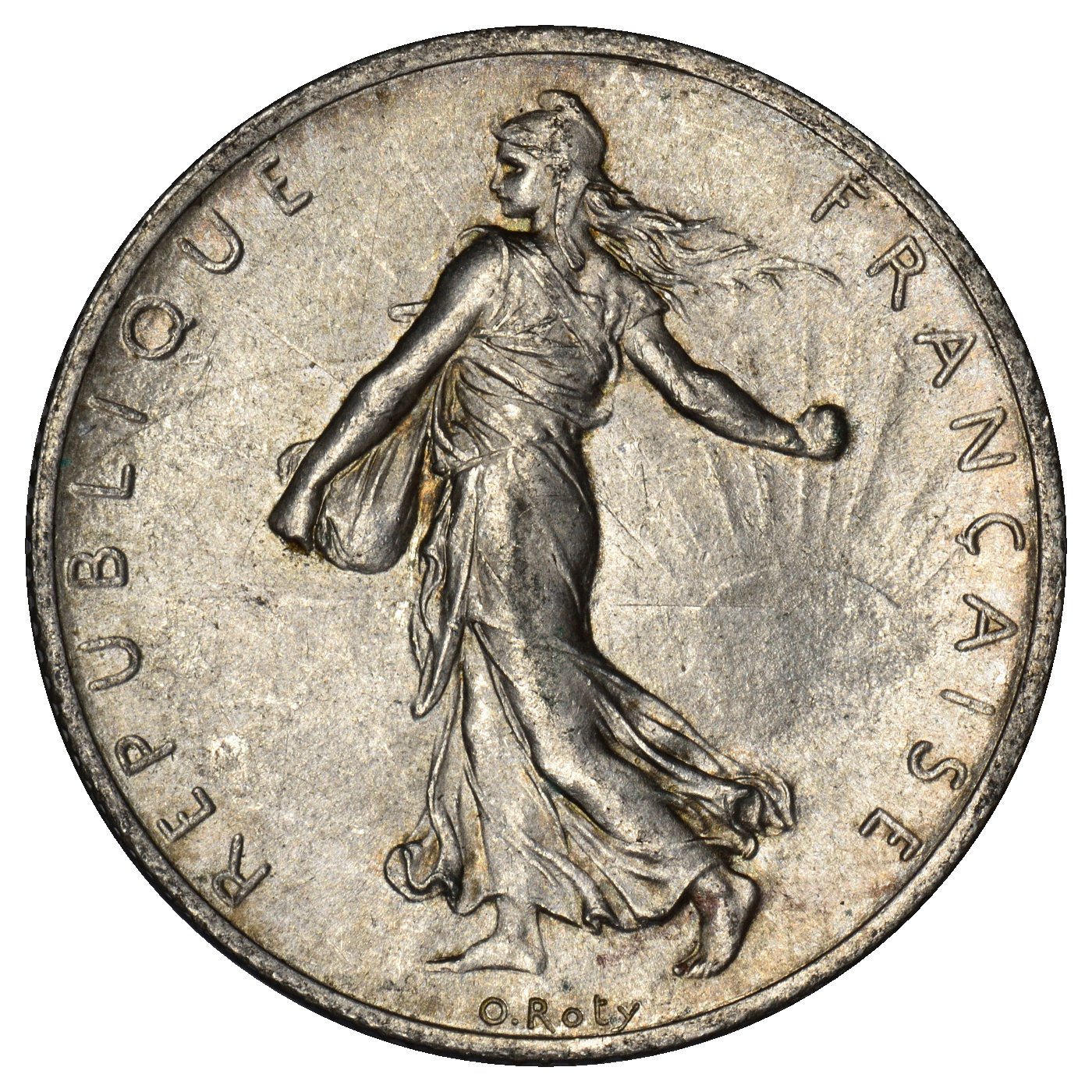
La Semeuse — O. Roty
REPUBLIQUE FRANÇAISE
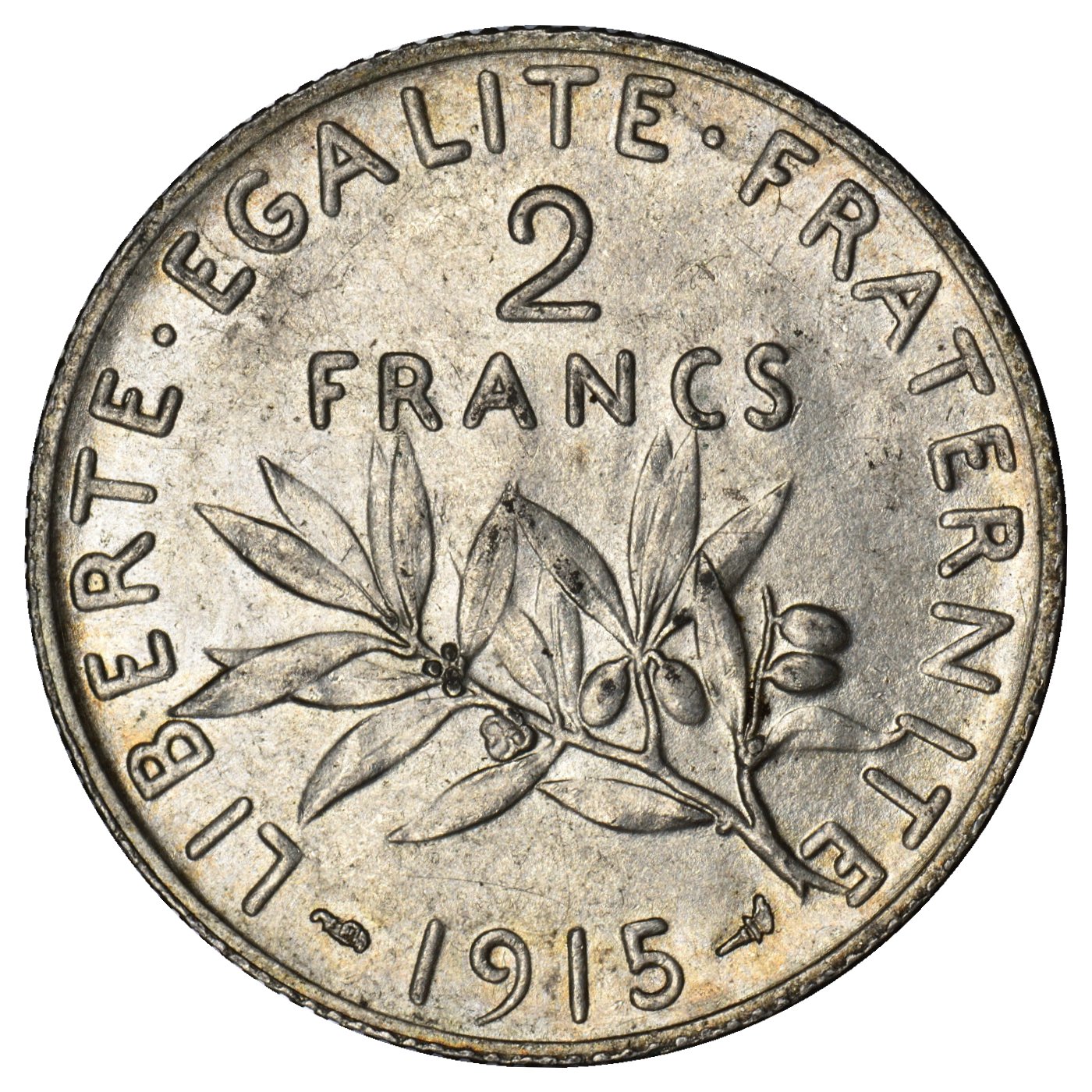
Olive branch, value & date
LIBERTÉ · ÉGALITÉ · FRATERNITÉ
| Section | Topic | Notes | ||||||||||||||||||||||||||||||||||||||||
|---|---|---|---|---|---|---|---|---|---|---|---|---|---|---|---|---|---|---|---|---|---|---|---|---|---|---|---|---|---|---|---|---|---|---|---|---|---|---|---|---|---|---|
| History & Context | ||||||||||||||||||||||||||||||||||||||||||
| History | France in 1915 | 1915 was one of the most brutal years of the First World War for France. The Western Front ran directly through French soil — through Flanders, Artois, the Champagne, Verdun, and the Vosges. By the end of 1915 approximately 960,000 French soldiers had been killed or died of wounds since August 1914. The Second Battle of Artois (May–June 1915) and the Third Battle of Artois (September 1915) alone cost France hundreds of thousands of casualties. Yet the Paris Mint continued to strike silver 2 Franc pieces — the monetary infrastructure of the Republic had to function even as its army fought for survival in the trenches less than 100 kilometres from the capital. The Monnaie de Paris (Paris Mint) is the oldest institution in France — it has struck coins continuously since 864 AD. In August 1914, as German forces swept toward Paris, the Mint actually moved its most important equipment and personnel to Castelsarrasin in southern France (giving rise to the rare 1914-C variety). By 1915 it was back in Paris, operating under wartime conditions. | ||||||||||||||||||||||||||||||||||||||||
| History | The Semeuse at War | The 2 Franc Semeuse circulating in France in 1915 carried a design of republican idealism — a woman freely sowing seeds in the rising sun — while passing through the hands of people experiencing the worst violence in French history since the Revolutionary wars. The coin's reverse proclaimed LIBERTÉ · ÉGALITÉ · FRATERNITÉ while the Republic was mobilising its entire national life for industrial warfare. This tension between the coin's optimistic symbolism and the reality of 1915 France gives the wartime Semeuse issues a particular historical depth. Silver coins were increasingly hoarded or exported from 1916 onward as the war economy disrupted currency circulation. The wartime silver 2 Franc issues (1914–1920) thus include a significant proportion of pieces that never circulated heavily — surviving in high grades because they were saved rather than spent. | ||||||||||||||||||||||||||||||||||||||||
| History | France & the Latin Monetary Union |
France was the founding member and dominant power of the Latin Monetary Union (1865–1927), which standardised silver coinage across France, Belgium, Italy, Switzerland, Greece, and associated territories at the .835 fine, 10g standard for the 2 Franc piece. This meant that the 1915 French 2 Franc was interchangeable at face value with the Austrian 2 Corona, the Serbian 2 Dinara, the Italian 2 Lire, the Belgian 2 Francs, the Greek 2 Drachmas, and the Swiss 2 Francs — all struck to identical specifications. In the chaos of wartime European commerce, this interchangeability had practical significance. Austria-Hungary was not a formal LMU member, but adopted the same specifications for its reform coinage — giving the remarkable numismatic situation where the Austrian 2 Corona (enemy) and the French 2 Franc (ally) were physically identical in weight and fineness, minted in the same year, by countries at war. | ||||||||||||||||||||||||||||||||||||||||
| Design — La Semeuse & Louis-Oscar Roty | ||||||||||||||||||||||||||||||||||||||||||
| Design | Louis-Oscar Roty (1846–1911) |
Louis-Oscar Roty was born in Paris on 11 June 1846 and died there on 23 March 1911 — four years before this coin was struck. A graduate of the École des Beaux-Arts under François Ponscarme, he won the Grand Prix de Rome for medal engraving in 1875 for a wax model representing "a shepherd trying to read the inscription engraved on a rock at Thermopylae." He was one of the great medallists of the Belle Époque, renowned for his portrait plaques, his delicate rendering of drapery and movement, and his ability to tell a narrative within the tiny circular field of a coin. Roty's influence extended beyond France: his approach to numismatic portraiture influenced Victor David Brenner (designer of the Lincoln Cent, 1909) and can be seen in the compositional language of the US Walking Liberty Half Dollar (1916). The Semeuse is his most enduring work. | ||||||||||||||||||||||||||||||||||||||||
| Design | Rosalina Pesme: The Model |
In 1887, Roty created the Semeuse design for a medal for the Ministry of Agriculture. His model was a 15-year-old Italian girl, Rosalina Pesme, whom he had encountered by chance in the street and who agreed to pose for him for the modest sum of 100 sous (approximately 1 euro in modern value). The resulting figure — young, purposeful, walking into the wind — became the visual embodiment of the French Republic for more than a century. Rosalina Pesme herself lived in obscurity; her connection to one of the world's most reproduced images was not publicly known until after her death. | ||||||||||||||||||||||||||||||||||||||||
| Design | Obverse Description | The left-facing figure of a woman wearing a Phrygian cap (the traditional symbol of liberty and the French Republic), her robes flowing left in the wind she walks against, sowing seeds from a bag held at her left hip. Her right arm is extended upward in the sowing gesture; her hair streams behind her. The rising sun fills the upper right field behind her. Below the figure: the designer's signature O. ROTY incised in small letters. The legend curves around the outer rim: REPUBLIQUE FRANÇAISE. The detail of Roty's design — the fine modelling of the drapery, the individual grain seeds being scattered, the expression of the figure's face — is remarkable for a coin of this size. The design was engraved to the highest Belle Époque medallic standards. On gem uncirculated examples, every fold of the woman's robes is distinct. | ||||||||||||||||||||||||||||||||||||||||
| Design | Reverse Description | An olive branch occupies the centre of the reverse — its leaves and small fruits rendered with botanical precision — dividing the value 2 FRANCS above from the date 1915 below. The branch is enclosed by the legend LIBERTÉ · ÉGALITÉ · FRATERNITÉ — the motto of the French Republic — arching around the upper and lower rim. The Monnaie de Paris privy marks (the mint director's mark and the mint master's mark) appear in the left and right fields of the reverse, and serve as authentication markers. The Paris Mint marks for 1915: the cornucopia (always present on Paris-struck coins) and the mark of the serving mint master. These small marks in the reverse field — visible under magnification — confirm the coin was struck at the Monnaie de Paris and not at the Castelsarrasin auxiliary mint (which would carry different marks). | ||||||||||||||||||||||||||||||||||||||||
| Design | Toning on French .835 Silver |
The 1915 2 Franc shares its .835 fine silver alloy with the Austrian 1 and 2 Corona of the same era. This copper-containing alloy ages beautifully, and wartime Semeuse coins in high grades often develop striking natural toning. Caesar's Ghost Numismatics describes their NGC MS-64 1915 example as having "stunning blue/green/gold toning with lustrous surfaces" — precisely the multi-colour toning range noted for Austrian and Serbian silver of the same standard. Original-toned examples command significant premiums over dipped bright coins. | ||||||||||||||||||||||||||||||||||||||||
| The Semeuse 2 Franc Series — KM#845, 1898–1920 | ||||||||||||||||||||||||||||||||||||||||||
| Series | The Complete Series — Selected Dates |
The 2 Franc Semeuse ran for 22 years, from 1898 to 1920. Within this run, most dates are broadly available in circulated grades; a few dates are genuinely scarce and command significant premiums. The 1915 is a normal wartime issue — neither a key date nor particularly rare, but with historical resonance as a WWI-struck piece.
|
||||||||||||||||||||||||||||||||||||||||
| Series | 1914-C — The Castelsarrasin Mint |
The rarest and most historically dramatic variety in the Semeuse 2 Franc series. As the German army advanced on Paris in August 1914, the decision was made to evacuate the Monnaie de Paris and its key personnel to Castelsarrasin, a small town in the Tarn-et-Garonne. The 1914-C coins bear a different privy mark (C for Castelsarrasin) and have a mintage of only 461,647 pieces — roughly one-tenth the normal Paris output. By November 1914 the threat to the capital had subsided and the Mint returned to Paris; the 1915 coins are the first full year of resumed Paris production. An NGC MS-63 example of the 1914-C 2 Franc was noted by CoinVarieties.com as "choice blast white uncirculated with just a hint of patina... scarce." This variety consistently commands a premium of 5–10× the 1915 Paris date at equivalent grades. | ||||||||||||||||||||||||||||||||||||||||
| Series | The 1 Franc Parallel Series |
Roty also designed the 1 Franc Semeuse (KM#844, 5g, .835 silver, 23mm) — the smaller half-denomination using the identical obverse and reverse design format, struck 1898–1920 in parallel with the 2 Franc. The 1 Franc series has its own key dates (1900, 1903, and the 1914-C with a mintage of just a few hundred thousand). The two denominations form a natural companion pair; a collector building a Semeuse type set will typically pursue both. | ||||||||||||||||||||||||||||||||||||||||
| Mint & Production | ||||||||||||||||||||||||||||||||||||||||||
| Mint | Monnaie de Paris (Paris Mint) |
The 1915 2 Franc was struck at the Monnaie de Paris — France's national mint, founded in 864 AD and the oldest continuously operating institution in France. By 1915 the Mint was back at its Paris premises on the Quai de Conti, having returned from its wartime evacuation to Castelsarrasin in late 1914. Paris-struck coins carry the privy marks of the Mint director (cornucopia) and the mint master on the reverse — these marks, while small, are the primary authentication identifier for Paris-struck pieces versus the Castelsarrasin issues. The Monnaie de Paris also struck coinage for Serbia during the same period — as noted in our companion article on the 1915 Serbia 1 Dinar. The Paris Mint was the busiest foreign-national-coinage facility in Europe in 1915, simultaneously producing silver for its own wartime economy and for Allied partners. | ||||||||||||||||||||||||||||||||||||||||
| Mint | Silver Content & Latin Union Standard |
The 2 Franc weighs 10.0g at .835 fine, giving 8.35g pure silver = 0.2684 troy oz — precisely the Latin Monetary Union standard for the 2 Franc denomination. At $33/oz (May 2026), the bullion floor is approximately $8.85 USD. This is the same silver content as the Austrian 2 Corona (KM#2821) and double the silver content of the Austrian 1 Corona (KM#2820) — the specifications of these Latin Union standards were deliberately harmonised. See the companion articles in this series for the Austrian and Serbian coins. | ||||||||||||||||||||||||||||||||||||||||
| Mint | Wartime Hoarding & Silver Scarcity |
From 1916 onward, silver coins increasingly disappeared from French circulation as Gresham's Law operated at full force — people hoarded the intrinsically valuable silver coins and spent the paper money that was being issued in increasing quantities to finance the war. Many wartime silver 2 Franc pieces were saved by the first holder who received them — stored in drawers, boxes, and jars rather than circulated to further wear. This hoarding behaviour is the reason that MS-grade wartime Semeuse pieces are available today at all reasonable prices. | ||||||||||||||||||||||||||||||||||||||||
| Valuation | ||||||||||||||||||||||||||||||||||||||||||
| Value | Market Overview | The 1915 2 Franc Semeuse is a normal wartime issue — well available in all circulated grades and modestly priced below EF, with premiums building through EF and AU for quality original-surface examples. The WWI context adds collector appeal beyond pure silver value at all grades. MS examples with original toning attract strong demand: Caesar's Ghost Numismatics offered an NGC MS-64 with "stunning blue/green/gold toning"; a separate NGC MS-65 was offered at $249.95 (eBay 2025). The 1916 NGC MS-64 at $199 provides a close benchmark for the adjacent year. The 1915 is not a key date in the 2 Franc series (those are 1900 and 1903). It is a normal date with a historical story — the WWI premium is real but modest for circulated examples; it becomes more significant in MS grades where toning quality drives the market. | ||||||||||||||||||||||||||||||||||||||||
| Value | Price Guide (approximate, 2025–26) |
|
||||||||||||||||||||||||||||||||||||||||
| Value | Key Date Premium: 1914-C vs 1915 |
For perspective on where the 1915 sits within the series: a 1914-C (Castelsarrasin) example in comparable MS-63 grade is worth approximately 5–10× the value of the 1915 Paris, given its mintage of 461,647 vs the much larger normal Paris production. Collectors seeking the most affordable entry to the Semeuse 2 Franc series should start with the 1915 or other normal Paris dates; those seeking the set highlight should target the 1914-C and the 1900/1903 key dates. | ||||||||||||||||||||||||||||||||||||||||
| Collecting Notes | ||||||||||||||||||||||||||||||||||||||||||
| Collect | What to Look For | Key grading points on the Semeuse 2 Franc: (1) The Sower's cap and extended right arm — the highest points of the obverse relief; these wear first and define EF from VF. (2) The folds of the Sower's robes — Roty's finest design detail; individual folds should be distinct in EF and above. (3) The sun rays behind the figure — at EF all rays are distinct; in VF they begin to merge at the outside. (4) The olive leaves on the reverse — individual leaf veins at gem level; leaf outlines clear in EF; general leaf shapes in VF. (5) The Paris Mint privy marks in the reverse fields — confirm Paris origin and authenticity; should be legible on EF and above. | ||||||||||||||||||||||||||||||||||||||||
| Collect | Problems to Avoid | Common issues: (1) Cleaning / dipping — extremely widespread in French silver; a natural-toned example is worth more than a bright dipped one at equivalent technical grade. (2) Artificial toning — applied to conceal cleaning; check that toning sits deepest in recesses, not on high points. (3) Paris vs Castelsarrasin confusion — the 1914-C carries different privy marks from the 1914 Paris issue; some sellers list both as "1914" without specifying the mint. The 1914-C is worth dramatically more. (4) Scratches in the fields — Roty's finely polished fields show contact marks readily; check fields under raking light. (5) Edge damage — reeded edges ding easily in bulk storage; significant rim bruises reduce grade and value. | ||||||||||||||||||||||||||||||||||||||||
| Collect | Collection Contexts | The 1915 2 Franc Semeuse fits naturally into: a complete Semeuse date set (1898–1920, all 22 years including the 1914-C variant); a French Third Republic silver collection; a WWI Allied nations silver thematic set (France, Serbia, Britain); a Latin Monetary Union type set (French, Belgian, Italian, Swiss, Greek 2 Franc coins to the same specification); or a Roty medallic art collection alongside related medals and the 1 Franc companion series. As a standalone piece, the 1915 WWI context gives it a narrative that elevates it above a purely bullion purchase. | ||||||||||||||||||||||||||||||||||||||||
| Collect | Related Coins | The natural companions are: the 1915 1 Franc Semeuse (KM#844 — same obverse design, half weight, 23mm, scarcer in MS than the 2 Franc); the 1914-C 2 Franc (the key variety of this article's type); the 1920 2 Franc (last year of silver issue — withdrawn 25 June 1928); and the Austria 2 Corona 1912–1913 and Serbia 2 Dinara 1915 (identical Latin Union specifications, enemy and ally). For the broader design legacy, the French nouveau franc 1 Franc Semeuse (1960–2001) and the euro cent Semeuse (2002–present) complete the century-long continuum of Roty's design. | ||||||||||||||||||||||||||||||||||||||||
Sources: Krause, C. L. & Mishler, C. Standard Catalog of World Coins — KM#845.1 · Gadoury catalogue — F.266, Gad.532 · Numista catalogue entry #1178 — 2 Francs Semeuse 1898–1920 · leboncoin.fr — 1915 2F specifications (silver 835‰, 10g, 27mm, 2mm) · Caesar's Ghost Numismatics — NGC MS-64 1915 ("stunning blue/green/gold toning") · eBay Treasure Hunter 1278 — NGC MS-65 1915 at $249.95 (2025) · eBay — NGC MS-64 1916 at $199 (benchmark) · CoinVarieties.com — 1914-C mintage 461,647; NGC MS-63 description · nicolas-salagnac.com — Roty biography · remiseenligne.over-blog.com — Roty's model Rosalina Pesme · Collectors Universe forums — Semeuse 1 Franc series notes · walmart.com product listing — ASW 0.2684oz confirmed