May 29, 2026
Austria 1 Corona, 1916 Franz Joseph I — Last Imperial Issue — Austro-Hungarian Empire — Vienna Mint
KM# 2820 · Silver .835 · 23 mm · 5.0 g · Smooth edge · ASW 0.1342 troy oz · Mintage: 12,415,404 · Last Franz Joseph I silver corona
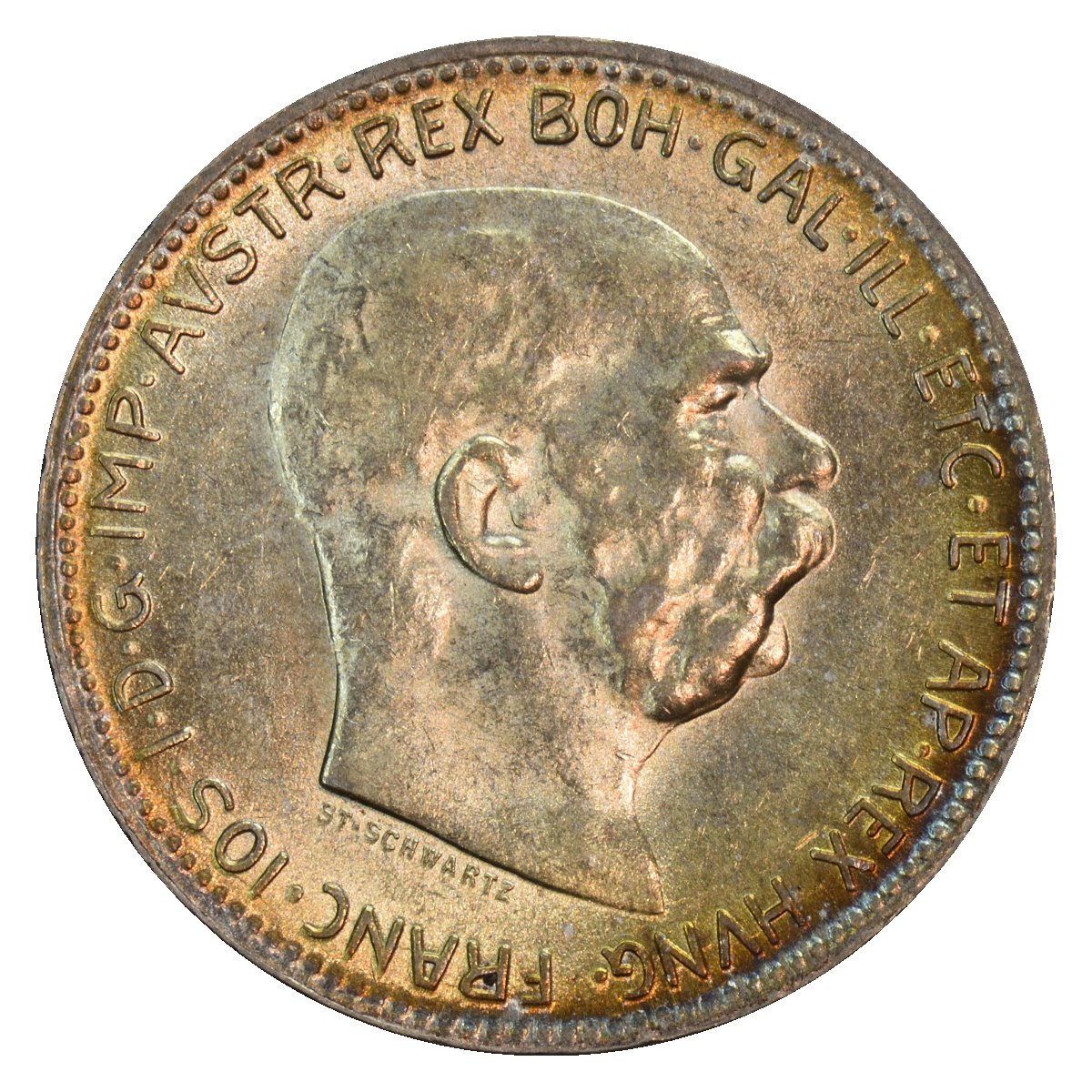
Franz Joseph I
laureate bust right
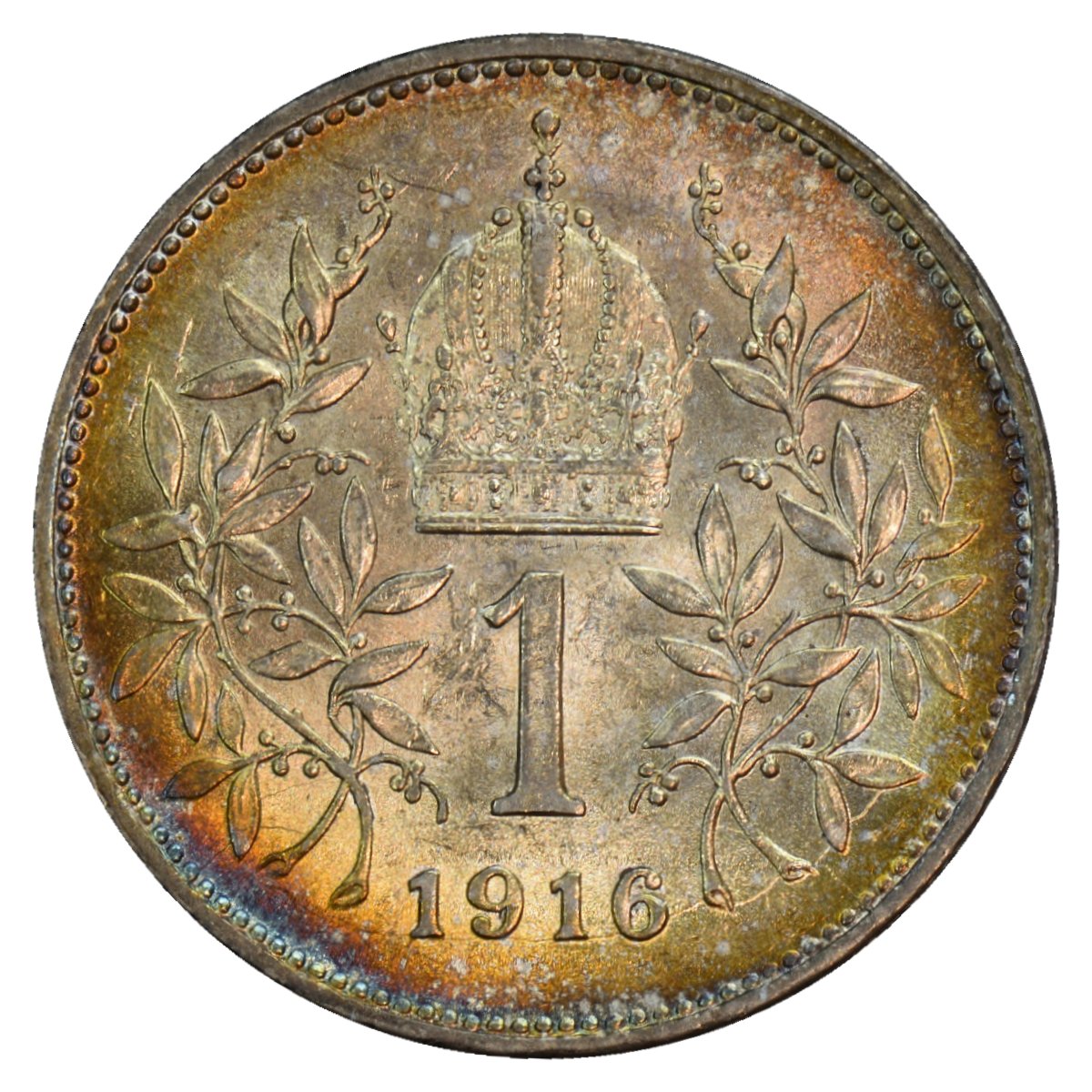
Imperial Crown
laurel sprays, value & date
Denomination
1 Corona
Country
Austria-Hungary
Year
1916
Monarch
Franz Joseph I
Catalogue
KM# 2820
Metal
Silver .835 fine
Diameter
23 mm
Weight
5.0 g
Edge
Smooth (plain)
ASW
0.1342 troy oz
Mint
Vienna — Hauptmünzamt
Mintage
12,415,404
History & Context
Design
The Series
Mint & Production
Valuation
Collecting Notes
| Section | Topic | Notes | ||||||||||||||||||||||||||||||||||||||||
|---|---|---|---|---|---|---|---|---|---|---|---|---|---|---|---|---|---|---|---|---|---|---|---|---|---|---|---|---|---|---|---|---|---|---|---|---|---|---|---|---|---|---|
| History & Context | ||||||||||||||||||||||||||||||||||||||||||
| History | Austria-Hungary in 1916 | By 1916 the Austro-Hungarian Empire was in the second full year of the First World War. The conflict had shattered the peaceful order of the pre-war years: casualties on the Eastern and Italian fronts ran into the hundreds of thousands; food shortages were spreading across the Empire's cities; the Brusilov Offensive of summer 1916 had inflicted catastrophic losses on the Austro-Hungarian army. Yet the Vienna Mint continued to strike silver coinage — the 1916 1 Corona, at 12,415,404 pieces, was a substantial issue, reflecting the ongoing monetary needs of a war economy that had not yet exhausted its silver reserves. Austria-Hungary had entered the war on 28 July 1914 by declaring war on Serbia — directly precipitated by the assassination of Archduke Franz Ferdinand in Sarajevo on 28 June 1914. By 1916 the alliance with Germany and the Ottoman Empire (the Central Powers) was under severe strain from the attritional nature of the conflict. | ||||||||||||||||||||||||||||||||||||||||
| History | The Death of Franz Joseph I |
Franz Joseph I died on 21 November 1916, aged 86, at Schönbrunn Palace, Vienna — the same palace where he had lived and worked for nearly seven decades. He had been Emperor of Austria since 2 December 1848 — a reign of 67 years, 356 days, making him one of the longest-reigning monarchs in modern European history. The 1916 1 Corona was struck during his lifetime (the year began on 1 January and he died on 21 November), making it the last silver corona struck while he was alive — and the last of his portrait to appear on any Austrian circulation coin. He was succeeded by his great-nephew Charles I (Karl I), the last Habsburg Emperor, who reigned from 21 November 1916 until the dissolution of the Empire in November 1918. Charles was beatified by Pope John Paul II in 2004. | ||||||||||||||||||||||||||||||||||||||||
| History | The Last Habsburg Silver Coin |
The 1916 1 Corona holds a special place in Austro-Hungarian numismatics as the final silver coin to bear the portrait of Franz Joseph I — and the last standard silver coin struck for the Empire before wartime debasement and the post-war dissolution ended the coinage tradition entirely. No silver 1 Corona was struck for Charles I. After 1916, Austrian coinage switched to base metal for small denominations as the war economy consumed silver reserves. The 1916 date is thus a genuine final-year issue: the closing chapter of a 24-year silver corona series. The 1 Corona type (KM#2820) ran from 1892 to 1916 — 24 years and 25 date varieties. The 1916 issue is the full stop. For comparison, the equivalent George V Ceylon one cent (KM#107) ran from 1912 to 1929; the 1916 Austrian 1 Corona spans an equally significant transitional moment but in a far more compressed and dramatic way. | ||||||||||||||||||||||||||||||||||||||||
| History | Wartime Coinage & Silver Hoarding |
Across all belligerent nations in the First World War, silver coins disappeared from circulation rapidly — hoarded by civilians and businesses as a hedge against inflation and monetary uncertainty. Gresham's Law ("bad money drives out good") operated at full force: as paper currency was inflated by wartime spending, people retained silver coins and spent the paper. This behaviour means that higher-grade survivors of the 1916 1 Corona are genuinely scarce relative to the mintage figure — a significant proportion of the 12,415,404 pieces struck was hoarded or melted rather than circulated into oblivion. The VDB Coins dealer description of an MS-65 PCGS example notes it has "blast white lustrous & reflective surfaces" — consistent with a coin that spent very little time in circulation, saved from the outset by a hoarder who appreciated its silver content. | ||||||||||||||||||||||||||||||||||||||||
| Design | ||||||||||||||||||||||||||||||||||||||||||
| Design | Obverse | The right-facing laureate (laurel-wreathed) bust of Franz Joseph I — the same engraved portrait by Stephan Schwartz that had appeared on the 1 Corona since the series began in 1892. By 1916 the portrait had been in production for 24 years, but the dies were periodically refreshed to maintain sharpness. The legend reads: FRANC·IOS·I·D·G·IMP·AVSTR·REX BOH·GAL·ILL·ETC·ET AP·REX HVNG· followed by the engraver's signature ST · SCHWARTZ · Note the design difference from the 2 Corona (KM#2821): on the 1 Corona the Emperor wears a laurel wreath on the 1 Corona, presenting a more classically imperial image. On the 2 Corona he is bare-headed, with a more naturalistic portrait. Both were engraved by Stephan Schwartz. | ||||||||||||||||||||||||||||||||||||||||
| Design | Reverse | A clean, elegant reverse: the Crown of Rudolf II (the Imperial Crown of Austria) centred in the field, flanked on each side by a laurel branch. Below the crown: the numeral 1 and below that the date 1916, all within the laurel arrangement. Above the crown, at the rim, a small ornamental device. The reverse legend reads simply 1 COR· completed by the date below. The Crown of Rudolf II (1602), also known as the Crown of Austria, is a masterpiece of Mannerist goldsmithing. Made for Emperor Rudolf II, it became the personal crown of all Austrian Emperors after 1804 and is now held in the Kunsthistorisches Museum, Vienna. Its appearance on the reverse of the 1 Corona — without the doubled eagle of the 2 Corona — gives the smaller coin a more intimate, imperial character. | ||||||||||||||||||||||||||||||||||||||||
| Design | The Edge | Unlike the 2 Corona (which had a milled edge with incuse lettering), the 1 Corona carries a smooth (plain) edge. This is the standard for this denomination across the entire 1892–1916 series. The smooth edge is an identifying feature and should be verified when assessing authenticity — any 1 Corona with a lettered or reeded edge should be treated with suspicion. | ||||||||||||||||||||||||||||||||||||||||
| Design | Physical Character | At 23 mm and 5.0 g the 1 Corona is a compact, well-proportioned silver coin — approximately the diameter of a modern British 5p or US dime, but noticeably thicker and heavier. The laureate portrait in medium relief gives the obverse good visual quality; the clean reverse with the Imperial Crown is among the most restrained and dignified of any Habsburg denomination. On uncirculated examples the fields are semi-reflective and the devices are sharply struck, giving the coin a pleasing contrast between its polished background and frosted design elements in gem condition. | ||||||||||||||||||||||||||||||||||||||||
| The KM#2820 Series — Selected Dates | ||||||||||||||||||||||||||||||||||||||||||
| Series | A 24-Year Type: 1892–1916 |
The KM#2820 1 Corona ran for the full span of the Austro-Hungarian reform coinage, with issues in most years from 1892 through 1916. The 1916 closes the series at the Emperor's death. Selected dates below illustrate the range:
|
||||||||||||||||||||||||||||||||||||||||
| Series | The Hungarian Parallel Type |
A parallel type — the Hungarian 1 Korona (KM#492) — was struck simultaneously for circulation in the Hungarian half of the Dual Monarchy. The Hungarian coin has the same obverse portrait by Schwartz but a different reverse: the Holy Crown of Hungary (Crown of St Stephen) replacing the Imperial Austrian Crown, and the Hungarian royal motto on the edge rather than a plain edge. Collectors building a comprehensive Franz Joseph set often include both the Austrian and Hungarian corona types. The dual coinage reflected the constitutional structure of Austria-Hungary after 1867: two separate kingdoms sharing the same monarch, each with its own parliament, administration, and — technically — its own coinage, though struck to identical standards and freely interchangeable. | ||||||||||||||||||||||||||||||||||||||||
| Mint & Production | ||||||||||||||||||||||||||||||||||||||||||
| Mint | Vienna Mint — Hauptmünzamt |
All KM#2820 pieces were struck at the Vienna Mint (Hauptmünzamt Wien), the sole production facility for Austrian imperial coinage. No mint mark appears on the coin — Vienna-struck coins of this series are identified by type attribution, not by a visible mark. The Vienna Mint in 1916 was operating under wartime conditions, with labour diverted to military production and silver increasingly scrutinised as a strategic resource. The continued production of silver 1 Corona coins in substantial numbers reflects the Austrian government's decision to maintain monetary confidence through 1916. | ||||||||||||||||||||||||||||||||||||||||
| Mint | Engraver: Stephan Schwartz |
The portrait was designed and engraved by Stephan Schwartz (1851–1924), principal engraver at the Vienna Mint, whose signature ST · SCHWARTZ · appears on the obverse. Schwartz had created the Franz Joseph portrait for the 1892 reform coinage; by 1916 he had been the Imperial portraitist for 24 years and was 65 years old. This was to be his portrait's final numismatic appearance in a circulation issue. He would outlive the Empire he served by six years, dying in 1924 in the First Austrian Republic. | ||||||||||||||||||||||||||||||||||||||||
| Mint | Silver Content | Each 1 Corona contains 5.0 g of 835/1000 silver = 4.175 g pure silver = 0.1342 troy ounces. At approximately $33/troy oz (May 2026), the intrinsic bullion floor is approximately $4.43 USD / £3.50 GBP. Circulated examples typically trade at 2–4× bullion value; EF and above carries a substantial numismatic premium beyond the silver floor. The 1 Corona contains exactly half the silver of the 2 Corona (KM#2821) — by design, as both coins were struck to the same fineness, the 2 Corona simply weighing 10g rather than 5g. | ||||||||||||||||||||||||||||||||||||||||
| Valuation | ||||||||||||||||||||||||||||||||||||||||||
| Value | Market Overview | The 1916 1 Corona commands a premium over most other dates in the series by virtue of its last-year status — the final silver coin of Franz Joseph's reign. In circulated grades it is readily available and modestly priced, as the large mintage of 12,415,404 ensures adequate supply. In EF and above, the last-year premium and collector demand push values meaningfully higher. Certified MS examples are genuinely scarce: the PCGS population for MS-65 is only 6 coins with 2 higher — a remarkably thin census for a coin with a mintage exceeding 12 million. VDB Coins describes an MS-65 PCGS example as having "blast white lustrous & reflective surfaces" and notes it is the "last year of issue for type." The NGC/PCGS price guides for this series are not publicly available without a subscription, but auction results and dealer prices (2023–2026) form the basis for the estimates below. | ||||||||||||||||||||||||||||||||||||||||
| Value | Price Guide (approximate, 2025–26) |
|
||||||||||||||||||||||||||||||||||||||||
| Value | 1916 vs Other Dates | The 1916 carries a last-year premium of approximately 20–50% over common mid-series dates (1895–1910) in equivalent grades. The 1892 (first year) is the other premium date within the series. Years immediately before the war (1912–1914) also attract mild premiums. The most common and least expensive date in the series is generally one of the high-mintage early 1900s issues; the 1916 is consistently the most sought-after single date. | ||||||||||||||||||||||||||||||||||||||||
| Collecting Notes | ||||||||||||||||||||||||||||||||||||||||||
| Collect | What to Look For | When assessing a 1916 1 Corona, the key areas to examine are: (1) The laurel wreath on the obverse — individual leaf tips should be distinct in EF and above; in VF they flatten; in F the wreath merges with the surrounding field. (2) Franz Joseph's facial detail — the whiskers, side-burns, and eye socket; these are the highest points and wear first. (3) The Imperial Crown reverse — the arched bands, orb, and cross at the summit of the crown; on gem examples every element of the crown's decoration is visible. (4) Schwartz's signature — the ST · SCHWARTZ · on the obverse truncation should be clear on EF examples and above; its legibility is a useful grade cross-check. | ||||||||||||||||||||||||||||||||||||||||
| Collect | Problems to Avoid | Common problems with this type: (1) Dipping / cleaning — silver cleaning solutions are often used to restore "brightness," leaving an unnatural white or over-reflective surface without lustre flow; check under raking light for the cartwheel lustre of a genuine MS coin vs the flat brightness of a cleaned one. (2) Artificial toning — applied to cover a clean; natural toning on a cabinet coin will be uneven, deeper in recesses, lighter on high points; artificial toning is often too vivid or uniform. (3) Hairlines from wiping — particularly common on silver; visible under magnification as fine parallel scratches in the fields. (4) Spot corrosion — black or dark spots from contact with sulphur compounds; these significantly reduce value and cannot be reversed without further cleaning. | ||||||||||||||||||||||||||||||||||||||||
| Collect | Collection Contexts | The 1916 1 Corona is the natural anchor piece in any of the following: a Franz Joseph I silver type set (one coin per denomination, 1892–1916); a last-year-of-type collection; an Austro-Hungarian Empire collection across metals and denominations; a World War I era thematic collection; or a Schwartz portrait series alongside the 1912–1913 2 Corona. As the closing coin of 24 years of continuous production, it forms the natural terminus of the most complete single-portrait coinage series in Habsburg history. | ||||||||||||||||||||||||||||||||||||||||
| Collect | Related Coins | The immediate companions are: the 1892–1916 1 Corona type set (all dates of KM#2820); the 1912–1913 2 Corona (KM#2821 — same obverse portrait, bare-headed variety, double-headed eagle reverse — discussed in the companion article); the 1908 commemorative 1 Corona (KM#2808, 60th anniversary of Franz Joseph's reign, special obverse); and the Hungarian 1 Korona (KM#492, Hungarian reverse with Crown of St Stephen). For a complete Habsburg last-year set, the 1916 20 Corona gold (KM#2818, same legend format) is the gold companion piece. | ||||||||||||||||||||||||||||||||||||||||
Franz Joseph I died on 21 November 1916, aged 86, after 67 years on the Habsburg throne. The 1916 1 Corona — the last silver coin struck in his name — was still circulating in Vienna, Budapest, Prague, and Sarajevo when he died. It outlasted the Emperor, and very nearly outlasted the Empire.
Sources: Krause, C. L. & Mishler, C. Standard Catalog of World Coins — KM#2820 · Numista catalogue entry #7003 · Numiscorner.com — 1916 KM#2820 MS-63 specifications & mintage (12,415,404) · VDB Coins — 1916 PCGS MS-65 description ("blast white… last year of issue") · Caesar's Ghost Numismatics — PCGS MS-65 population (6 coins, 2 higher) · coinshome.net — 1914 NGC MS-66 at ~$125 (reference benchmark) · uCoin.net — 1 corona 1912–1916 series values · eBay completed sales 2024–2026 · Miller zu Aichholz / Loehr / Holzmair, Österreichische Münzprägungen 1519–1938