May 29, 2026
Austria 2 Corona, 1913 Franz Joseph I — Austro-Hungarian Empire — Vienna Mint (Hauptmünzamt)
KM# 2821 · Silver .835 · 27.1 mm · 10 g · Incuse lettering edge · ASW 0.2684 troy oz · Two-year type: 1912–1913
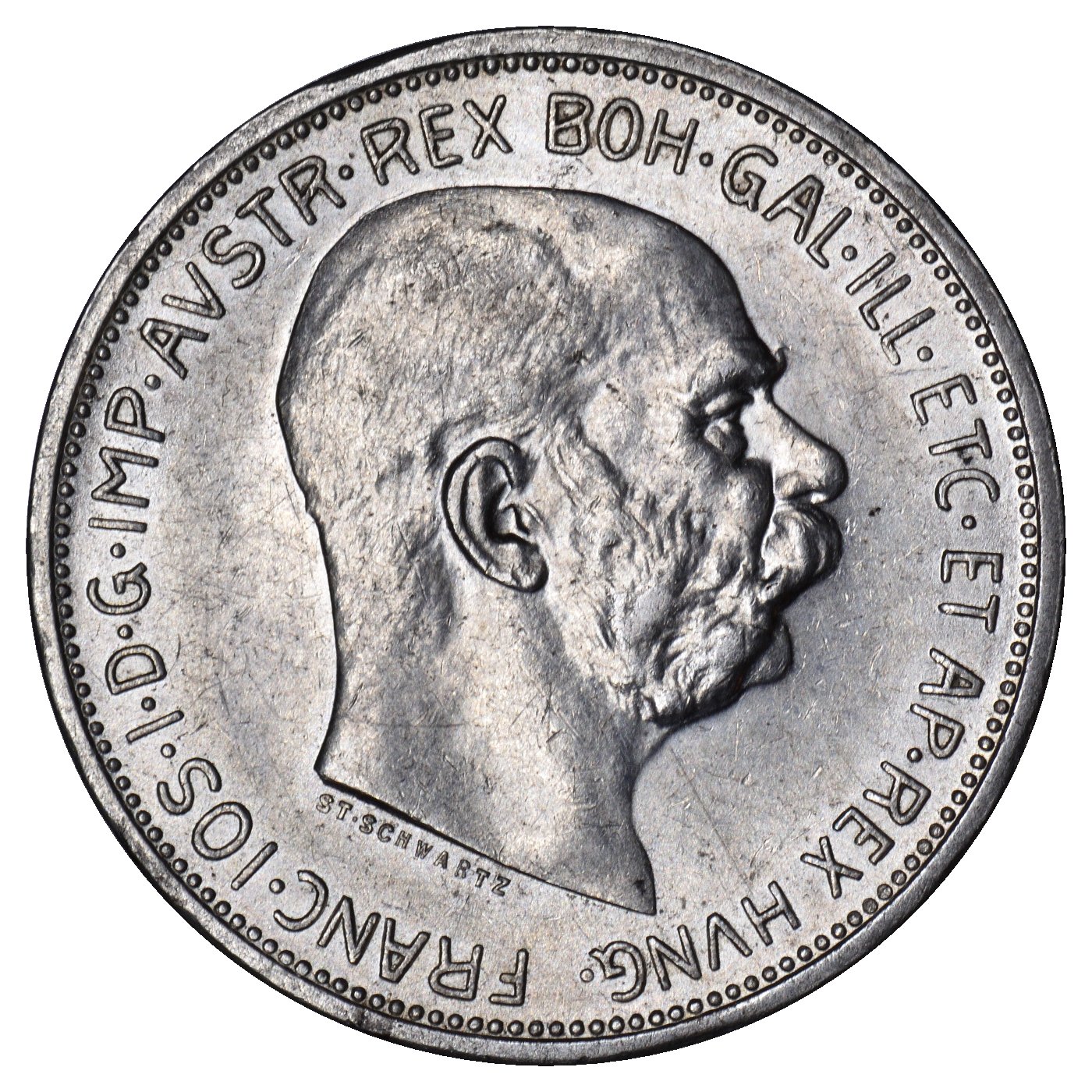
Franz Joseph I
bare-headed right
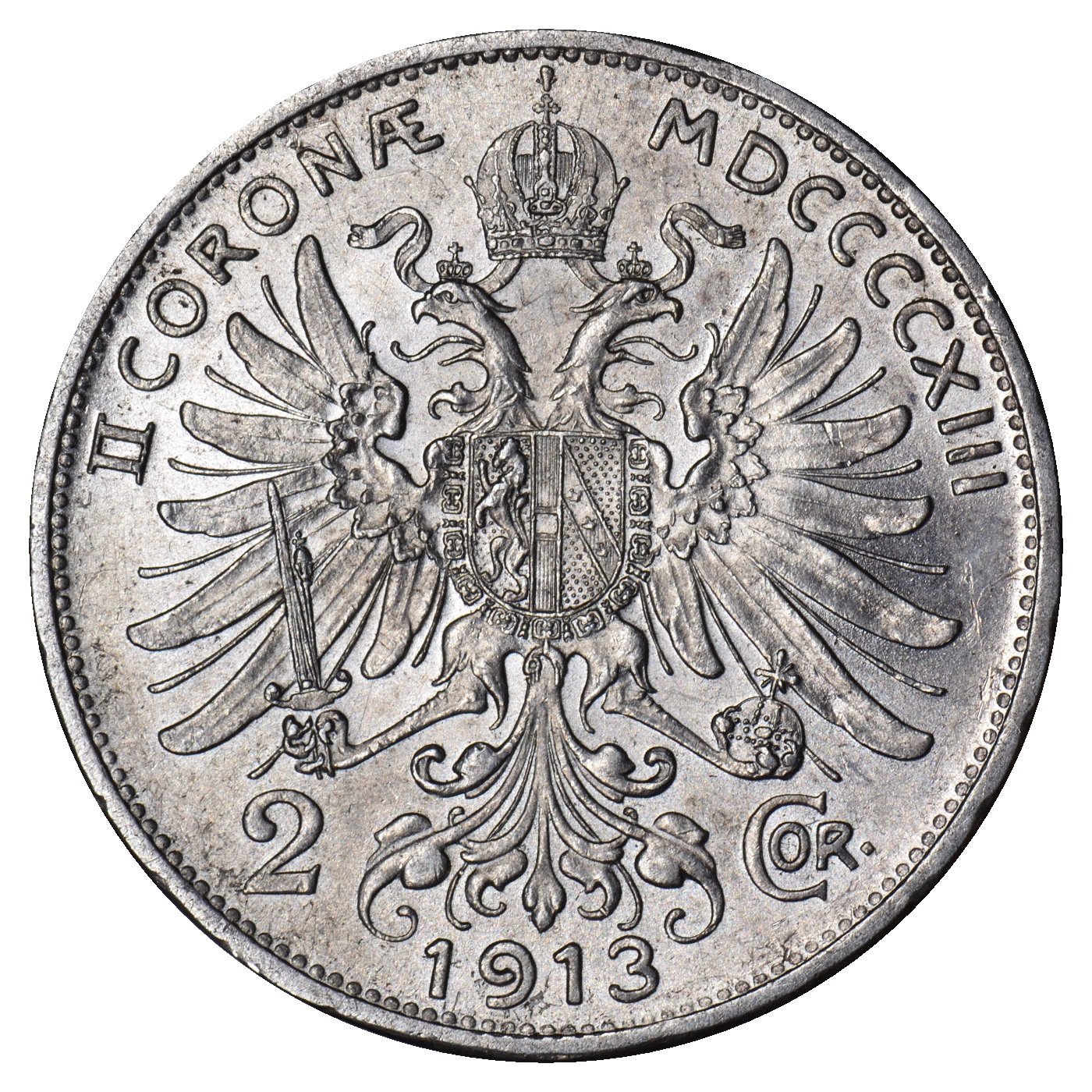
Double-headed eagle
crowned Habsburg arms
Denomination
2 Corona
Country
Austria-Hungary
Year
1913
Monarch
Franz Joseph I
Catalogue
KM# 2821
Metal
Silver .835 fine
Diameter
27.1 mm
Weight
10.0 g
Edge
Milled with incuse lettering
ASW
0.2684 troy oz
Mint
Vienna — Hauptmünzamt
Type span
1912–1913 only
History & Context
Design
The Series
Mint & Production
Valuation
Collecting Notes
| Section | Topic | Notes | ||||||||||||||||||||||||||||||||||||
|---|---|---|---|---|---|---|---|---|---|---|---|---|---|---|---|---|---|---|---|---|---|---|---|---|---|---|---|---|---|---|---|---|---|---|---|---|---|---|
| History & Context | ||||||||||||||||||||||||||||||||||||||
| History | The Austro-Hungarian Empire in 1913 | In 1913 the Austro-Hungarian Empire was one of the five great powers of Europe — a multinational state of some 51 million people, spanning modern Austria, Hungary, Czech Republic, Slovakia, Slovenia, Croatia, Bosnia-Herzegovina, and parts of Poland, Romania, Ukraine, and Italy. Franz Joseph I, Emperor of Austria and Apostolic King of Hungary, had been on the throne since 2 December 1848 — already 65 years. He was 83 years old when the 1913 2 Corona was struck. The Empire's vast ethnic diversity — Germans, Hungarians, Czechs, Poles, Slovenes, Croats, Slovaks, Serbs, Romanians, Italians and more — made it one of the most complex political entities in history. That complexity would contribute directly to the crisis triggered in 1914 by the assassination of Archduke Franz Ferdinand in Sarajevo. | ||||||||||||||||||||||||||||||||||||
| History | The Shadow of War | The year 1913 was the last full calendar year of peace before the catastrophe of the First World War. It was the year of the Second Balkan War, of rising pan-Slavic nationalism in Bosnia, of Austrian anxieties about Serbian expansionism. The Triple Entente and the Triple Alliance had aligned almost all major European powers into opposing camps. The coins struck in Vienna in 1913 — silver 2 Corona pieces passing through the hands of soldiers, merchants, and citizens across a dozen nationalities — would still be in circulation when those same people found themselves at war within eighteen months. Franz Joseph would not live to see the war's end. He died on 21 November 1916, aged 86, after 68 years on the throne — the longest-reigning major European monarch of modern history. The Empire itself survived him by only two years, dissolving in October–November 1918. | ||||||||||||||||||||||||||||||||||||
| History | The Corona Currency | The Krone (Crown) replaced the old Gulden/Florin system following the Austro-Hungarian Compromise of 1867 and the subsequent currency reform of 1892, under which 1 Gulden = 2 Kronen. The reform aligned Austria-Hungary with the Latin Monetary Union standard, at a rate of one corona to one French franc. All gold and silver coins were struck to metric Latin Union specifications. The 2 Corona piece weighed exactly 10 grams at 835/1000 silver fineness — identical to the French 2-franc coin and exchangeable at par across Union member states. The Latin Monetary Union (1865–1927) was an agreement among France, Belgium, Italy, Switzerland, and Greece — later expanded — to standardise silver and gold coinage on common weight and fineness standards, enabling frictionless cross-border circulation. Austria-Hungary participated de facto by adopting the same standards. | ||||||||||||||||||||||||||||||||||||
| Design | ||||||||||||||||||||||||||||||||||||||
| Design | Obverse | The right-facing bare-headed bust of Franz Joseph I in uniform, with a short truncation. The portrait is dignified and restrained — the elderly Emperor shown with natural realism rather than heroic idealisation. The legend reads (abbreviated): FRANC·JOS·I·D·G·IMP·AVSTR·REX·BOH·GAL·ILL·ETC·ET·AP·REX·HVNG — an abbreviation of the full title Franciscus Josephus I Dei Gratia Imperator Austriae Rex Bohemiae Galiciae Illyriae Et Cetera et Apostolicae Rex Hungariae (Francis Joseph I, by the Grace of God Emperor of Austria, King of Bohemia, Galicia, Illyria, etc. and Apostolic King of Hungary). Below the truncation: ST. SCHWARTZ — the name of the engraver. Stephan Schwartz (1851–1924) was one of the principal engravers at the Vienna Mint (Hauptmünzamt) during this period. His signature ST. SCHWARTZ appears on multiple Austrian and Austro-Hungarian coin types of the late 19th and early 20th centuries. He designed and engraved the portrait of Franz Joseph used across the corona reform coinage series. | ||||||||||||||||||||||||||||||||||||
| Design | Reverse | The crowned double-headed eagle of the Habsburg-Lorraine dynasty, displayed with spread wings. On the breast of the eagle: the composite shield of the Austro-Hungarian Empire, combining the Habsburg saltire, the Hungarian stripes and the apostolic cross, with the crowned arms of Bohemia (lion), Galicia (gold and blue), and other Habsburg territories arranged in the quartered escutcheon. Value and date appear in two formats: II CORONÆ MDCCCCXIII (Latin: Two Crowns 1913) divided by the eagle's tail feathers above, and 2 COR. 1913 below in smaller Arabic numerals — a bilingual denomination unique to this issue. The use of both Latin (MDCCCCXIII = 1913 in Roman numerals) and Arabic (1913) numerals on the same reverse is a striking design feature. MDCCCCXIII is technically non-standard — conventionally 1913 in Roman is MCMXIII — but MDCCCCXIII (M+D+CCCC+X+III = 1000+500+400+10+3) was a style deliberately chosen for its archaising, imperial character. | ||||||||||||||||||||||||||||||||||||
| Design | The Edge | The edge carries milled reeding with an incuse (recessed) inscription. This feature — combining physical milling with a stamped legend — was an anti-counterfeiting measure and also a mark of quality distinctive to the Vienna Mint's production standards. The incuse edge text is a secondary identifier that specialists use to confirm authenticity, particularly on coins offered as high-grade examples. The specific wording of the edge lettering on this series is a subject of interest to specialists; slight variations in spacing and letter depth exist between different die states and production years. | ||||||||||||||||||||||||||||||||||||
| Design | Physical Character | At 27.1 mm and 10.0 g the 2 Corona is a solid, well-balanced silver coin — comparable in size to a US quarter but heavier. The relatively high-relief portrait gives the obverse good visual presence. On well-struck examples, the detail of Franz Joseph's side-whiskers, the decorations at his collar, and the individual feathers of the double-headed eagle are crisply rendered. The coin's size and silver content make it satisfying to handle — one of the most aesthetically successful of the late Habsburg series. | ||||||||||||||||||||||||||||||||||||
| The KM#2821 Series — Both Dates | ||||||||||||||||||||||||||||||||||||||
| Series | A Two-Year Type | The KM#2821 2 Corona was struck in only two years: 1912 and 1913. This makes it a short two-year type rather than a long-running circulation series — a significant collecting consideration, since every collector who wants the type needs one of only two dates. The 1913 is generally considered slightly rarer than the 1912.
|
||||||||||||||||||||||||||||||||||||
| Series | Context within the Reform Coinage |
The 2 Corona sits within the broader Austro-Hungarian reform coinage introduced following the 1892 currency act, which replaced the Gulden system with the Krone. The full range of denominations struck in this reform era under Franz Joseph included: 1 Heller (bronze), 2 Heller, 1 Corona (silver, KM#2820, 1892–1916), 2 Corona (silver, KM#2821, 1912–1913), 5 Corona (silver, KM#2807), 10 Corona (gold), 20 Corona (gold), and 100 Corona (gold). The 2 Corona was a relatively late addition to the series, introduced only in 1912 — it was struck for just two years before war ended peacetime coin production. | ||||||||||||||||||||||||||||||||||||
| Series | Why Only 1912–1913? |
The 2 Corona was introduced as the final silver denomination in the Habsburg reform coinage. Its two-year production run was cut short by the outbreak of the First World War in July 1914. Wartime demand for silver led to the hoarding and melting of silver coinage across all belligerent nations; the Austro-Hungarian Mint suspended silver coin production for general circulation. Franz Joseph's death in 1916 and the Empire's collapse in 1918 meant that no further 2 Corona pieces were ever struck under this design. | ||||||||||||||||||||||||||||||||||||
| Mint & Production | ||||||||||||||||||||||||||||||||||||||
| Mint | Vienna Mint — Hauptmünzamt |
All KM#2821 pieces were struck at the Vienna Mint (Hauptmünzamt Wien), located in the 3rd district (Hietzing) of Vienna. The Vienna Mint traces its origins to the 12th century and in 1913 was among the most technically capable mints in the world, producing gold and silver coinage of consistently high quality. No other mint struck this denomination; unlike some British colonial coinage, there were no contract sub-contractors for the main Habsburg silver series. The mint mark for Vienna in this period is not a letter appearing on the coin face — the Vienna Mint's coins are identified by their origin through catalogue attribution rather than through a visible mark. Some earlier Habsburg issues carried an eagle-head mark; the reform coinage omits this. | ||||||||||||||||||||||||||||||||||||
| Mint | The Engraver: Stephan Schwartz |
The obverse was designed and engraved by Stephan Schwartz (1851–1924), the principal portraitist at the Vienna Mint during the late Franz Joseph era. Schwartz signed his work ST. SCHWARTZ on the truncation of the obverse. He was responsible for the updated Franz Joseph portrait used across the reform coinage series from 1892 onward, and his restrained, naturalistic style — presenting the ageing Emperor without flattery — was considered one of the most honest regal portraits on any European coinage of the period. The double-headed eagle reverse was a traditional heraldic design executed to the highest Vienna Mint standards. | ||||||||||||||||||||||||||||||||||||
| Mint | Silver Content & Bullion Value |
Each 2 Corona contains 10.0 g of 835/1000 silver = 8.35 g pure silver = 0.2684 troy ounces. At a silver spot price of approximately $33/troy oz (May 2026), the intrinsic bullion floor is approximately $8.85 USD / £7.00 GBP. All numismatic collector premiums sit above this floor. In lower circulated grades (F–VF) the coin typically trades at 1.5–3× its silver value; in EF and above, the numismatic premium rises significantly above bullion. | ||||||||||||||||||||||||||||||||||||
| Valuation | ||||||||||||||||||||||||||||||||||||||
| Value | Market Overview | The 1913 2 Corona is a moderately scarce two-year type with genuine collector demand. It is not rare in circulated grades — the series saw normal commercial production and circulated widely — but it is far from common in EF or above, and genuinely scarce in MS condition. The combination of historical resonance (last year of this type; struck on the eve of WWI), attractive design, and silver content makes it one of the more desirable pieces in the Franz Joseph silver series. uCoin.net market data (2025) shows VF-level examples trading at $20–$42 and better-grade pieces reaching $40–$80+. A PCGS MS-63 example was offered at a significant premium by Caesar's Ghost Numismatics. An EF example (VF+) was listed by NUMISMATICS-EU at $18.40, consistent with the VF–EF range given below. | ||||||||||||||||||||||||||||||||||||
| Value | Price Guide (approximate, 2025–26) |
|
||||||||||||||||||||||||||||||||||||
| Value | 1912 vs 1913 | Within the two-date type, the 1913 generally commands a modest premium over the 1912 in VF and above — approximately 10–20% — reflecting its slightly lower surviving population in higher grades. In circulated grades the price difference is minimal and both dates are considered approximately equivalent for type-set purposes. Collectors building a date set will naturally seek both; those wanting one example for a type set should prioritise grade over date choice. | ||||||||||||||||||||||||||||||||||||
| Collecting Notes | ||||||||||||||||||||||||||||||||||||||
| Collect | What to Look For | When assessing a 1913 2 Corona, examine the following in order: (1) Portrait detail on the obverse — the whiskers, ear, collar decorations, and the ribbon at the back of the bust; these areas grade the coin's obverse wear most accurately. (2) Eagle feathers on the reverse — individual primary and secondary feathers should be distinct in EF and above; in VF they will be present but somewhat flat. (3) The composite shield on the eagle's breast — the Habsburg saltire and the Hungarian stripes are the first details to merge with wear. (4) The incuse edge lettering — check for signs of tooling, polishing, or artificial enhancement of the edge, which can indicate a cleaned or tampered coin. | ||||||||||||||||||||||||||||||||||||
| Collect | Problems to Avoid | The most common problems with this type: (1) Cleaning — particularly "dipping" in silver cleaning solution, which removes toning and leaves bright, washed-out surfaces with reduced lustre; a dipped coin will look unnaturally bright and smooth under raking light. (2) Artificial toning — chemical or heat-induced toning applied to obscure cleaning, often too uniform or vivid compared to natural cabinet toning. (3) Tooling — engraving tool work to sharpen worn high points, particularly on the eagle or portrait; check under magnification for inconsistent metal flow lines. (4) Edge damage — nicks from bag storage are common; severe edge marks substantially reduce value. | ||||||||||||||||||||||||||||||||||||
| Collect | Collection Contexts | The 1913 2 Corona fits naturally into: a Franz Joseph I silver type set (one coin of each denomination from the reform coinage); a Austro-Hungarian Empire collection across multiple denominations and metals; a pre-WWI Europe thematic collection; a double-headed eagle heraldry collection; or a Latin Monetary Union date set including equivalent French, Belgian, Italian, and Swiss pieces. Its two-year production run gives it a built-in narrative as a type that barely existed before the world changed forever. | ||||||||||||||||||||||||||||||||||||
| Collect | Related Coins | The closest companions are: the 1912 2 Corona (KM#2821 — same type, first year); the 1892–1916 1 Corona (KM#2820 — same obverse style, single-headed denomination); the 5 Corona (KM#2807 — large silver, similar portrait); and the 1908 1 Corona commemorative (KM#2808, 60th anniversary of Franz Joseph's reign). For investors with a silver focus, the Austrian 100 Corona gold restrike is a well-known bullion product but unrelated in numismatic terms to the circulating silver series. | ||||||||||||||||||||||||||||||||||||
Struck in the last full year of Austro-Hungarian peacetime, the 1913 2 Corona is both a numismatic object and a historical one: a silver coin that passed through the hands of people who had no idea that within eighteen months their empire would be at war, and within five years would cease to exist.
Sources: Krause, C. L. & Mishler, C. Standard Catalog of World Coins — KM#2821 · Numista catalogue entry #7934 · uCoin.net — 2 Corona 1912–1913 series values · coin-identifier.com — specifications · coinscatalog.net — legend transcription · eBay completed sales 2024–2026 · Caesar's Ghost Numismatics — PCGS MS-63 example · NUMISMATICS-EU (eBay) — VF+ example, ~$18 · aurumpro.cz — silver content and weight confirmation · Miller zu Aichholz / Loehr / Holzmair, Österreichische Münzprägungen 1519–1938 (for type attribution)